
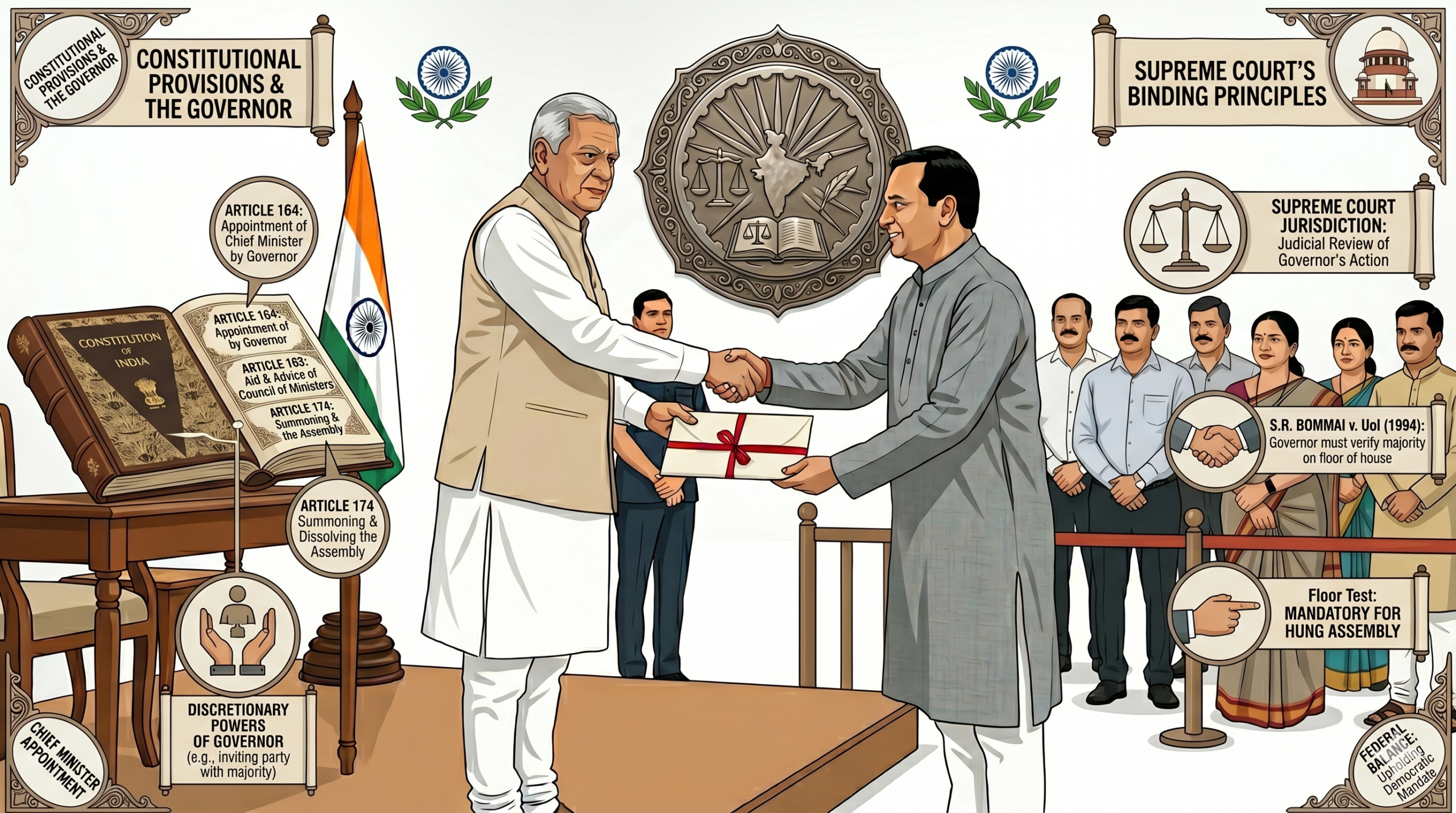
Governor’s Power to Call a Party to Form Government: Constitutional Provisions, Judicial Interpretation and Challenges
|
Getting your Trinity Audio player ready...
|
ARTICLE
The office of the Governor occupies a unique position in India’s constitutional framework. As the constitutional head of the state, the Governor acts as a link between the Union and the State governments while functioning within the parliamentary democratic structure. Although the Governor is generally expected to act on the aid and advice of the Council of Ministers, certain discretionary powers have been granted by the Constitution. One of the most debated among these powers is the Governor’s authority to invite a political party or coalition to form the government after elections, especially in situations of a hung assembly.
In recent decades, controversies surrounding government formation in several states have transformed this constitutional function into a major political and legal issue. Questions relating to neutrality, constitutional morality, judicial review, and federalism have emerged repeatedly. Therefore, understanding the Governor’s power requires an examination of constitutional provisions, judicial interpretations, and practical challenges.
The Framework of Discretion
The Governor’s authority stems from several key articles in the Constitution of India. Unlike the President of India, the Governor is explicitly granted discretionary powers under certain circumstances.
Article 163: The Source of Discretion
Article 163(1) states that there shall be a Council of Ministers with the Chief Minister at the head to aid and advise the Governor. However, it explicitly mentions that this does not apply to functions where the Governor is required to act in their discretion. Article 163(2) further protects this discretion, stating that the Governor’s decision on what falls within their discretionary power is final and cannot be questioned in court.
Article 164: Appointment of the Chief Minister
Article 164(1) simply states: ‘The Chief Minister shall be appointed by the Governor.’ The Constitution does not provide a specific manual or hierarchy of whom to invite first. This silence is the vacuum where political controversy often takes root.
The Constitutional Convention
In a clear majority scenario, the Governor has no choice but to invite the leader of the majority party. However, in a fragmented mandate, the Governor must use their judgment to determine who is best commanded to provide a stable government.
Recommendations of Expert Commissions
To provide a roadmap for Governors, various commissions have laid down guidelines to ensure transparency.
The Sarkaria Commission (1988)
The Commission suggested a specific order of preference for the Governor:
- An alliance of parties that was formed prior to the Elections.
- The single largest party (SLP) which stakes a claim to form the government with the support of others.
- A post-election coalition of parties, with all partners joining the Government.
- A post-election alliance of parties, with some becoming part of the Government and the remaining rendering support from outside.
The Punchhi Commission (2010)
The Punchhi Commission went further, suggesting that in the case of a hung assembly, there should be constitutional amendments to provide clear guidelines so that the Governor’s discretion is not arbitrary. It also recommended that the Governor should invite the person who has the best chance of proving a majority within a strictly defined period (ideally 30 days).
Post-Election Scenarios
When no single party reaches the magic number (50% + 1 of the seats), the Governor typically follows a set of conventions evolved through commissions and judicial precedents.
- The Pre-Poll Alliance: An alliance of parties formed before the elections should be treated as a single political unit. If they have a majority, they must be called first.
- The Single Largest Party (SLP): The party with the highest number of seats, even if short of a majority, claiming the support of others.
- Post-Poll Alliance: A coalition formed after the election results, with all partners joining the government.
- Post-Poll Support: A coalition where some parties join the government and others support from the outside.
Judicial Interpretation: From Pleasure to Floor Test
The constitutional role of the Governor has transitioned from a position of subjective pleasure to one tethered to the objective ‘Floor Test’ doctrine. While Article 164 states ministers hold office during the Governor’s pleasure, judicial intervention has clarified that this is not a personal whim.
Five decades ago in Shamsher Singh v. State of Punjab (1974), The Supreme Court clarified that ‘pleasure’ is not personal or unfettered. The Governor must exercise discretion in harmony with the Cabinet System of Government, meaning pleasure can only be withdrawn if the Ministry loses the confidence of the Legislative Assembly.
After the landmark S.R. Bommai (1994) to Nabam Rebia (2016), the Supreme Court has mandated that the Legislative Assembly not Raj Bhavan is the sole arena to test a government’s legitimacy. This shift reinforces federalism and cabinet responsibility, ensuring that discretionary powers act as a safeguard for democracy rather than a tool for its subversion. No obsess, For decades, the Governor’s discretion was seen as political and beyond judicial review.
The Watershed Moment: S.R. Bommai v. Union of India (1994)
The S.R. Bommai judgment is the most significant check on the misuse of Article 356 (President’s Rule) and the Governor’s discretion.
- The Floor Test Mandate: The Supreme Court ruled that the only way to determine if a government has lost its majority is through a floor test in the Assembly, not through the Governor’s subjective assessment in Raj Bhavan.
- Judicial Review: The court established that the Governor’s recommendation for President’s Rule is subject to judicial review to check for mala fide (bad faith) intentions or irrelevant considerations.
Strengthening the Floor Test: Modern Precedents
Recent years have seen the Supreme Court further refine the ‘Floor Test’ as a mandatory democratic exercise to prevent ‘horse-trading’ and political instability.
Nabam Rebia v. Deputy Speaker (2016)
The Court held that the Governor cannot exercise discretionary power to summon, prorogue, or dissolve the House without the aid and advice of the Council of Ministers, except in specific situations where the government has lost its majority (Drishti IAS, 2020). It emphasized that the Governor is a nominee, not an elected representative, and cannot override the will of the House.
Shiv Sena v. Union of India (2019)
Following the early morning swearing-in ceremony in Maharashtra, the Supreme Court ordered an immediate floor test (Sanjiv Khanna, 2019). The Court noted that in cases of potential ‘horse-trading,’ a quick floor test is the most effective mechanism to protect democratic values.
Subhash Desai v. Governor of Maharashtra (2023)
The Court clarified that a Governor cannot call for a floor test based solely on internal party disputes or factions. A floor test can only be called if there is objective material suggesting the government has lost the confidence of the House, not just a section of a party.
Major Challenges and Points of Contention
Despite legal safeguards, several challenges persist that lead to political instability and constitutional crises.
The Single Largest Party vs. Post-Poll Coalition
There is no constitutional mandate on whether the SLP or a post-poll coalition should be invited first. For example, in Goa (2017) and Manipur (2017), the Congress was the SLP, but the BJP formed post-poll alliances and was invited to form the government. Conversely, in the BJP (the SLP) was invited first despite a post-poll alliance claiming a majority. This inconsistency suggests that the Governor’s discretion is often influenced by the political affiliation of the party in power at the Center.
This creates a conflict of interest. Critics argue that Governors often act as agents of the Center to ensure their appointing party gains power in the State, undermining the spirit of federalism and undermines the credibility of the office.
Horse-Trading and Resort Politics
When a Governor grants a long window to prove a majority, it often leads to the sequestration of MLAs in luxury resorts to prevent them from being bought or intimidated by the opposing side. This degrades the integrity of the democratic process.
Subjective Stability
Governors often justify their choice by claiming they seek a stable government. However, stability is subjective. The judiciary has repeatedly emphasized that numerical strength is the only objective criteria the Governor should consider.
Needed Potential Reforms
To restore the prestige of the Governor’s office and ensure democratic fairness, several reforms have been proposed by legal experts and civil society:
- Codifying Conventions: The guidelines of the Sarkaria and Punchhi Commissions should be formally codified or incorporated into the Constitution to remove ambiguity.
- Time-Bound Floor Tests: The Constitution should specify a maximum period (e.g., 48 to 72 hours) within which a floor test must occur if a majority is in doubt.
- Selection of Governor: Moving away from political appointees to a panel-based selection (including the Vice President, Speaker, and Opposition leaders) could ensure more impartial individuals hold the post.
- Automatic Summoning: If a government falls or a new one needs to be formed, the Assembly should perhaps be summoned automatically by law, rather than waiting for a gubernatorial summons.
Focus on Constitutional Morality and Democratic Ethics
The Governor’s office, situated at the intersection of federalism and parliamentary democracy, finds its true legitimacy not in the literal text of the Constitution, but in the practice of Constitutional Morality. As envisioned by Dr. B.R. Ambedkar, this morality necessitates an adherence to democratic norms that transcend narrow political interests. It transforms the Governor from a potential agent of the Centre into a bridge between the Union and the States, acting as a neutral arbiter of constitutional machinery.
Democratic Ethics dictate that in a representative setup, the will of the people expressed through the Legislative Assembly is paramount. The judicial shift from the Pleasure Doctrine to the mandatory Floor Test is a manifestation of this ethical imperative. It reinforces the principle that the legitimacy of a government is determined by the collective wisdom of the House, rather than the subjective satisfaction of a nominated head. When a Governor bypasses the floor test, they do not just exercise discretion; they undermine the democratic mandate, violating the ethical core of their office.
Furthermore, the Supreme Court in cases like Nabam Rebia and Subhash Desai has underscored that the Governor is not a parallel power center. True constitutional morality requires the Governor to act with institutional self-restraint, ensuring that discretionary powers are used only to preserve, not to subvert, the parliamentary process. Ultimately, the Governor’s role is to ensure that the pleasure of the office remains a reflection of the confidence of the House, thereby upholding the sanctity of the Indian democratic fabric.