India’s Transition from a Reactive Economy to a Strategic Economy in the era of Global Conflicts
|
Getting your Trinity Audio player ready...
|
COLUMN
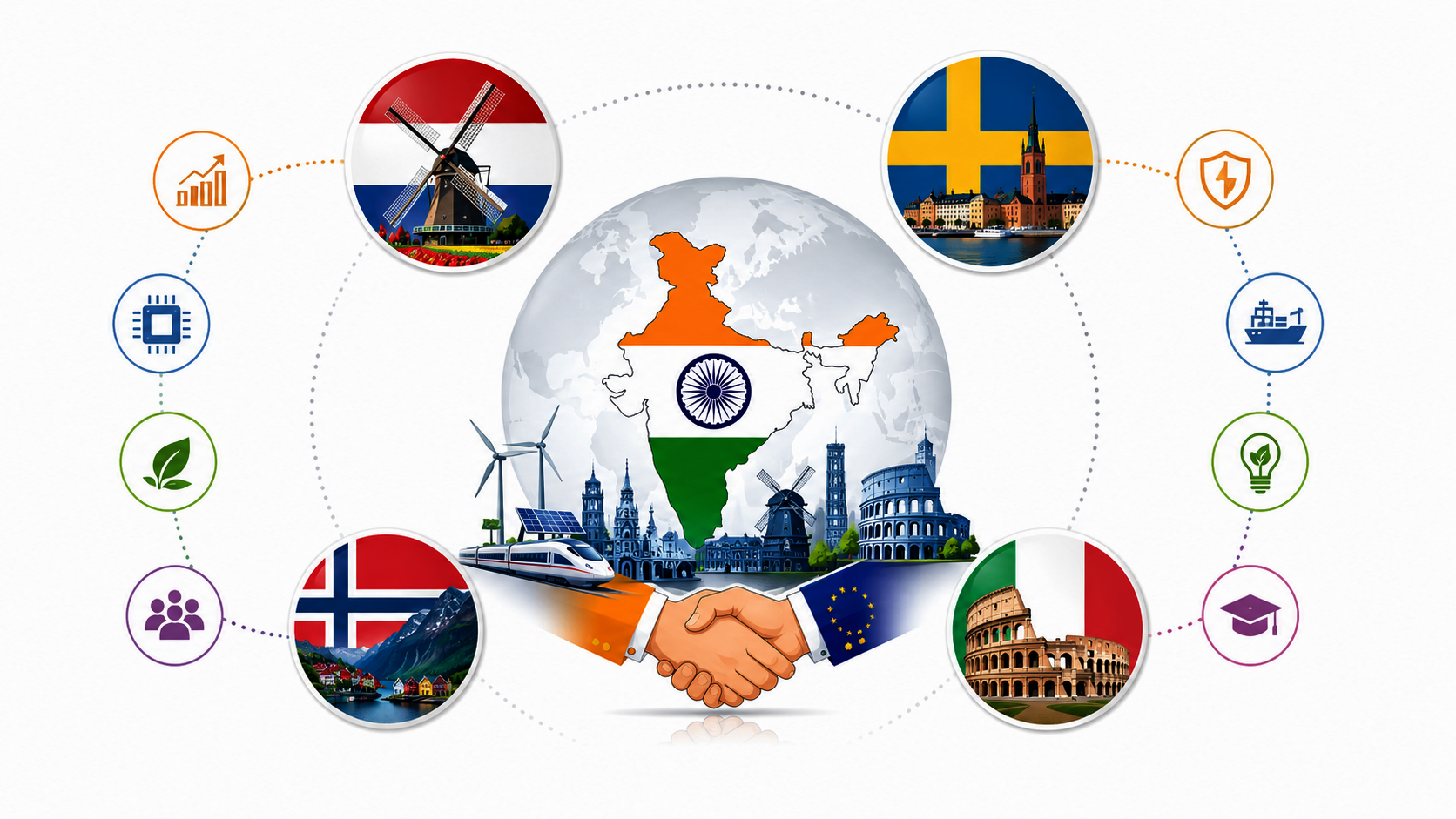
The recent four-nation Europe tour of Prime Minister Narendra Modi to the Netherlands, Sweden, Norway, and Italy marks a significant phase in India’s evolving engagement with Europe. Occurring against the backdrop of fluid geopolitical realignments and the successful culmination of the landmark India-European Union Free Trade Agreement (FTA) earlier in the year, this tour represents a structural maturation of India’s foreign policy apparatus. The engagements transcended ceremonial diplomacy, anchoring themselves deeply in geoeconomics, technological sovereignty, and energy security.
One of the most important dimensions of the visit was economic diplomacy. Europe today occupies an increasingly important place in India’s diplomatic and economic priorities. As the world moves toward a multipolar order, India seeks to position itself as a reliable economic partner, a technology hub, and a responsible global power. Prime Minister Modi’s Europe tour demonstrated India’s intention to transform traditional diplomatic ties into comprehensive strategic partnerships. India aims to attract investment, expand exports, and integrate itself into resilient global supply chains. The visit therefore carried significant economic implications.
The Geopolitical and Economic Imperatives
To understand the gravity of this tour, one must first examine the broader geopolitical context. Escalating tensions involving Iran and the broader Gulf region have revived acute concerns over the security of maritime trade and energy flows. For a country that imports the vast majority of its crude oil, uninterrupted access to energy is a strategic necessity. While the Prime Minister’s concurrent engagement with the UAE focused heavily on fossil fuel reserves and strategic petroleum stockpiles, the European leg of the tour is fundamentally about securing the future of energy and technology.
The Netherlands: Technological Sovereignty and Climate Adaptation
The diplomatic engagement in the Netherlands underscored a critical pivot from traditional bilateral trade toward securing frontier technologies and resilient supply chains. Central to this leg of the visit was India’s aggressive pursuit of semiconductor self-reliance. The landmark agreement struck between Dutch technology giant ASML and Tata Electronics to supply advanced lithography tools for the planned $11 billion semiconductor fabrication plant in Dholera, Gujarat, serves as a watershed moment. It signals Europe’s growing confidence in India’s manufacturing ecosystem and directly addresses the supply-chain vulnerabilities exposed during recent global crises.
Beyond silicon, the bilateral dialogue heavily emphasized climate adaptation and resource administration sectors where the Netherlands holds unparalleled historical expertise. The Prime Minister’s visit to the iconic Afsluitdijk dam highlighted a collaborative approach to flood control, inland water management, and green hydrogen infrastructure. For a climate-vulnerable nation, integrating Dutch coastal engineering and administrative water-management frameworks is essential for ensuring long-term urban and ecological resilience.
Furthermore, the visit carried a profound dimension of cultural diplomacy. The official restitution of the 11th-century Chola dynasty copper plates by the Netherlands to India sets a progressive, rules-based precedent for the repatriation of historical artifacts, acknowledging historical equities and fostering immense bilateral goodwill.
Sweden: Forging a Nordic Innovation Anchor
The Swedish leg of the tour marked both a quantitative and qualitative leap in bilateral relations, officially elevating the India-Sweden relationship to a formal Strategic Partnership.
The adoption of the India-Sweden Joint Action Plan (2026–2030) established a clear, ambitious administrative mandate to double bilateral trade and investment over the next five years. Currently standing at approximately $7.75 billion, this trade volume is poised for rapid expansion through targeted, high-level cooperation in artificial intelligence, emerging technologies, and space exploration.
Sweden’s industrial and regulatory prowess is critical to India’s green transition. By addressing the European Round Table for Industry alongside the European Commission President, the Indian leadership firmly positioned the country as an integral partner in Europe’s de-risking strategy. The discussions prioritized clean technology and sustainable manufacturing frameworks, aligning perfectly with India’s domestic decarbonization targets and its international commitments.
The diplomatic gravitas of this relationship was publicly cemented when Sweden conferred its highest honour for a foreign Head of Government the Royal Order of the Polar Star, Degree Commander Grand Cross upon the Indian Prime Minister. This gesture reflects deep strategic trust and a mutual recognition of the vital role both democracies play in shaping a sustainable, technology-driven future.
Norway: The Arctic Frontier and Capitalizing on the Green Transition
The visit to Norway the first by an Indian Prime Minister in 43 years served as the geographic and strategic linchpin for India’s broader Nordic outreach. Hosting the 3rd India-Nordic Summit in Oslo, alongside leaders from Denmark, Finland, Iceland, and Sweden, India consolidated its engagement with one of the world’s most technologically advanced regions. The Nordic nations collectively represent a formidable bloc in global innovation, and the summit provided the necessary political impetus to leverage the recently signed India-EFTA Trade and Economic Partnership Agreement (TEPA).
A crowning achievement of the Oslo visit was the official elevation of India-Norway ties to a Green Strategic Partnership. This framework introduces a structured focus on the blue economy, maritime security, and an accelerated green energy transition. Crucially, the economic discussions successfully tapped into the immense financial capital of Norway’s Government Pension Fund Global (GPFG), which currently holds close to $28 billion in the Indian capital market. Channelling these vast sovereign investments into Indian green infrastructure is a masterstroke of economic diplomacy.
Moreover, the geopolitical and legal relevance of the Arctic region is expanding rapidly. As melting ice caps open new navigational routes and expose untapped mineral resources, establishing a joint front on Arctic strategy and maritime security with Norway ensures that India secures a legitimate, active voice in the future environmental governance and scientific exploration of the region. The conferment of the Royal Norwegian Order of Merit Grand Cross by King Harald V further highlighted the elevation of this strategic embrace.
Italy: Mediterranean Geopolitics and Defence Synergy
Concluding the comprehensive tour in Italy, India sought to solidify its Mediterranean geostrategic anchor. Building upon the momentum generated during recent G7 summits, the bilateral dialogue with the Italian leadership focused intensely on the proactive implementation of the Joint Strategic Action Plan 2025–2029. The economic target established is highly ambitious, aiming to elevate bilateral trade to $23.2 billion by the end of the decade.
The structural agreements signed in Rome demonstrate a comprehensive widening of the strategic net. Pacts covering maritime transport, critical minerals, and agricultural technology signify a concerted effort to secure strategic commodities essential for India’s economic engine.
Furthermore, the focus on combating economic and financial crime underscores a shared commitment to strengthening global legal governance and regulatory compliance.
Italy occupies a pivotal geographic and political position in the evolving architecture of the India-Middle East-Europe Economic Corridor (IMEC). By deepening defence, trade, and logistical ties with Rome, India is effectively securing the European terminus of this strategic trade route. The growing synergy in defence manufacturing and co-development also aligns perfectly with India’s drive to transition from a net importer of military hardware to a robust, self-reliant exporter.
Strategic and Administrative Implications for India’s Foreign Policy
Viewed in totality, this four-nation European tour illuminates several core tenets of India’s evolving diplomatic and administrative doctrine:
- Operationalizing Free Trade Frameworks: Having secured the comprehensive FTA with the European Union, this tour shifts the administrative focus from bilateral negotiation to aggressive operationalization. By engaging directly with critical member states and the broader European industrial base, India is ensuring that the legal and economic benefits of the FTA translate directly into tangible capital inflows and technology transfers.
- De-risking and Supply Chain Diversification: The global economic paradigm has firmly shifted from pure efficiency to structural resilience. By securing long-term commitments for semiconductor lithography equipment, green technology, and critical minerals, India is actively de-risking its domestic economy from over-reliance on singular, potentially volatile supply chains.
- Legal and Regulatory Convergence: As India deeply integrates with European markets through the FTA and TEPA frameworks, the harmonization of legal standards becomes paramount. The agreements in Italy concerning financial crime, alongside the intellectual property frameworks underpinning the technological transfers from the Netherlands and Sweden, highlight a maturation in India’s international legal diplomacy. Observing European regulatory models on AI, data protection, and environmental compliance will heavily inform India’s own next-generation legislative drafting.
- Plurilateral Agility: The tour perfectly encapsulates India’s preference for issue-based plurilateralism. Whether navigating the India-Nordic format for innovation and Arctic strategy or leveraging individual bilateral partnerships for defence and technology, New Delhi is adeptly manoeuvring through a complex European architecture to maximize national interest.
A Blueprint for Resilience
The Indian Prime Minister’s four-nation tour of the Netherlands, Sweden, Norway, and Italy is a masterclass in modern diplomatic strategy. It moves decisively away from transactional diplomacy toward building long-term, structural partnerships.
By targeting specific synergies, Dutch semiconductors and water management, Swedish industrial innovation, Norwegian green capital and maritime technology, and Italian defence capabilities—India is systematically assembling the components required for its ascent as a developed nation. In an era defined by geopolitical fragmentation, this tour effectively communicates India’s intent: to be a proactive shaper of the global technological and economic architecture. It solidifies Europe’s position as a critical partner in India’s growth story, ensuring that as global power dynamics shift, India remains securely anchored in a web of mutually beneficial, future-oriented partnerships. The strategic dividends of this European engagement will undoubtedly resonate for decades, reinforcing India’s energy security, technological sovereignty, and geopolitical weight.