
Accountability as the Ethical Foundation of Democratic Governance
|
Getting your Trinity Audio player ready...
|
COLUMN
Democracy is often distilled into the simple mechanic of regular elections a system where the majority decides who holds power. However, the true lifeblood of a functioning democracy is not merely the casting votes, but what happens between elections. At the heart of this ongoing democratic process lies accountability: the obligation of those in power to explain their actions, justify their decisions, and face consequences for their misconduct.
More than a legal or administrative requirement, accountability is the fundamental ethical foundation of democratic governance. It is the moral contract that transforms a government from an arbitrary ruler into a public servant. Without it, the vast machinery of the state inevitably bends toward authoritarianism, corruption, and the erosion of civic trust.
The Ethical Imperative of Accountability
The ethical necessity of accountability is rooted in social contract theory. Citizens surrender a portion of their individual liberties to the state in exchange for protection, order, and the promotion of the public good. This transfer of power is conditional, not absolute. Therefore, politicians and bureaucrats are not owners of the state; they are merely temporary stewards.
Accountability operates on two distinct but interconnected levels:
- Answerability: The obligation of public officials to provide information about their activities and justify their decisions in the public forum.
- Enforcement: The capacity of accounting agencies or the public to impose sanctions ranging from electoral defeat to legal prosecution on powerholders who violate their public duties.
When leaders operate without accountability, the ethical premise of equality is shattered. Decisions are made in the shadows, resources are distributed based on patronage rather than need, and the state becomes an instrument of exploitation. Accountability forces transparency, demanding that governance serves the marginalized as effectively as it serves the elite.
Indian Governance and Accountability Architecture
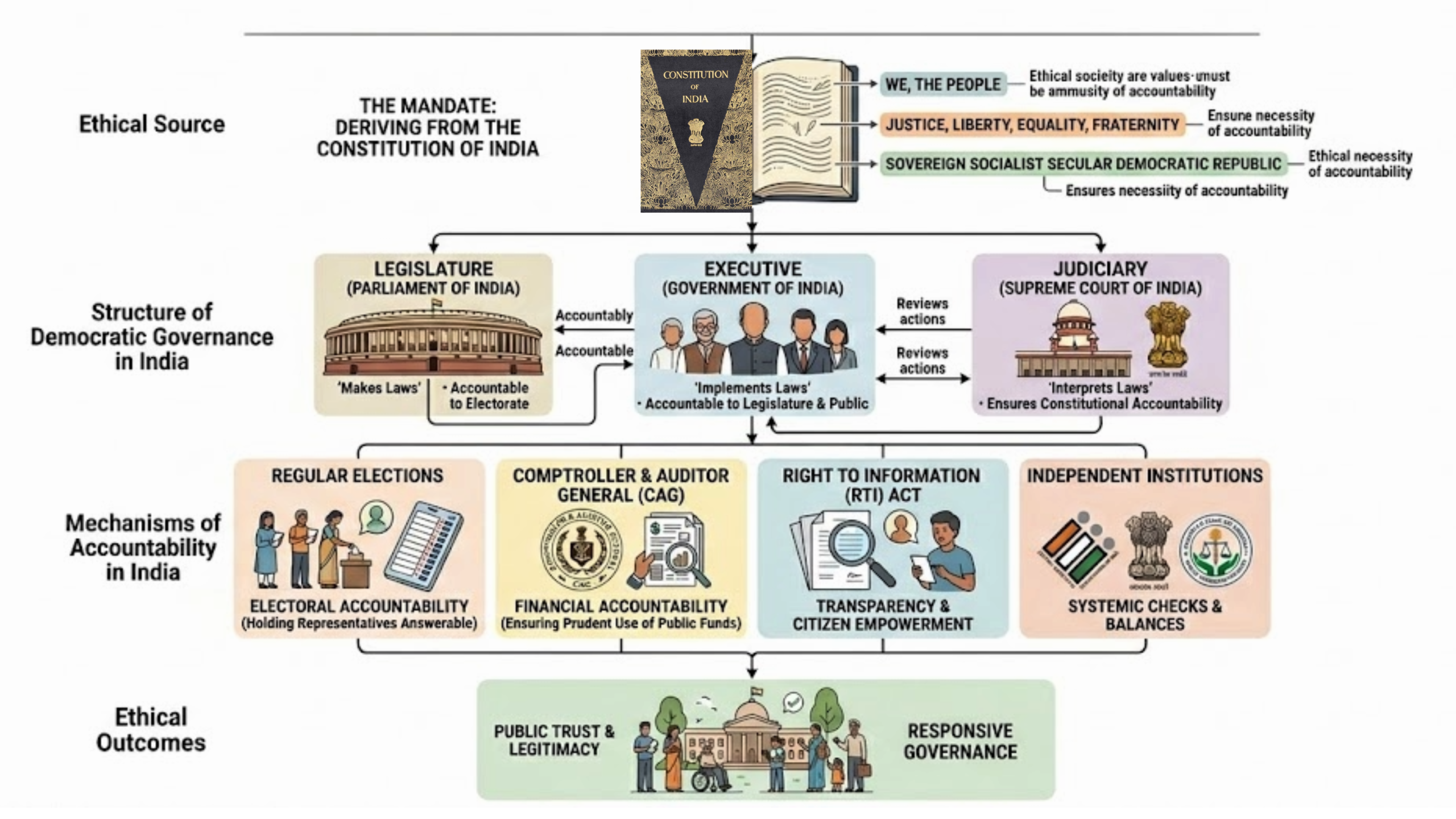
India, as the world’s most populous democracy, offers a rich, complex canvas for examining accountability. The architects of the Indian Constitution, deeply aware of the dangers of concentrated power, wove accountability into the very fabric of the republic. Article 75 of the Constitution mandates that the Council of Ministers is collectively responsible to the Lok Sabha (the lower house of Parliament), ensuring that the executive remains answerable to the people’s representatives.
However, the Indian experience shows that constitutional provisions alone are insufficient; they must be animated by active civic engagement and institutional courage.
The Constitutional Watchdogs
The Indian Constitution established fiercely independent institutions to act as the nation’s ethical guardians.
- The Comptroller and Auditor General (CAG): As the supreme audit institution of India, the CAG has been instrumental in enforcing horizontal accountability. By meticulously auditing government accounts and presenting reports to Parliament, the CAG ensures that public funds are utilized efficiently and ethically. Its reports have historically sparked national debates on resource allocation and executive overreach, reinforcing the principle that no government is above the ledger.
- The Election Commission of India (ECI): Entrusted with conducting free and fair elections, the ECI holds political parties accountable to a Model Code of Conduct, ensuring that the ruling party cannot easily misuse state machinery to manipulate voter will.
Institutionalizing Transparency
- The Right to Information (RTI) Act, 2005: The RTI Act stands as perhaps the most profound ethical intervention in Indian governance since independence. Prior to 2005, the colonial-era Official Secrets Act allowed the government to operate behind an iron curtain. The RTI Act inverted this dynamic, legally establishing that information belongs to the public. By allowing any citizen to question government expenditure, track files, and demand reasons for administrative delays, the RTI Act democratized accountability. It played a pivotal role in exposing high-profile irregularities, such as the Adarsh Housing Society scam and the 2G spectrum allocation controversies, proving that transparency is the most effective antidote to corruption.
- Judicial Activism and Public Interest Litigation (PIL): The Indian Judiciary has frequently stepped in to enforce accountability when the executive and legislature have faltered. The innovation of the Public Interest Litigation (PIL) in the 1980s allowed ordinary citizens and social activists to approach the Supreme Court on behalf of the marginalized. Whether it was the exposure of the Bhagalpur blindings (where police blinded undertrials), the protection of the Taj Mahal from industrial pollution, or mandating the disclosure of criminal antecedents of electoral candidates, the judiciary has repeatedly acted as the ethical guardian of constitutional rights.
Challenges to the Ethical Foundation in India
Despite these triumphs, the framework of accountability in India faces severe and ongoing challenges that threaten the ethical core of its democracy.
- The Criminalization of Politics: Accountability relies on the moral character of those in power. However, data from the Association for Democratic Reforms (ADR) consistently shows a rising percentage of Members of Parliament (MPs) and Members of Legislative Assemblies (MLAs) with serious criminal charges including murder, kidnapping, and extortion against them. When lawmakers themselves are lawbreakers, the ethical foundation of legislative accountability collapses. The electorate often overlooks these charges due to caste alignments, the winnability factor of wealthy candidates, highlighting a failure in accountability.
- Erosion of Institutional Autonomy: In recent years, there have been widespread concerns regarding the weaponization of investigative agencies. When these agencies are aggressively deployed against political opponents while showing lethargy toward members of the ruling dispensation, they cease to be instruments of accountability and become tools of political vendetta. This selective enforcement destroys public trust in the state’s ethical neutrality.
- The Weakening of the Fourth Estate: A thriving democracy requires a fearless press to hold a mirror to the government. In India, increasing corporate ownership of media houses, combined with political pressure and the pursuit of government advertising revenues, has led to significant media polarization. When mainstream news channels act as cheerleaders for the ruling establishment rather than critical watchdogs, the public is deprived of the objective facts needed to exercise vertical accountability.
- Dilution of the RTI: While the RTI Act remains powerful, it has faced systemic pushback. Amendments to the Act have altered the tenure and salary conditions of Information Commissioners, sparking fears about their independence from the executive. Furthermore, the sheer volume of pending appeals and the tragic murders of dozens of RTI activists highlight the dangerous resistance exacted by entrenched, corrupt interests against civic accountability.
Rebuilding the Ethical Core
The erosion of accountability is not a uniquely Indian problem, but the sheer scale of the Indian republic means the stakes are unprecedentedly high. Strengthening this ethical foundation requires structural and cultural shifts.
First, the autonomy of independent institutions must be protected through transparent, bipartisan appointment processes. Institutions like the Election Commission and investigative agencies cannot function as the ethical arbiters of democracy if their leadership is entirely beholden to the executive.
Second, the culture of state secrecy must be continually challenged. The creeping dilution of the RTI Act through amendments and the intentional understaffing of Information Commissions must be fiercely resisted by civil society.
Third, comprehensive and robust implementation of whistleblower protection laws is non-negotiable. Citizens and insiders who risk their lives to expose corruption must be guaranteed physical and legal safety.
Fourth, to break the nexus between crime and politics, fast-track courts must adjudicate cases against legislators. Simultaneously, police forces must be insulated from political interference as recommended by the Supreme Court’s Prakash Singh directives so they serve the law, not the ruling party.
Fifth, Democracies like India must invest in civic education that teaches citizens not just how to vote, but how to track budgets, file RTIs, and demand answers between election cycles.
Finally, accountability requires an active citizenry. Democracy is not a spectator sport played once every five years; it is an everyday practice of questioning, demanding, and participating.