What Modern Day Public Servants Can Learn From Indian Philosophy?
|
Getting your Trinity Audio player ready...
|
ARTICLE
The 21st-century civil servant operates in a complex matrix of technological disruption, climate change, socio-economic inequality, and shifting geopolitical realities. In this environment, the traditional Weberian model of bureaucracy characterized by rigid rules, impersonal hierarchies, and strict adherence to precedent often falls short when confronted with dynamic human crises. While modern administrative training emphasizes technical competence and policy analysis, true administrative excellence requires an unwavering ethical compass.
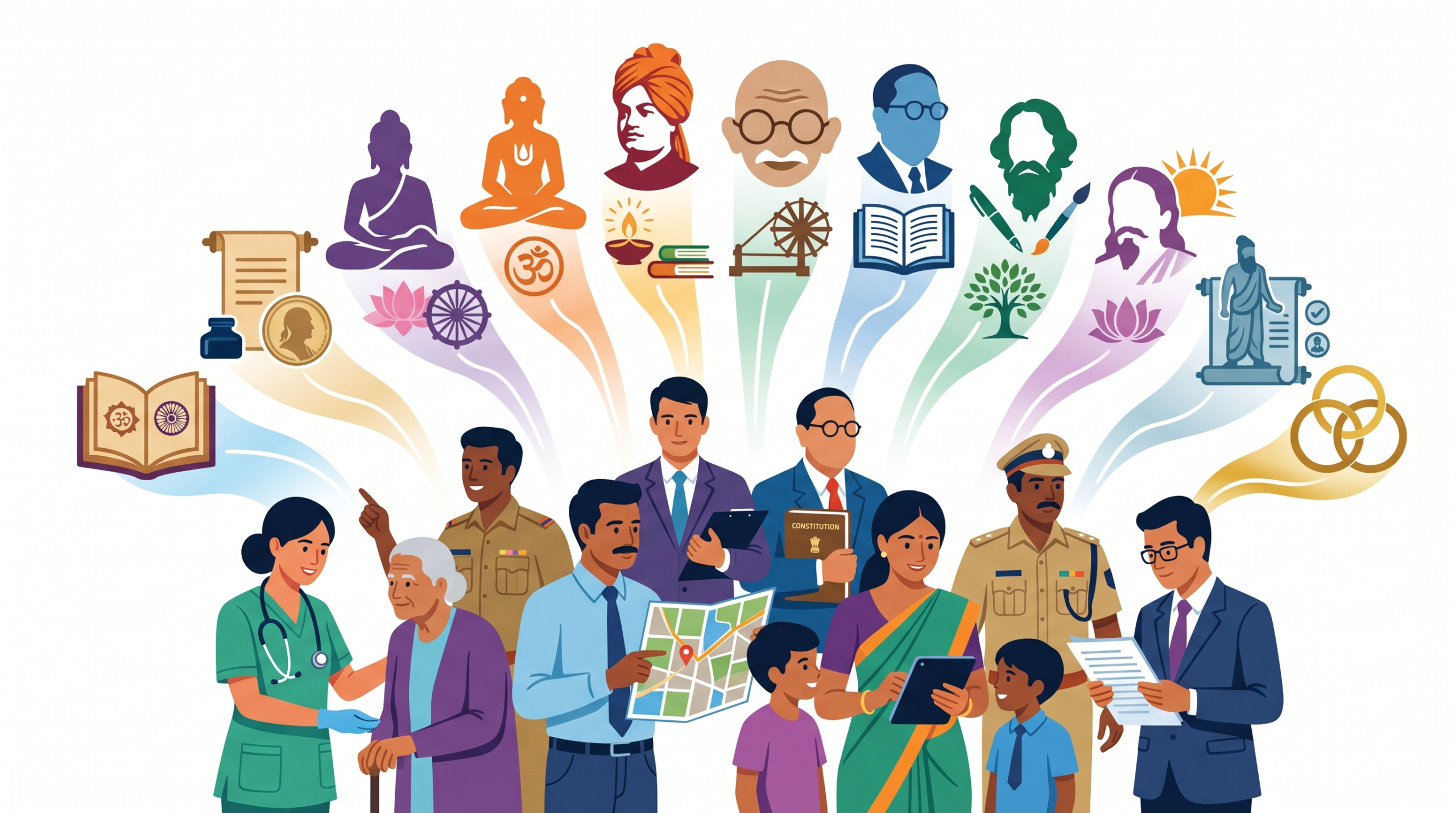
India’s rich philosophical tradition offers timeless guidance for modern governance. Indian philosophers and thinkers such as Lord Krishna, Chanakya, Gautama Buddha, Mahavira, Swami Vivekananda, Mahatma Gandhi, Dr. B.R. Ambedkar, Rabindranath Tagore, and Sri Aurobindo emphasized values like duty, justice, compassion, self-discipline, and service to humanity. Their teachings continue to remain highly relevant for public administration in the twenty-first century. By integrating these philosophical paradigms, today’s public servants can transition from being mere cogs in the state machinery to true agents of transformative governance.
Lessons From Bhagavad Gita: Nishkama Karma (Duty Without Attachment)
A persistent challenge in civil services is the psychological toll of political interference, frequent punitive transfers, and the craving for public recognition. The Bhagavad Gita introduces the doctrine of Nishkama Karma performing one’s duty without attachment to the fruits or outcomes of the action. The Gita teaches that an administrator has the right to the work alone, but not to its rewards. This philosophy is the bedrock of the foundational civil service values of anonymity and political neutrality.
Modern Application and Examples
- Resilience Against Transfers: An upright Indian Administrative Service (IAS) or Indian Police Service (IPS) officer tasked with dismantling illegal sand mining mafias often faces immense political pushback and the threat of immediate transfer. Guided by Nishkama Karma, the officer executes their duty fearlessly, viewing a transfer not as a punishment, but simply as a relocation to a new sphere of duty.
- Curbing the ‘Celebrity Bureaucrat’ Syndrome: In the age of social media, many public servants seek validation through viral videos of their raids or inspections. Nishkama Karma reminds the administrator that their mandate is silent, systemic change, not personal glorification.
Lessons From Buddha: Madhyam Marg (The Middle Path), Compassion and Human-Centric Governance
The teachings of Gautam Buddha provide profound tools for conflict resolution and balanced decision-making. The Buddha advocated for the Madhyam Marg (The Middle Path), avoiding extreme asceticism on one hand and extreme indulgence on the other. In governance, this translates to balanced, sustainable policies.
Gautama Buddha also emphasized compassion, non-violence, mindfulness, and reduction of human suffering. His teachings remind public servants that governance is ultimately about people, not merely procedures. Modern bureaucracy sometimes becomes rigid and insensitive toward ordinary citizens. Long delays, lack of empathy, and administrative indifference often create frustration among people. Buddha’s philosophy teaches that public servants should treat citizens with dignity and compassion.
Modern Application and Examples
- Sustainable Development (The Middle Path): Modern public servants constantly face the ‘Economy vs. Environment’ dilemma. Whether it is clearing a forest for a crucial highway or halting mining to protect biodiversity, extreme stances lead to either economic stagnation or ecological disaster. The Buddha’s Middle Path guides administrators to seek sustainable development approving infrastructure while mandating compensatory afforestation and green technologies.
- At The Time of Pandemic (Compassion): Many police officers and healthcare workers during the pandemic showed humanity by helping migrant workers, arranging food, and supporting vulnerable families. Such actions reflect Buddhist compassion in governance.
Lessons from Mahavira: Anekantavada (The Doctrine of Multifaceted Reality) and Aparigraha (Non-Possessiveness)
Mahavira and Jain philosophy emphasize Ahimsa (non-violence), truthfulness, self-restraint, and simplicity. These principles are highly relevant for ethical governance. The principle of non-violence extends beyond physical harm. Policies and administrative actions should not exploit weaker sections of society. Public servants must ensure that development projects do not unfairly displace poor communities without proper rehabilitation.
Jain philosophy introduces Anekantavada (the doctrine of multifaceted reality), which teaches that truth and reality are perceived differently from diverse points of view, and no single point of view is the complete truth.
Mahavira, the 24th and final Tirthankara also emphasized Aparigraha or non-possessiveness. In modern governance, corruption and misuse of public office often arise from greed and excessive materialism. Public servants who practice simplicity and restraint are less likely to misuse power. Former President Dr. A.P.J. Abdul Kalam is often cited as an example of simplicity and integrity in public life. Despite holding high office, he lived modestly and dedicated himself to national service. Such examples demonstrate the importance of ethical conduct in administration.
Modern Application and Examples
- Conflict Resolution (Anekantavada): When mediating disputes such as a labour strike in a factory or a land dispute between communities an administrator must apply Anekantavada. By genuinely listening to the grievances of the workers, the financial constraints of the management, and the legal constraints of the state, the administrator acknowledges multiple truths to negotiate a harmonious consensus, rather than imposing a heavy-handed, unilateral order.
Lessons From Kautilya: The Architecture of Strategic Accountable Governance and Yogakshema (Preservation of Well-being)
Kautaliya, also known as Chanakya, was one of India’s greatest political thinkers. His Arthashastra discusses governance, economics, taxation, diplomacy, intelligence systems, and public administration
Written over two millennia ago, Kautilya’s Arthashastra remains one of the most comprehensive treatises on statecraft, economics, and public administration. For Kautilya, the ultimate purpose of the state is the welfare of its citizens. His central tenet, ‘Praja sukhe sukham rajnah, prajanam cha hite hitam’ forms the foundational mandate for any modern welfare state.
Kautilya was also a profound realist regarding human nature. He famously observed that just as it is impossible to know when a fish swimming in water is drinking it, it is difficult to detect government servants misappropriating public funds. He identified forty methods of embezzlement and prescribed a rigorous system of checks, balances, and intelligence gathering.
Modern Application and Examples
- Preventive Vigilance over Punitive Action: A modern administrator learning from Kautilya does not wait for a scam to occur. They build systems that eliminate human discretion where it is not needed. For example, the implementation of Direct Benefit Transfer (DBT) utilizing the JAM trinity (Jan Dhan, Aadhaar, Mobile) is a Kautilyan approach to eliminating middlemen and ensuring targeted welfare.
- Data-Driven Governance: Kautilya relied heavily on the Gudhapurusha (intelligence network) to gauge the ground reality. A modern public servant utilizes big data, public grievance portals (like CPGRAMS), and social audits as their intelligence network to continuously monitor policy impact and correct course.
Lessons From Thiruvalluvar: The Ethics of Objective Decision-Making
The Tirukkural, penned by the ancient Tamil poet-philosopher Thiruvalluvar, devotes significant sections to the ethics of wealth (Porul) and the conduct of the state and its ministers. Thiruvalluvar emphasized impartiality, the careful selection of personnel, and the importance of taking counsel.
He wrote, ‘To discern the truth in everything, by whomsoever spoken, is wisdom.’ This is a timeless directive for objectivity and meritocracy in civil service.
Modern Application and Examples
- Objectivity in Administration: Public servants are routinely flooded with biased reports, political pressures, and media narratives. Thiruvalluvar’s wisdom requires the administrator to sift through the noise, verify facts independently, and base their decisions purely on empirical evidence and merit, free from prejudice or favouritism.
- Delegation and Team Building: Thiruvalluvar advised rulers to test a person’s capacity before entrusting them with a task, and once entrusted, to give them the freedom to execute it. A District Collector of modern time must apply this by assessing the strengths of their subordinate officers, delegating tasks appropriately, and backing their team against unwarranted external pressure.
Lessons From Swami Vivekananda: Daridra Narayana (Service to Man is Service to God) and Emotional Intelligence
Swami Vivekananda transformed the concept of spiritual salvation into a call for aggressive social service. He coined the term Daridra Narayana. For Vivekananda, true religion and true duty lay in selfless service to humanity. He championed fearlessness, character-building, and an empathetic approach to leadership.
Vivekananda also emphasized youth empowerment and education. Public servants today must focus on empowering citizens through skill development, digital literacy, and employment opportunities rather than creating dependency.
Honest administrators often face political pressure or criticism. Vivekananda’s message of courage inspires public servants to uphold truth and justice despite difficulties. In modern administrative terms, Vivekananda’s teachings translate directly to Emotional Intelligence (EQ) and Compassion.
Modern Application and Examples
- Empathetic Public Dealing: Bureaucracies are naturally prone to red tape, which can reduce human beings to mere file numbers. A public servant inspired by Vivekananda does not view a destitute woman seeking a widow pension as a bureaucratic burden, but as a duty of the highest spiritual order. This shifts the administrative attitude from apathy to active empathy.
- Crisis Leadership: During disasters, such as the COVID-19 pandemic, public servants were pushed to their physical and mental limits. The inner strength and fearlessness advocated by Vivekananda empower administrators to lead from the front, taking calculated risks to save lives rather than hiding behind procedural safety.
Lessons From Mahatma Gandhi: Antyodaya (Rise of the Last Person) and The Purity of Means
Mahatma Gandhi’s philosophy offers perhaps the most rigorous ethical stress-test for public administration. Two of his concepts are indispensable for modern bureaucrats: the Talisman and the principle that Means are as important as the Ends.
Gandhi’s Talisman asks the decision-maker to recall the face of the poorest and weakest person they have seen and ask if the step they contemplate will be of any use to them. Furthermore, Gandhi staunchly opposed the Machiavellian idea that the ends justify the means. He argued that if the seeds (means) are corrupt, the tree (ends) cannot be pure.
Modern Application and Examples
- Policy Formulation and Antyodaya: When an administrator is designing a master plan for urban development, the utilitarian approach might advocate clearing slums rapidly to build commercial hubs benefiting the majority. However, applying Gandhi’s Talisman forces the administrator to prioritize the rehabilitation and livelihood of the displaced slum dwellers before breaking ground.
- Administrative Integrity: Consider a police officer pressured to carry out an encounter (extrajudicial killing) to swiftly eliminate a notorious criminal and restore public peace (a noble end). A Gandhian public servant will strictly uphold the rule of law and the judicial process (pure means), knowing that bypassing the law erodes the very foundations of the justice system.
Lessons From Dr. B.R. Ambedkar: Constitutional Morality over Personal Morality
Dr. B.R. Ambedkar emphasized equality, liberty, fraternity, and constitutional morality. He believed that democracy must ensure dignity and justice for all citizens, specially marginalized groups. While deeply rooted in modern legal frameworks, Dr. B.R. Ambedkar’s philosophy on social justice and constitutional morality is a vital guiding light. Ambedkar warned that democracy in India is only a top dressing on an inherently undemocratic soil. He argued that administrators must be guided by Constitutional Morality the principles of liberty, equality, and fraternity even when it clashes with prevailing public morality or majoritarian sentiment.
Modern Application and Examples:
- Protecting Minorities and the Marginalized: During instances of communal tension or moral policing, the mob, representing a skewed public morality often demands action against a specific community or individuals exercising their rights. An Ambedkarite public servant uses the Constitution as their ultimate shield, ensuring that the fundamental rights of even the most unpopular minority are protected against the tyranny of the majority.
- Challenging the Status Quo: A District Magistrate working in a deeply patriarchal or caste-stratified region cannot simply maintain law and order if it means maintaining an oppressive status quo. They must actively promote policies that dismantle caste-based discrimination, such as ensuring Dalits have access to public wells and temples, thereby enforcing constitutional morality.
Lessons From Rabindranath Tagore: Humanism and Cultural Harmony
Rabindranath Tagore emphasized universal humanism, cultural harmony, and freedom of thought. His philosophy teaches public servants to respect diversity and promote social harmony. India is a multicultural society with diverse languages, religions, and traditions. Public servants must ensure equal treatment of all communities and avoid prejudice.
Rabindranath Tagore’s philosophy transcends geopolitical borders, offering timeless lessons in Universal Humanism and Cultural Harmony vital principles for ethical governance. He warned against aggressive nationalism, arguing that elevating the nation over humanity inevitably leads to moral collapse and conflict.
Instead, Tagore championed a world where rooted in a humanism that recognizes the innate dignity of every individual, regardless of caste, creed, or nationality. For Tagore, true freedom meant liberation from dogma and prejudice, not just political independence.
Modern Application and Examples
- Fostering Cultural Synthesis: Through Visva-Bharati, Tagore modeled global cultural harmony. Civil servants must actively protect India’s pluralism. During communal tensions, a District Magistrate must uphold constitutional morality and protect minorities, resisting majoritarian pressures.
- Inner Freedom: Tagore’s ‘mind without fear’ demands administrative courage. A civil servant maintaining strict political neutrality and exposing corruption, prioritizing ethical duty over careerism.
Karma Yogi: The Path of Modern Day Public Servants
The modern state expects its public servants to be efficient managers, adept at handling complex legal frameworks and global technologies. However, the Indian philosophical tradition demands something higher: it demands that the administrator be a Karma Yogi.
Whether it is Kautilya’s mandate for rigorous accountability, Gandhi’s profound empathy for the marginalized, Ambedkar’s fierce adherence to constitutional justice, or the Gita’s call for selfless duty, Indian philosophy provides a robust blueprint for ethical governance. By internalizing these principles, modern public servants can bridge the gap between mere administration and true leadership, transforming the machinery of the state into a vibrant instrument for human welfare.