
Caste-Based Census: Essential for Policy or Divisive Exercise?
|
Getting your Trinity Audio player ready...
|
DEBATE
Topic: Caste-based census: Essential for policy or divisive exercise?
Motion: Caste-based census: A necessary tool for equitable policy or a catalyst for social fragmentation?
Thesis Statement: The motion examines whether a caste-based census is an indispensable instrument for achieving substantive equality through informed policymaking, or whether it risks reinforcing social cleavages and undermining the pursuit of a cohesive national identity.
Side I: In Favour (Essential for Policy)
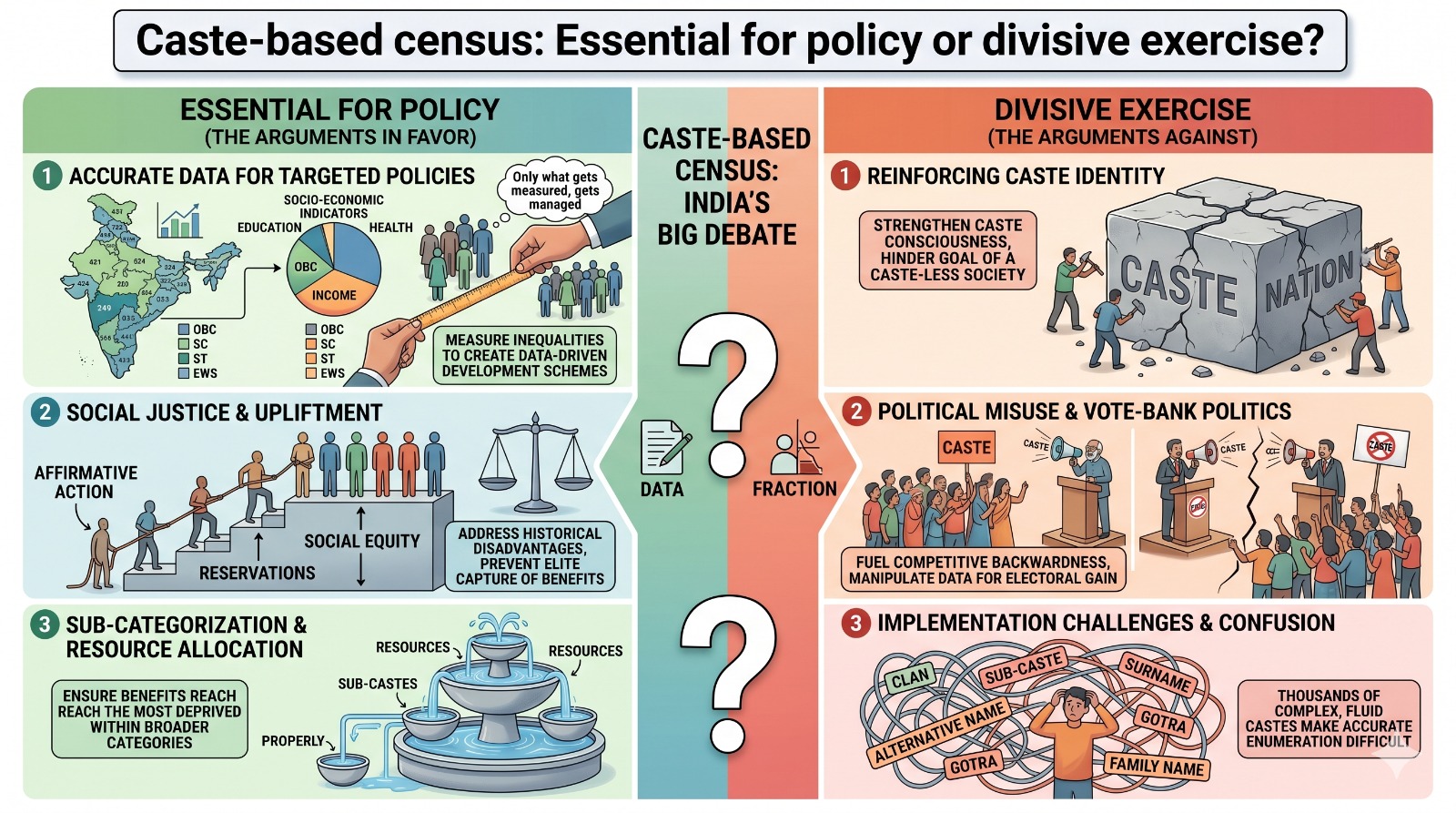
Main Idea: You cannot remedy what you cannot measure. A caste-based census is crucial for accurate data-driven governance, targeted welfare, and achieving substantive equality.
Opening Statement: India’s social structure has historically been shaped by caste hierarchies. Without reliable and updated caste data, policymaking remains incomplete. A caste-based census would enable the state to design more inclusive and effective interventions, especially for marginalized communities.
Arguments:
Evidence-Based Policy: Current reservation quotas are largely based on 1931 data. A fresh census provides the empirical data required by the Supreme Court (e.g., M. Nagaraj and Jarnail Singh cases) to justify reservations and prevent legal strikes.
Targeting Sub-categorization: Within the OBC category, a few dominant groups often corner all benefits. Data allows for equitable distribution among the most marginalized sub-castes.
Objective Socio-Economic Mapping: It reveals the correlation between caste and access to healthcare, education, and land, allowing the State to move beyond blind welfare to precision targeting.
Transparency and Accountability: Enhances trust in governance through data-backed interventions that reduces arbitrariness in policy decisions.
Inclusive Development: Ensures no group remains statistically invisibleand all categoriesalign with constitutional goals of equality and justice.
Conclusion: To ignore caste in the census is to practice ‘color – blindness’ in a society that is deeply stratified. Justice requires data, and data requires the courage to count.
Side II: Against (Divisive Exercise)
Main Idea: Solidifying identities that the Republic sought to erase. A caste-based census risks entrenching caste identities, fostering social fragmentation, and politicizing governance.
Opening Statement: By making caste a permanent column in our national accounting, we are not just counting heads; we are hardening hearts and ensuring that an individual’s primary identity remains their birth, not their citizenship. Institutionalizing caste through a census may perpetuate divisions rather than eliminate them. India must move toward a more unified identity rather than reinforcing caste consciousness.
Arguments:
Institutionalization of Caste: A census forces the youth to identify with their caste for state benefits, reversing the process of social assimilation and ‘annihilation of caste’ envisioned by Dr. Ambedkar.
Political Weaponization: Such data is prone to ‘Mandalization 2.0,’ where political parties use precise numbers for ‘social engineering’ and ‘vote-bank politics,’ leading to competitive radicalization.
Administrative & Social Complexity: There are thousands of sub-castes and phonetic variations. Collecting this data is a logistical nightmare that often leads to more litigation over nomenclature than actual welfare.
Alternative Metrics Available: Focus should shift to poverty alleviation irrespective of caste for this exercise economic and educational indicators can be used instead of caste.
Conclusion: Government must count citizens, not castes. Focusing on socio-economic indicators such as income, housing, and assets to help the poor can promote unity and inclusive growth regardless of the labels they inherited at birth.
Rebuttals
Side I Rebuttal to Side II: The concern that a caste-based census will create divisions overlooks the fact that such divisions already exist in lived reality. The absence of data does not dissolve inequality; it merely obscures it. By bringing disparities into the open, the census can facilitate more equitable policy outcomes and reduce grievances arising from perceived injustice. As for political misuse, that is a challenge inherent in any form of data, and it calls for better institutional safeguards rather than the abandonment of data collection itself.
Side II Rebuttal to Side I: While inequalities persist, institutionalizing caste through enumeration risks normalizing it as a permanent feature of governance. The process may lead to an endless cycle of claims and counterclaims, making policy increasingly identity-driven. Instead of resolving disparities, it could deepen contestation. A shift toward economic and capability-based measures would address deprivation without reinforcing social boundaries.
Final Synthesis
The debate ultimately reflects a deeper dilemma between the need to recognize social realities and the aspiration to transcend them. A caste-based census offers the promise of precision in policymaking and a stronger foundation for social justice, yet it also carries the risk of intensifying identity politics and social fragmentation. A balanced path forward may lie not in a binary choice but in careful design and intent: if undertaken, such an exercise must be accompanied by robust safeguards, integration with broader socio-economic indicators, and a clear commitment to using the data to diminish inequalities rather than entrench identities. The challenge, therefore, is not merely whether to count caste, but how to ensure that the act of counting contributes to building a more equitable and cohesive society.