Indian Judiciary and the Challenge of Hate Speech
|
Getting your Trinity Audio player ready...
|
OPINION
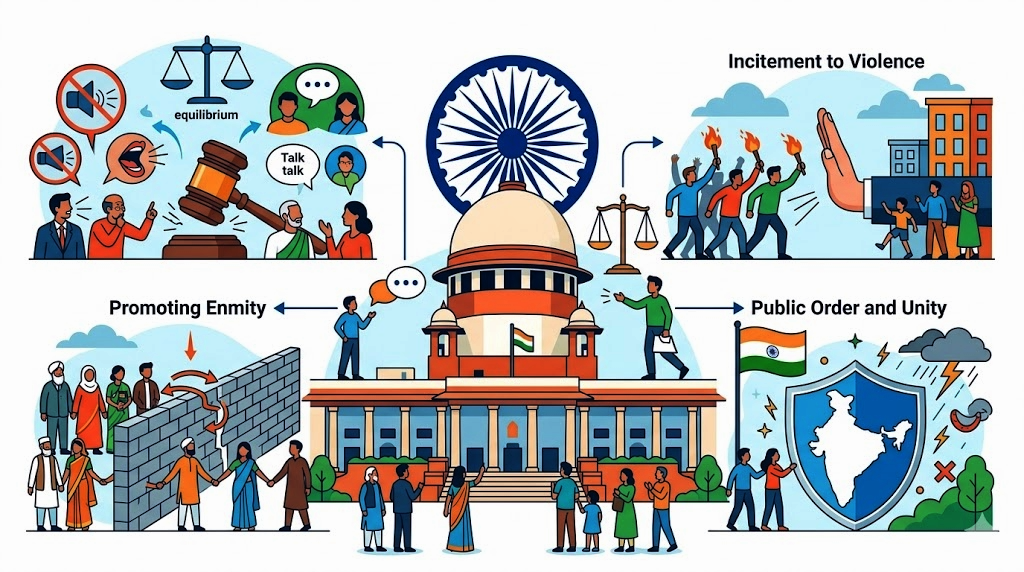
The paradox of hating speech while protecting speech is one of the most complex challenges facing the Indian judiciary. In a country as pluralistic and diverse as India, the line between robust political criticism and speech that incites communal disharmony is often razor-thin. Hate speech, though not explicitly defined in the Constitution or Indian Penal Code (IPC), but Bharatiya Nyaya Sanhita (BNS), 2023, addresses hate speech primarily through Sections 196 and 299, which replace corresponding IPC sections to penalize promoting group enmity and insulting religious feelings. The Supreme Court of India, as the sentinel on the qui vive, attempting to balance the Fundamental Right to freedom of speech and expression under Article 19(1)(a) with the reasonable restrictions permitted under Article 19(2) in the interest of public order and decency which evolved a nuanced doctrine that distinguishes between advocacy, discussion, and incitement.
The Constitutional Framework and Early Restrictions
The journey of hate speech jurisprudence began with the realization that speech is not absolute. Article 19(2) allows the State to impose reasonable restrictions on grounds including public order, decency, and incitement to an offense.
Ramji Lal Modi v. State of Uttar Pradesh (1957)
One of the earliest tests involved Section 295A of the IPC, which criminalizes deliberate and malicious acts intended to outrage religious feelings. The petitioner challenged its constitutionality, arguing it was too broad. The Constitution Bench upheld the section, clarifying that it does not penalize every act of insult to religion, but only those performed with a malicious intent to disrupt public order. This established the calculated tendency of speech to cause disorder as a yardstick for restriction.
Defining the Threshold: Advocacy vs. Incitement
A pivotal moment in Indian free speech history came with the distinction between mere speech and speech that leads to violence.
Shreya Singhal v. Union of India (2015)
While primarily famous for striking down Section 66A of the IT Act, this judgment is the cornerstone of modern hate speech discourse. Justice J. Chelameswar categorized speech into three levels:
- Discussion
- Advocacy
- Incitement
The Court ruled that a person can discuss or even advocate for a highly unpopular or offensive idea. The law can only intervene when speech reaches the level of incitement, where it directly leads to an immediate threat to public order or the security of the State. This clear and present danger philosophy (borrowed from US jurisprudence but adapted to India) protects dissent from being labeled as hate speech.
The Rights of the Vulnerable: Content vs. Context
In recent years, the Court has shifted its focus toward the impact of speech on the dignity of marginalized groups, recognizing that hate speech is often a tool of exclusion.
Pravasi Bhalai Sangathan v. Union of India (2014)
In this case, the Court was asked to issue guidelines to curb hate speech by elected representatives. While the Court declined to legislate from the bench, it referred the matter to the Law Commission of India. Critically, the Court defined hate speech as an effort to marginalize individuals based on their membership in a group, observing that it seeks to delegitimize the group in the eyes of the majority.
“Hate speech is an effort to marginalize individuals based on their membership in a group. It rises beyond causing distress to individual dignity and targets the social standing of entire communities.”
Amish Devgan v. Union of India (2020)
This judgment provided a sophisticated definition of hate speech, distinguishing it from free speech. The Court noted that ‘Free speech includes the right to comment, favour or criticize government policies,’ but Hate Speech is focused on vilification and targeted insult. The Court emphasized the Person in Authority test speech by influential figures carries more weight and, therefore, a higher potential for harm, necessitating stricter scrutiny.
The Duty of the State: Proactive Intervention
The most recent phase of jurisprudence reflects the Court’s frustration with administrative apathy in the face of inflammatory rhetoric.
Shaheen Abdulla v. Union of India (2022-2023)
Responding to petitions regarding Dharam Sansads or religious assemblies where provocative speeches were made, the Supreme Court issued a series of interim directions. The Court noted that the “soul of the Constitution” is at stake. It directed all States and Union Territories to:
- Register suo motu cases against hate speech offenders without waiting for a formal complaint.
- Act regardless of the religion of the speaker to maintain the secular fabric of the nation.
- Warned that failure to act would be treated as contempt of court.
This marked a transition from a reactive judiciary to a proactive guardian of communal harmony.
Hate Speech in the Media and Digital Age
The Court has also addressed how the medium amplifies the message, particularly in television news and social media.
Kaushal Kishore v. State of Uttar Pradesh (2023)
A Constitution Bench addressed whether the right to free speech of a Minister could be restricted beyond Article 19(2). While the Court ruled that no additional restrictions could be placed on Ministers, it clarified that the State has a positive obligation to protect the rights of citizens from the harmful effects of hate speech, even if made by private individuals.
Firoz Iqbal Khan v. Union of India (Sudarshan TV Case, 2020)
When a news channel planned to air a show titled ‘UPSC Jihad,’ the Court intervened, stating that the program appeared to vilify a specific community. The Court observed that ‘the medium of television is powerful’ and that anchors have a responsibility to ensure their platforms are not used to spread venomous content that creates a sense of fear among minorities.
Key Judicial Tests and Doctrines
To summarize the Supreme Court’s approach, several tests have been established to determine if speech crosses the line:
- (Test) The Spark in a Powder Keg – (Description) Does the speech have an immediate, direct link to violence or public disorder?
- (Test) The Dignity Test – (Description) Does the speech strip a community of its social standing or right to equal concern?
- (Test) The Intent Test – (Description) Was the speech deliberate and malicious (as per Section 295A) or a bona fide criticism?
- (Test) The Authority Test – (Description) Is the speaker a public official or someone with the power to influence mass behaviour?
The Way Forward
The Supreme Court’s journey through hate speech shows a clear trajectory: from protecting the State from the citizen, to protecting the Citizen from the State and other citizens. The Court has correctly identified that in a diverse democracy like India, hate speech is not just a nuisance; it is a constitutional wrong that poisons the spirit of fraternity.
As India moves further into the digital age, the Supreme Court will likely need to refine these tests further, perhaps by adopting the threshold test suggested by the UN’s Rabat Plan of Action, which considers the social context, speaker’s influence, and likelihood of harm. For now, the Court’s message is clear: the ‘Right to Speech’ does not include the ‘Right to Hate.’