
The Science & Technology Behind The Solar Energy
|
Getting your Trinity Audio player ready...
|
EXPLAINER
What is the Photovoltaic (PV) Effect?
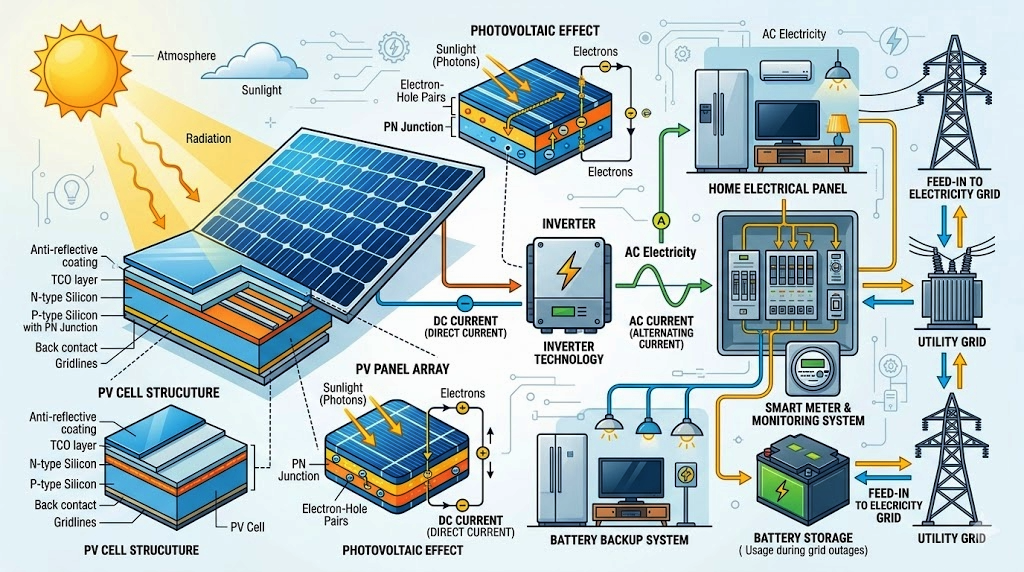
The photovoltaic effect is the chemical and physical phenomenon where a material generates an electric current when exposed to light. It was first observed by Edmond Becquerel in 1839. In a solar cell, photons from sunlight strike a semiconductor (usually silicon), knocking electrons loose from their atoms. This creates a flow of electricity. This process occurs at the atomic level, converting light energy directly into electrical energy without any moving parts or noise.
How do solar panels work?
Solar panels are composed of many individual solar cells made of silicon layers. When sunlight hits the cell, it energizes electrons, creating an electric field. This flow of electrons is captured as Direct Current (DC) electricity. To make this power usable for homes, an inverter converts the DC into Alternating Current (AC). The efficiency of this process depends on the quality of the silicon and the bandgap of the material, which determines how much of the light spectrum can be absorbed.
What are the different types of solar cells?
There are three primary types: Monocrystalline, Polycrystalline, and Thin-Film. Monocrystalline cells are made from a single, pure silicon crystal, offering the highest efficiency and sleekest look. Polycrystalline cells are made from fragments of silicon melted together; they are cheaper but slightly less efficient. Thin-film cells are made by depositing layers of PV material onto a substrate like glass or metal. They are flexible and lightweight but generally require much more space to produce the same amount of power.
How do Thin-Film solar cells differ from Silicon cells?
Thin-film solar cells are made by depositing one or more thin layers of photovoltaic material (such as Cadmium Telluride or CIGS) onto a substrate like glass, plastic, or metal. They are much thinner and more flexible than traditional crystalline silicon wafers. While they are generally less efficient and degrade faster, they are lighter, cheaper to manufacture, and perform better in low-light or high-heat conditions. They are often used in Building-Integrated Photovoltaics (BIPV), such as solar shingles or flexible panels for curved surfaces where traditional rigid panels won’t fit.
What is the role of an inverter in a solar system?
The inverter is the brain of a solar energy system. Solar panels produce Direct Current (DC), but most household appliances and the utility grid operate on Alternating Current (AC). The inverter performs this conversion. Modern smart inverters also provide system monitoring, ground fault protection, and maximum power point tracking (MPPT) to ensure the panels are operating at their peak efficiency regardless of temperature or shading.
What is Concentrated Solar Power (CSP)?
Unlike PV panels which use light, CSP uses mirrors or lenses to concentrate a large area of sunlight onto a small receiver. This intense heat is used to boil water or heat a transfer fluid (like molten salt), which then drives a steam turbine to generate electricity. CSP is typically used in massive utility-scale plants in desert regions and has the advantage of being able to store thermal energy to generate power even after the sun goes down.
How does solar energy storage work?
Since solar power is intermittent, batteries (usually Lithium-ion) are used to store excess energy produced during the day. When the sun sets, the stored chemical energy is converted back into electricity. Advanced systems use Battery Management Systems (BMS) to regulate charging cycles and prevent overheating. Beyond batteries, other storage technologies include pumped hydro, compressed air, and thermal storage in molten salts.
What is the efficiency of a solar panel?
Efficiency refers to the percentage of sunlight energy that a solar cell can convert into usable electricity. Most commercial panels today have an efficiency between 17% and 22%. While this may seem low, it is a significant leap from the 6% efficiency of the 1950s. The theoretical limit for a single-junction silicon cell (the Shockley-Queisser limit) is about 33.7%, though multi-junction cells used in space can reach over 40%.
What is the difference between active and passive solar?
Active solar technology uses mechanical or electrical devices like PV panels or pumps to capture and convert sunlight. Passive solar design, however, involves architectural techniques to harness heat without hardware. Examples include south-facing windows to collect heat in winter, thermal mass materials like concrete to store heat, and natural ventilation. Passive solar is about using the building’s structure itself as a solar collector.
What is the difference between Monocrystalline and Polycrystalline panels?
Monocrystalline panels are made from a single, continuous crystal structure of high-purity silicon. It can be identified by their dark, uniform look and rounded edges. They are more efficient (often 20%+) because electrons have more room to move, but they are more expensive to produce. Polycrystalline panels are made by melting many silicon fragments together. They have a blue, speckled appearance and are generally less efficient (around 15-17%) because the multiple crystal boundaries slightly hinder electron flow. However, they are more affordable and involve less waste during manufacturing. For homeowners with limited roof space, monocrystalline is usually preferred, while polycrystalline is common for large-scale utility farms.
How do ‘N-type’ and ‘P-type’ silicon differ?
Solar cells use two layers of silicon: N-type (negative) and P-type (positive). N-type silicon is doped with phosphorus, which has more electrons than silicon, creating a surplus of negative charge. P-type silicon is doped with boron, which has fewer electrons, creating holes or positive charges. The junction between these layers creates an internal electric field that forces electrons to flow in one direction, creating a circuit.
What is the impact of temperature on solar panels?
Contrary to popular belief, solar panels actually perform better in cold temperatures. Like most electronic devices, solar cells become less efficient as they get hotter. The voltage of the cell drops as the temperature rises, leading to a decrease in total power output. Most panels are rated with a temperature coefficient, which tells you exactly how much efficiency is lost for every degree the temperature rises above 25°C (77°F).
What is Bifacial solar technology?
Bifacial solar panels can capture sunlight from both the front and the back. While the front faces the sun directly, the back captures albedo light sunlight reflected off the ground, roof, or nearby snow. This can increase energy yield by up to 30% compared to traditional monofacial panels. They are particularly effective when installed on light-colored surfaces or in snowy environments.
What is Concentrated Solar Power (CSP)?
Unlike PV panels that convert light to electricity, CSP uses mirrors or lenses to concentrate a large area of sunlight onto a small receiver. This intense light is converted into heat, which then drives a steam turbine connected to an electrical generator. CSP systems often use Thermal Energy Storage (like molten salts), allowing them to continue generating electricity even after the sun goes down. This makes CSP a dispatchable renewable energy source, meaning it can provide power on demand, similar to a coal or gas plant, but without the carbon emissions.
What are Perovskite Solar Cells?
Perovskites are a class of materials that have a specific crystal structure. They are the next big thing in solar research because they are cheaper to produce than silicon and have shown rapid improvements in efficiency. Scientists are currently developing Tandem Cells, which layer perovskite on top of traditional silicon. Because perovskite absorbs different parts of the light spectrum than silicon, these hybrid cells can potentially break the Shockley-Queisser limit, which is the theoretical maximum efficiency of a standard single-junction silicon cell (roughly 33.7%).
What is the difference between Solar PV and Solar Thermal?
Solar PV (Photovoltaic) uses the quantum properties of light to create electricity directly. Solar Thermal, on the other hand, uses the sun’s heat. This can be as simple as a black tank of water on a roof (Solar Hot Water) or as complex as a CSP plant using mirrors to boil water for turbines. PV is more versatile because electricity can be used for anything, but Solar Thermal is often much more efficient at heating converting up to 70% of solar energy into heat, whereas PV only converts about 20% into electricity.
What is Building-Integrated Photovoltaics (BIPV)?
BIPV refers to solar materials that are used to replace conventional building materials in parts of the building envelope, such as the roof, skylights, or facades. Instead of mounting panels on top of a roof, the roof is the solar system (like Tesla’s Solar Roof). This approach is aesthetically pleasing and can save on construction costs by serving as both a weather barrier and a power generator. While currently more expensive and slightly less efficient than standard panels, BIPV is a growing field in sustainable architecture and urban design.
What are Smart Grids?
A Smart Grid is an electricity network that uses digital technology, sensors, and software to better manage the flow of power between producers and consumers. Traditional grids were one-way – plant to home. Smart grids allow for two-way communication, which is essential for solar energy. They can automatically balance the fluctuating supply from thousands of rooftop solar arrays with the real-time demand of the city. This technology helps prevent blackouts, integrates more renewable energy, and allows for Virtual Power Plants where homeowners’ batteries are used to stabilize the national grid.
What is the Bandgap in solar physics?
The bandgap is the energy difference between the top of the valence band (where electrons stay) and the bottom of the conduction band – where electrons flow as current. For a solar cell to work, a photon must have enough energy to kick an electron across this gap. If the bandgap is too wide, low-energy photons pass through; if it’s too narrow, high-energy photons waste energy as heat. Tuning this bandgap is the holy grail of solar material science.
How does a solar thermal collector work?
Solar thermal technology is used to heat water or air rather than generate electricity. A collector (often a black-coated plate or glass tubes) absorbs solar radiation and transfers that heat to a fluid, like water or antifreeze. This fluid is then pumped to a storage tank for use in showers, swimming pools, or space heating. It is much more efficient at heating water than using PV panels to power an electric water heater.
What are Microinverters vs. String Inverters?
A string inverter connects a string of panels to a single box; if one panel is shaded, the whole string’s performance drops. Microinverters are small devices installed on the back of each individual panel. This allows every panel to operate independently. If one panel is shaded by a chimney or a leaf, the rest of the system continues to produce power at full capacity. This increases overall system reliability and energy harvest.
How does a solar thermal collector work?
Solar thermal technology is used to heat water or air rather than generate electricity. A collector (often a black-coated plate or glass tubes) absorbs solar radiation and transfers that heat to a fluid, like water or antifreeze. This fluid is then pumped to a storage tank for use in showers, swimming pools, or space heating.
What is the role of Silver and Copper in solar panels?
While silicon is the semiconductor, metal contacts are needed to collect the electricity. Silver is the most common material for the fingers and busbars on the front of the cell because of its high conductivity. However, because silver is expensive, researchers are working on using copper or aluminum. This transition is critical for scaling solar production globally without depleting precious metal supplies.
What are Solar Trackers?
Solar trackers are mechanical systems that move panels to follow the sun’s path across the sky. Single-axis trackers follow the sun from East to West, while dual-axis trackers also adjust for seasonal height changes. By keeping the panels at a 90-degree angle to the sun’s rays, trackers can increase energy production by 25% to 45% compared to fixed-tilt systems, though they add mechanical complexity and cost.
Can solar panels work at night?
Standard PV panels cannot produce electricity at night because they require photons. However, researchers are developing anti-solar cells that can generate a small amount of power at night by capturing the heat radiating from the earth into the cold sky (thermoradiative power).
What is the Duck Curve in solar energy?
The Duck Curve is a graph showing the timing imbalance between peak solar production and peak electricity demand. Solar produces most of its power midday, when demand is often low. As the sun sets, solar production drops just as people come home and turn on lights/appliances – peak demand. This requires the grid to ramp up other power sources extremely quickly. Solving this belly of the duck requires large-scale battery storage.
What is Organic Photovoltaics (OPV)?
OPV cells use carbon-based molecules or polymers instead of silicon. They can be made into thin, flexible, and even transparent films. While they are currently less efficient and have shorter lifespans than silicon, they can be manufactured using low-cost roll-to-roll printing (like a newspaper). They are ideal for portable electronics, wearable tech, and windows that generate power while letting light through.
What materials are used in solar cells besides Silicon?
While Silicon is the industry standard (over 90% of the market), other materials are used for specific needs. Cadmium Telluride (CdTe) is the most common thin-film material, prized for low manufacturing costs. Copper Indium Gallium Selenide (CIGS) offers high efficiency for thin-film. Gallium Arsenide (GaAs) is incredibly efficient and heat-resistant but very expensive, making it ideal for space-based applications like the Mars Rovers. Scientists are also exploring organic solar cells (OPV), which use carbon-based polymers to create flexible, printable, and even transparent solar inks.
How does dust or shading affect solar performance?
Even a small amount of shade or dust can significantly impact power output. In a standard string-inverter system, if 10% of a panel is shaded, the entire circuit’s current can drop. Dust and soiling can block photons from reaching the silicon. Modern panels use bypass diodes to allow current to flow around shaded cells, and self-cleaning hydrophobic coatings are being developed to help rain wash away dirt more effectively.
How does the Angle of Incidence affect power?
The Angle of Incidence is the angle between the sun’s rays and a line perpendicular to the solar panel’s surface. Maximum power is generated when the sun hits the panel at a perfect 900 angle. As the sun moves, the energy density decreases because the same amount of light is spread over a larger surface area. This is why many large solar farms use Solar Trackers mechanical motors that move the panels to follow the sun across the sky, keeping them perfectly aligned and increasing energy harvest by up to 40%.
What is the future of Solar Energy technology?
The future of solar lies in Solar Everywhere. This includes transparent solar windows that turn skyscrapers into power plants, solar-powered vehicles, and ultra-high-efficiency tandem cells. We are also seeing a shift toward Circular Economy practices, where old panels are recycled to recover 95% of their glass and metal. On the grid level, AI-driven software will manage millions of decentralized solar sources, creating a resilient, self-healing energy web. As costs continue to plummet, solar is on track to become the cheapest and most dominant source of energy in human history.