The Final Push Against Naxalism
|
Getting your Trinity Audio player ready...
|
PERSPECTIVE ANALYSIS
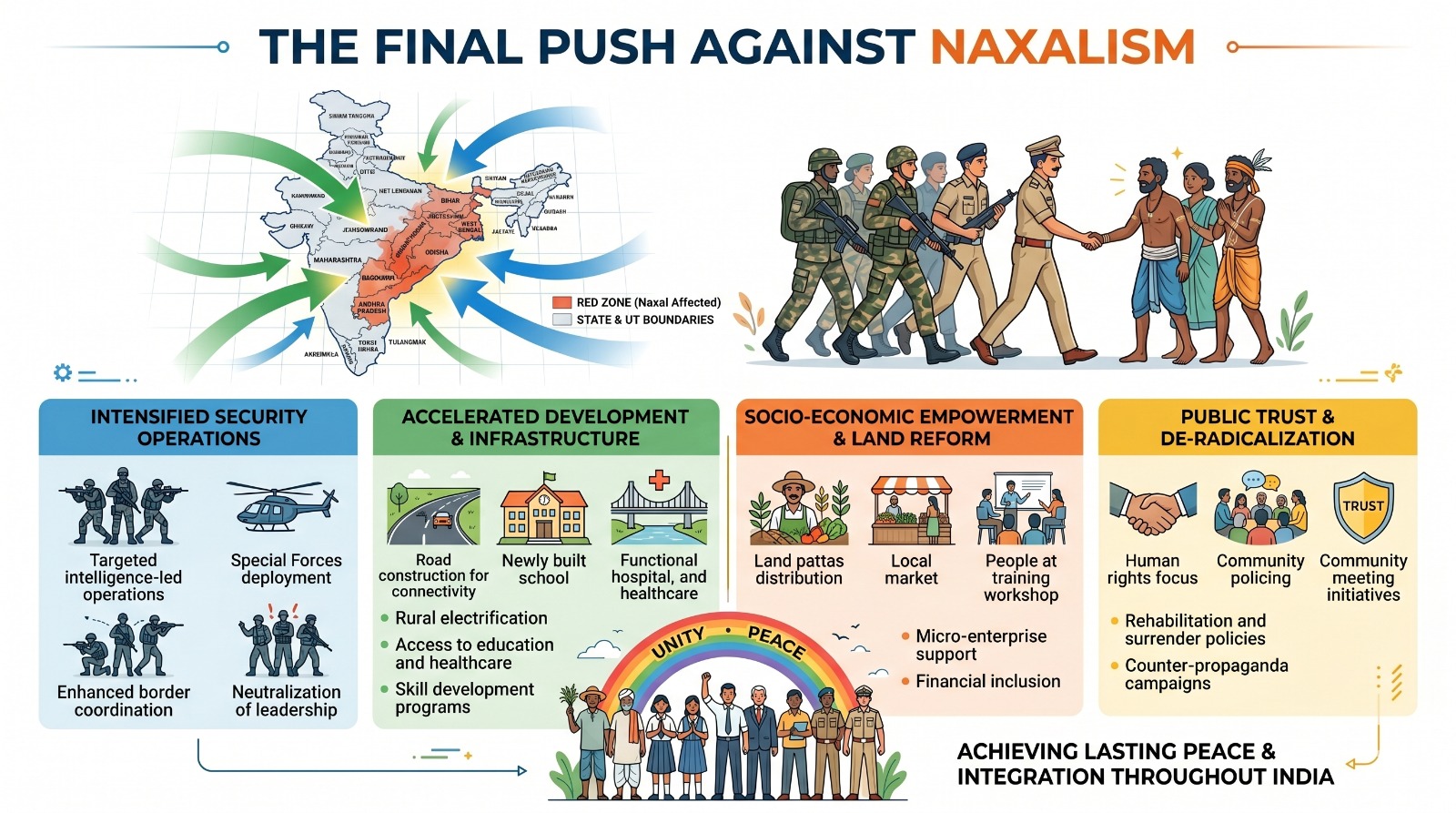
For over five decades, Left-Wing Extremism (LWE), often referred to as Naxalism, has been termed India’s greatest internal security challenge. Originating from the small village of Naxalbari in 1967 as a peasant revolt, it evolved into a sophisticated Maoist insurgency aiming to overthrow the Indian state through armed struggle. However, as of 2026, the tide has turned. Through a calibrated Whole-of-Government approach, the Indian state is currently engaged in what many security experts call the ‘Final Push’ a multi-pronged strategy to permanently dismantle the insurgent infrastructure and integrate the ‘Red Corridor’ into the national mainstream.
Understanding the Roots: Beyond Law and Order
Naxalism cannot be understood purely through the lens of security. Its origins lie in deep-seated issues such as land alienation, exploitation of tribal communities, lack of access to basic services, and historical neglect of remote regions. For many marginalized groups, specially in forested and mineral-rich areas, the state was either absent or extractive.
Even today, while violence has declined, the underlying structural challenges poverty, displacement, and limited livelihood opportunities continue to exist in varying degrees. Therefore, any ‘final push’ against Naxalism must address not just the symptoms of insurgency but its foundational causes.
Security Gains: Weakening the Insurgency
The past decade has seen a marked improvement in India’s security response to Naxalism. Better coordination between central and state forces, intelligence-based operations, and capacity building of local police have significantly weakened the operational capabilities of Naxal groups. The shrinking geographical spread of violence indicates that insurgents are now confined to smaller, fragmented pockets.
The adoption of a comprehensive strategy often encapsulated in frameworks like the ‘SAMADHAN’ doctrine has ensured a multi-pronged approach combining smart leadership, aggressive strategy, and technological integration. Increased use of drones, surveillance systems, and real-time intelligence sharing has shifted the balance in favour of the state. As a result, many top leaders have been neutralized, and recruitment has declined. However, security success alone does not guarantee permanence. History shows that insurgencies can resurface if underlying grievances remain unaddressed.
The Architecture of the Final Push: SAMADHAN-Plus
The current success is rooted in the SAMADHAN strategy launched in 2017, which stands for Smart Leadership, Aggressive Strategy, Motivation and Training, Actionable Intelligence, Dashboard-based KPIs, Harnessing Technology, Action Plan for each theatre, and No access to Financing. In this final phase, the strategy has shifted from mere containment to a high-pressure vacuum-filling model.
Security forces, particularly the CRPF’s CoBRA units and state-specific forces like the Greyhounds (Andhra/Telangana) and District Reserve Guard (DRG in Chhattisgarh), have established Forward Operating Bases (FOBs) in the deepest recesses of the Abujhmad forest. By establishing a physical presence in these formerly liberated zones, the state has effectively choked the Maoists’ logistical corridors, forcing them into a shrinking geographic footprint.
Technology as a Force Multiplier
In the final push, the traditional boots on the ground approach is being augmented by cutting-edge technology. The use of UAVs and high-resolution satellite imagery has stripped the insurgents of their greatest advantage: the dense forest cover. Thermal imaging and foliage-penetrating radars now allow security forces to track movement in real-time, significantly reducing the success rate of Naxal ambushes.
Furthermore, the focus has shifted to the financial strangulation of the movement. By leveraging the Prevention of Money Laundering Act (PMLA) and tracking the illegal levy collection from mining and infrastructure projects, the National Investigation Agency (NIA) has crippled the Maoists’ ability to procure sophisticated weaponry and maintain their urban networks.
The Battle for the Narrative: Winning Hearts and Minds
A significant pillar of the endgame is the Psychological Operations (PsyOps) and the aggressive surrender-and-rehabilitation policies. By showcasing the hollow nature of the Maoist ideology which often prevents the building of schools and roads to keep populations dependent the government has triggered a wave of ideological fatigue among the lower and middle rungs of the Naxal cadres.
The ‘Lone Varratu’ – Return to your home/village campaign in Chhattisgarh is a prime example. By offering former insurgents a path to dignity, employment, and protection, the state has induced a record number of surrenders. When a local tribal youth chooses a laptop or a plough over an AK-47, the Maoist People’s War loses its most vital resource: human recruitment.
The Tribal Question: Centering Rights and Dignity
At the heart of the Naxal issue lies the question of tribal rights. Many affected regions are home to indigenous communities whose relationship with land and forests is integral to their identity and survival. Policies related to mining, industrialization, and conservation have sometimes led to displacement and loss of livelihoods, fueling resentment.
Recognizing land rights, ensuring fair compensation, and involving local communities in decision-making processes can transform the state from a perceived adversary into a partner. Empowerment, rather than mere pacification, must be the guiding principle.
The Challenges of the Last Mile
Despite the optimism, the last mile remains the most dangerous. As the Naxal movement is pushed into a corner, its remnants have become more desperate and lethal. The inter-state borders (Chhattisgarh-Odisha-Maharashtra tri-junction) remain porous, allowing insurgents to slip through different jurisdictions.
Moreover, the Legal India must ensure that in this final push, the rights of the innocent tribal population are not caught in the crossfire. The success of the state depends on its ability to be perceived as a Protector, not an Occupier. Any collateral damage or human rights violation provides the Maoists with the “fuel” needed to reignite the movement.
Toward a Durable Peace: A Rational and Social Synthesis
India stands at a critical juncture in its fight against Naxalism. The decline in violence and the shrinking footprint of the insurgency suggest that the end may be within reach. Yet, the true measure of success will not be the elimination of armed groups alone, but the creation of conditions in which such movements cannot re-emerge.
The Indian state’s internal security doctrine is a transition from a Rational India using calculated force and technology to a Social India that addresses the historical grievances of the marginalized. As the Red Corridor shrinks and the Development Corridor expands, the goal is no longer just a Naxal-free India but a Prosperous and Integrated India. The sun is finally setting on the Naxalbari experiment, replaced by the rising dawn of constitutional governance in the heart of India’s forests. The battle is far from over, but for the first time in fifty years, the end is in sight.