
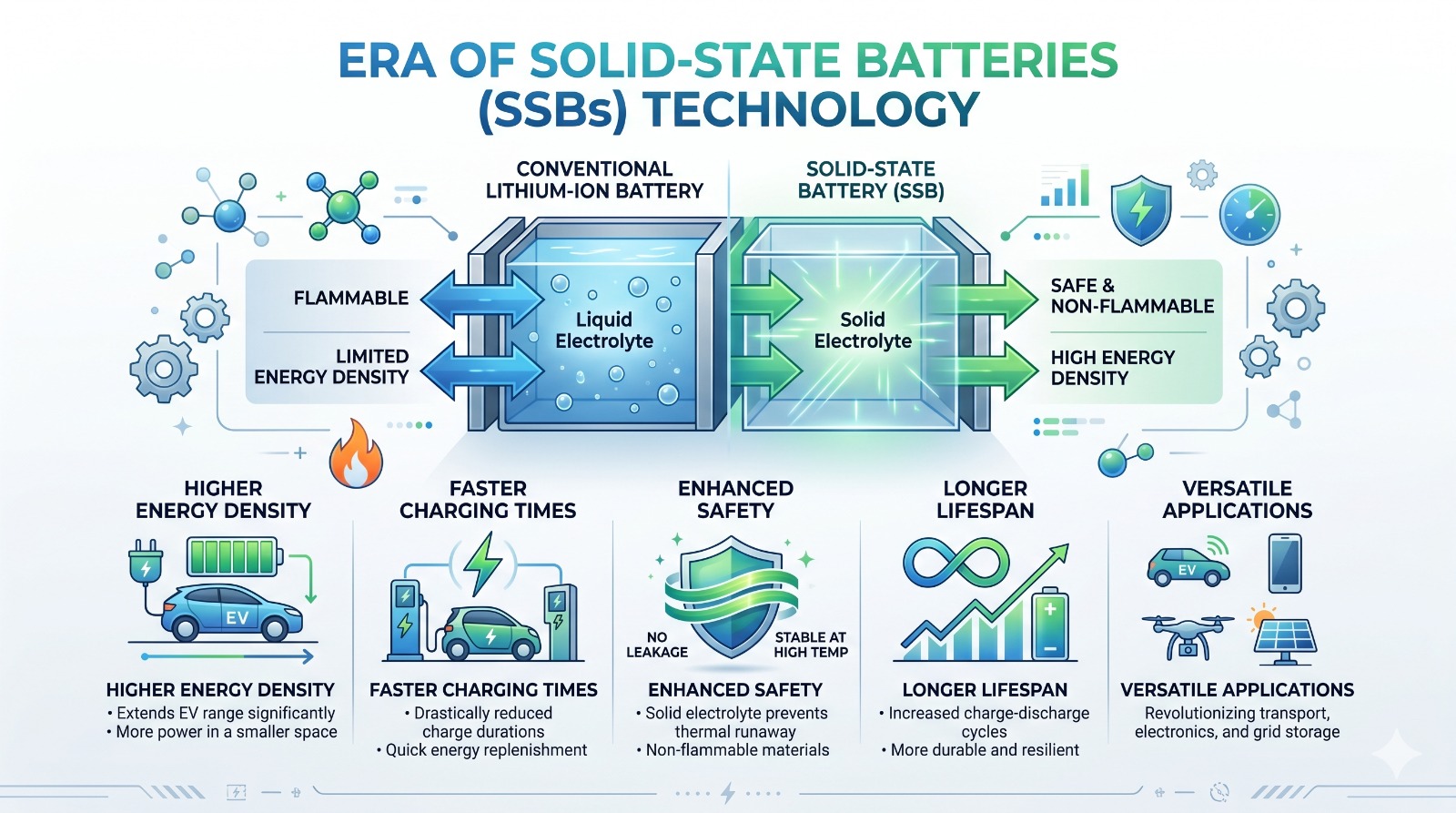
Era of Solid-State Batteries (SSBs) Technology
|
Getting your Trinity Audio player ready...
|
What is a solid-state battery (SSB)?
A battery that replaces the liquid or gel electrolyte found in traditional lithium-ion batteries with a solid material (such as ceramic, sulphide, or polymer) to conduct ions between the anode and cathode.
How do they differ from traditional lithium-ion batteries?
Standard batteries use a flammable liquid ‘juice’ to move ions. SSBs use a solid crystal or glass-like layer that also acts as a separator, eliminating the need for bulky safety components required to contain liquids.
Why are they considered safer than current batteries?
The solid electrolyte is non-flammable and thermally stable. It significantly reduces the risk of thermal runaway—the chain reaction that leads to battery fires in EVs, even if the battery is punctured or damaged.
What is Energy Density in the context of SSBs?
It refers to how much energy can be stored in a given weight. SSBs are evolving to reach 400–500 Wh/kg, nearly double the density of current lithium-ion cells (~250 Wh/kg), potentially doubling the range of electric vehicles.
What are the different types of solid electrolytes being used?
There are three main families: Sulfides (highest conductivity, but moisture sensitive), Oxides (stable and durable, but harder to manufacture), and Polymers (flexible and easier to scale, but require higher operating temperatures).
What is a Semi-Solid State battery?
A transitional technology currently in production (e.g., used by NIO in 2024–2026). It uses a hybrid electrolyte partially solid and partially liquid to improve safety and density while utilizing existing manufacturing lines.
What are Lithium-Metal Anodes?
The holy grail of SSB evolution. While current batteries use graphite anodes, SSBs aim to use pure lithium metal. Lithium metal can store significantly more energy but was previously too dangerous to use with liquid electrolytes due to fire risks.
What are Dendrites and why do they matter?
Dendrites are microscopic, needle-like whiskers of lithium that can grow during charging. In the past, they would pierce the separator and cause a short circuit. Evolution in solid electrolytes is focused on creating a physical barrier strong enough to stop these needles.
Can solid-state batteries charge faster?
Yes. Because solid electrolytes are more stable at high temperatures, they can theoretically handle much higher charging currents without the risk of fire, potentially allowing a 10–80% charge in under 10–15 minutes.
How do SSBs perform in extreme cold?
Solid-state systems generally perform better in cold climates than liquid batteries, which sluggishly move ions when frozen. SSBs can retain a higher percentage of their capacity and power at sub-zero temperatures.
Do solid-state batteries last longer?
Potentially. Without a liquid electrolyte to degrade over time through side-reactions, SSBs could offer a cycle life of 5,000 to 10,000 cycles, meaning the battery could outlast the vehicle itself.
What is the current range of an SSB-powered car?
Early high-end models and prototypes using semi-solid or early-stage all-solid packs are achieving ranges of 900–1,200 km on a single charge.
Why aren’t all cars using them yet?
The primary barriers are manufacturing cost and scalability. Producing solid electrolytes requires specialized dry room environments and high-pressure assembly techniques that are currently much more expensive than traditional lines.
When will mass-market solid-state EVs be available?
While semi-solid cars are on the road now (2026), all-solid-state mass-market vehicles are expected to begin appearing in significant numbers between 2028 and 2030.
Which companies are leading the evolution?
Major players include Toyota (holding the most patents), Samsung SDI, QuantumScape, Solid Power, and Chinese firms like CATL and Gotion Hi-Tech.
Will they be used in things other than cars?
Yes. Their high energy-to-weight ratio makes them ideal for Electric Vertical Take-off and Landing (eVTOL) aircraft (air taxis), drones, and medical implants where safety and size are paramount.
Are solid-state batteries more environmentally friendly?
They can be. By potentially using less cobalt and nickel and lasting twice as long as traditional batteries, they reduce the overall “carbon footprint” of energy storage over the product’s lifetime.
Can they be recycled?
Yes, but the recycling infrastructure for solid-state is still being developed. Because they contain valuable lithium and other metals, the goal is to create a “closed-loop” system similar to current lead-acid battery recycling.
Will they replace Lithium-Ion completely?
Not immediately. Lithium-ion technology is very mature and cheap. It is likely that SSBs will dominate the premium and long-range sectors, while cheaper chemistries (like Sodium-ion or LFP) will handle budget vehicles and home storage.
What is the next frontier after solid-state?
Researchers are already looking at Lithium-Sulfur and Fluoride-ion batteries, which could theoretically offer even higher energy densities, though these are still in the early laboratory stages in 2026.
LONG EXPLAINER
How has the architectural design of batteries evolved from liquid to solid states?
Traditional lithium-ion batteries rely on a liquid organic electrolyte and a polymer separator to facilitate ion movement. The evolution toward SSBs involves removing this liquid juice entirely and replacing it with a solid-state electrolyte (SSE). This SSE serves a dual purpose: it acts as the ion-conducting medium and a physical separator. By 2026, researchers have diversified these solids into three main chemical families: sulphides, which offer high conductivity; oxides, known for extreme chemical stability; and polymers, which are easier to manufacture. This architectural shift allows for much thinner cells and removes the risk of leakage or combustion associated with liquid solvents.
How do lithium-metal anodes represent a Quantum Leap in energy density?
The most significant evolutionary step in SSB technology is the move from graphite anodes to pure lithium-metal anodes. Graphite is heavy and bulky; lithium metal, however, has a theoretical capacity ten times higher (3,860 mAh/g). Using pure lithium allows the battery to be significantly lighter and smaller for the same amount of stored energy.
While lithium-metal was too dangerous to use with flammable liquid electrolytes, the non-flammable nature of solid electrolytes makes this high-energy-density material viable for the first time in commercial applications, pushing pack-level density toward 500 Wh/kg.
How has the safety profile of batteries fundamentally changed with the advent of SSBs?
The evolution of SSBs is primarily driven by intrinsic safety. Standard lithium-ion batteries have a “flash point” where the liquid electrolyte can ignite if the cell is punctured or overheats (thermal runaway). SSBs eliminate this failure pathway. In 2026, solid-state cells have successfully passed rigorous nail penetration and crush tests that would typically cause a standard battery to burst into flames. Because the solid electrolyte is inherently non-flammable and stable up to several hundred degrees Celsius, the need for heavy, complex liquid-cooling systems and fire-suppression shields in EV packs is greatly reduced.
How does the fast-charging capability of SSBs compare to 2020-era technology?
In 2020, fast-charging was limited by heat generation and the risk of lithium plating (which causes fires in liquid cells). Because SSBs are thermally stable and don’t involve flammable liquids, they can tolerate much higher charging currents. By 2026, prototype solid-state packs are demonstrating a 10% to 80% charge in just 10-15 minutes. This is a massive evolutionary jump, as it brings the EV refuelling experience closer to the time it takes to fill a tank of petrol, addressing one of the biggest psychological barriers to EV adoption.
What is a “Battery Passport,” and how does it apply to SSBs in 2026?
As part of the evolution toward a circular economy, many regions (including the EU and parts of Asia) now mandate a Battery Passport for all new energy storage. This digital
record tracks the source of critical minerals (Lithium, Nickel, Cobalt), the manufacturing carbon footprint, and the health history of the battery. For SSBs, this passport is vital because their unique solid-electrolyte materials require specialized recycling streams that differ from standard lithium-ion batteries. It ensures that the high-value materials in an SSB are tracked from cradle to grave.
How will SSBs impact the “eVTOL” (Electric Vertical Take-off and Landing) industry?
For electric air taxis and delivery drones, weight is the ultimate enemy. Traditional batteries are simply too heavy for long-distance flight. The evolution of SSBs to 500 Wh/kg is the unlock for this industry. By providing nearly double the energy for the same weight, SSBs allow for flight times of 60-90 minutes, compared to the 20-30 minutes possible with 2020 technology. In 2026, the first commercial eVTOL prototypes are exclusively using high-density solid-state or semi-solid cells to meet their strict safety and weight requirements.
How does the evolution of SSBs influence Energy Sovereignty for nations like India?
Nations with limited domestic lithium or cobalt reserves view the evolution of SSBs as a strategic opportunity. Because solid-state technology allows for Diversified Chemistries like Sodium-Solid-State or Lithium-Sulphur countries can develop batteries using more locally abundant materials. By 2026, India’s PLI Scheme for Advanced Chemistry Cells has pivoted to include solid-state research, aiming to reduce dependence on foreign battery supply chains by mastering the software and manufacturing processes rather than just the raw minerals.
How does AI contribute to the evolution of SSB management?
Solid-state cells are complex chemical systems that require precise pressure and temperature management. In 2026, Battery Management Systems (BMS) are powered
by Artificial Intelligence. These AI systems use Digital Twins to simulate the state of the solid interfaces in real-time. If the AI detects that a cell’s interface is “gapping,” it can adjust the charging speed or thermal management to “reseal” the contact, significantly extending the life of the battery pack beyond what a human-designed algorithm could achieve.
What is the ‘Lithium-Sulphur’ solid-state evolution? After mastering solid-state lithium-metal, the next step on the 2026 horizon is the Lithium-Sulphur (Li-S) SSB. Sulphur is incredibly cheap and abundant. If paired with a solid electrolyte (which solves the historic polysulfide shuttle problem that plagued liquid Li-S), these batteries could theoretically hit 600-800 Wh/kg. This would make electric long-haul trucking and even commercial trans-continental flights a scientific possibility by the 2030s.