
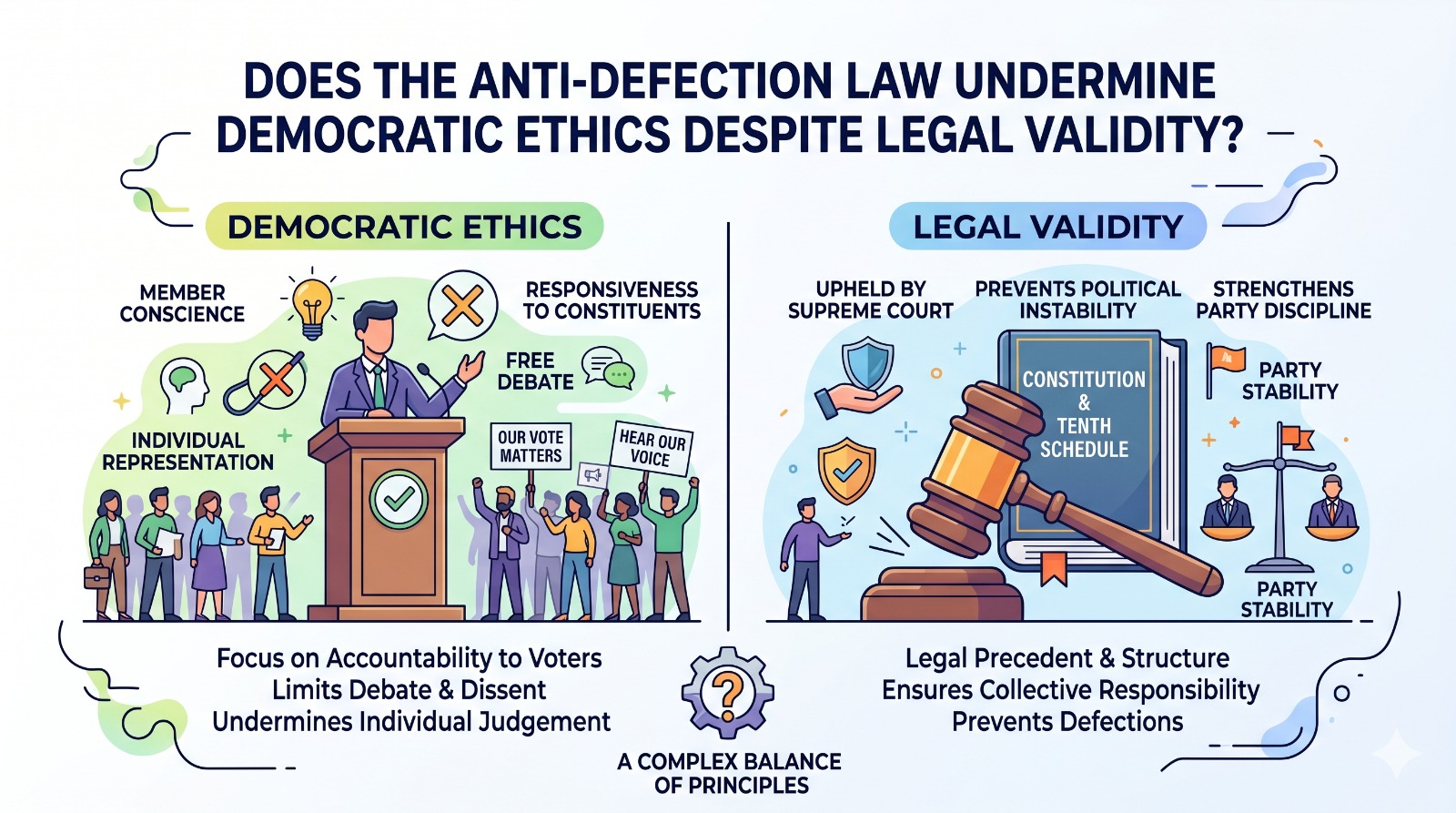
Does the Anti-Defection Law Undermine Democratic Ethics despite Legal Validity?
|
Getting your Trinity Audio player ready...
|
DEBATE
Topic: Does the Anti-Defection Law Undermine Democratic Ethics despite Legal Validity?
Motion: The Anti-Defection Law, while legally valid, undermines the fundamental democratic ethics of representative accountability and freedom of conscience.
Thesis Statement: The Anti-Defection Law, introduced through the 52nd Constitutional Amendment Act, 1985 and strengthened by the 91st Constitutional Amendment Act, 2003, seeks to ensure political stability by preventing opportunistic party-switching. While the law prevents ‘Aaya Ram Gaya Ram’ style horse-trading, it simultaneously transforms legislators into mere voting machines of their party leadership, potentially silencing the diverse voices of the electorate they represent which raises serious concerns of democratic ethics such as freedom of expression, accountability, and representative autonomy.
Side I: The Law Undermines Democratic Ethics (Opposition to the Law)
Main Idea: The law prioritizes party discipline over the representative-constituent relationship.
Opening Statement: Democratic ethics dictate that a Member of Parliament (MP) or Member of Legislative Assembly (MLA) is accountable first to the people who elected them, and then to their conscience. The Anti-Defection Law effectively breaks this bond by mandating absolute obedience to the party whip, even when the party’s stance contradicts the interests of the legislator’s constituency.
Arguments:
Stifling of Intraparty Democracy: Legislators cannot criticize or vote against their party’s flaws without risking their seats. This prevents honest debate within the house.
Erosion of Representative Accountability: If a legislator believes a party policy is detrimental to their voters, they are legally coerced into supporting it, rendering the representative element of democracy secondary to party dominance.
The Machine Legislator: It reduces the status of an MP/MLA to a data point. If the whip decides every vote, the 543 individual brains in the Lok Sabha are replaced by the collective will of 4 or 5 high-command leaders.
Reduction of Deliberative Debate: Parliamentary discussions lose depth when outcomes are predetermined by party lines rather than genuine debate.
Conclusion: By institutionalizing the ‘whip culture,’ the Tenth Schedule has sacrificed the soul of representative democracy at the altar of government stability. While the law ensures stability, it does so at the cost of democratic ethics, turning representatives into mere instruments of party authority.
Side II: The Law Upholds Democratic Ethics (Support for the Law)
Main Idea: The Anti-Defection Law protects democratic integrity by ensuring stability, preventing corruption, and respecting the mandate of the electorate.
Opening Statement: Ethics in democracy are not just about individual freedom; they are about honouring the mandate. Most legislators are elected on a party ticket, using party resources and a party manifesto. To switch sides after winning is a betrayal of the voters who chose that specific ideological platform. The Anti-Defection Law is a necessary safeguard against political opportunism and chaos.
Arguments:
Preventing Unethical Opportunism: Before 1985, governments fell frequently due to ‘horse-trading’ and bribery. The law provides the ethical floor that prevents the sale of public mandates.
Party Discipline and Political Stability: For a government to fulfill its manifesto and provide governance, it needs a stable majority. The Anti-Defection law ensures that the executive can function without the constant threat of blackmail by individual defectors.
Protecting the Collective Mandate: In the Indian context, people often vote for the ‘Party’ or the ‘Prime Ministerial/Chief Ministerial face.’ Switching parties mid-term is an ethical fraud on the collective choice of the voters.
Legal Safeguard with Defined Limits: The law allows exceptions (e.g., mergers), showing that it is not entirely rigid.
Conclusion: The law ensures that the public mandate is not treated as a commodity for sale. It provides the stability required for the democratic process to yield actual results.
Rebuttals
Side I Rebuttal to Side II: Side II argues that people vote for the party. However, if that were the absolute truth, India would have a ‘List System’ like some European nations. India chose a ‘Constituency System’ specifically because it believes the value of the local representative. By making the whip supreme, we are effectively running a presidential system under the mask of a parliamentary one.
Side II Rebuttal to Side I: Side I claims legislators are silenced. Yet, the law only penalizes voting against the whip, not speaking in the house. More importantly, the ‘freedom of conscience’ Side I speaks of was historically used as a shield for corruption. Ethical dissent is rare; defection for office was the norm before this legal check was implemented.
Final Synthesis
The Anti-Defection Law represents a classic paradox between stability and freedom in a democracy. Legally, it is a robust framework validated by the Supreme Court in the Kihoto Hollohan (1992) case, deemed necessary for the health of the body politic while Ethically, it creates a Representative Gap.
In essence, the law does not need abolition, but refinement. Most experts (including the Dinesh Goswami Committee) suggest that the Whip should only apply to No-Confidence Motions or Money Bills where the government’s survival is at stake. For all other legislative business, the legislator should be free to vote according to their conscience and the needs of their constituency. This would balance the Side II need for stability with the Side I demand for democratic accountability.