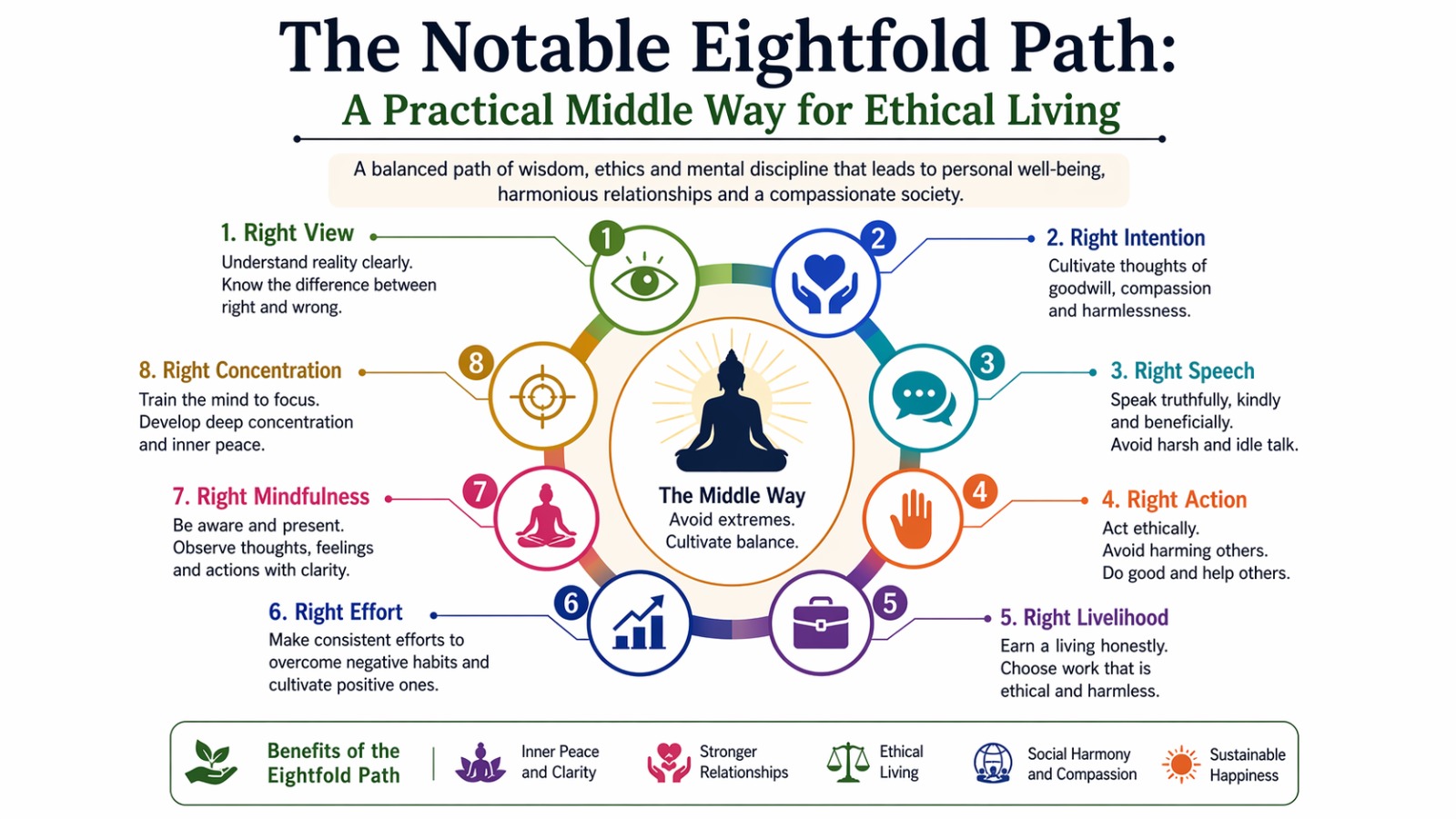
The Notable Eightfold Path: A Practical Middle Way for Ethical Living
OPINION
Within the rich tapestry of ancient Indian philosophy, Buddhism emerged not merely as a metaphysical doctrine, but as a profoundly practical framework for alleviating human suffering. At the heart of this pragmatism lies the Noble Eightfold Path (Arya Ashtanga Marga). Formulated by Siddhartha Gautama, the Buddha over two millennia ago, this path serves as the prescriptive climax of his foundational teaching, the Four Noble Truths. It is the definitive route out of Dukkha (suffering or unsatisfactoriness) and the operational blueprint for what is known as the ‘Middle Way.’
Understanding the Middle Way
To appreciate the Eightfold Path, one must first understand the concept of the Middle Way (Madhhyamā-pratipad). Before his enlightenment, the Buddha experienced two extreme lifestyles: the sensory indulgence of a royal prince and the severe, self-mortifying asceticism of a wandering monk. He found both extremes to be dead ends. Complete indulgence binds the mind to fleeting desires, while severe asceticism weakens the body without liberating the spirit.
The Middle Way is not a tepid compromise between two extremes, but a dynamic, harmonious point of balance. It is a practical, grounded approach to living that emphasizes clarity, sustainability, and profound ethical integrity. The Noble Eightfold Path is the step-by-step application of this Middle Way in daily life.
The Noble Eightfold Path forms the fourth of the Buddha’s Four Noble Truths
The Noble Eightfold Path forms the fourth of the Buddha’s Four Noble Truths. After diagnosing suffering (dukkha), identifying its cause (craving and ignorance), and affirming its end (nirvana), the Buddha prescribed this practical path as the method to achieve liberation.
Far from being abstract philosophy, it is a holistic way of life that integrates thought, speech, action, and awareness into daily existence. Its eight factors are traditionally grouped into three categories: Paññā (wisdom), Sīla (ethical conduct), and Samādhi (mental discipline).
First Pillar ‘Prajna’: The Pillar of Wisdom
Wisdom in the Buddhist context is not about accumulating intellectual knowledge, but developing a profound understanding of the true nature of reality. The path begins with Right View (Samyak Drishti) and Closely linked with Right Intention (Samyak Sankalpa)
Right View (Samyak Drishti): This is the cognitive foundation of the path. It involves understanding reality as it actually is, free from delusion. Practically, it means internalizing the Four Noble Truths, recognizing the law of Karma (cause and effect), and accepting the fundamental impermanence (Anicca) of all things. Without Right View, our actions are guided by ignorance and misperception.
Right Intention (Samyak Sankalpa): While Right View identifies the destination, Right Intention provides the fuel to get there. It is the conscious commitment to ethical and mental self-improvement. It requires renouncing harmful desires, cultivating goodwill, and developing harmlessness (Ahimsa) toward all living beings.
Second Pillar ‘Sila’: The Pillar of Ethical Conduct
Buddhism posits that an unquiet, guilt-ridden mind cannot achieve peace. Therefore, strict ethical conduct is the prerequisite for spiritual progress. Sila guides how we interact with the external world and our fellow beings.
Right Speech (Samyak Vak): The Buddha emphasized the immense power of words to heal or harm. Right Speech dictates abstaining from lying, divisive speech (slander), abusive or harsh language, and idle chatter or gossip. Instead, words should be truthful, unifying, gentle, and meaningful.
Right Action (Samyak Karmanta): This fold governs our physical deeds. It calls for abstaining from taking life (non-violence), abstaining from taking what is not given (non-stealing), and abstaining from sexual misconduct. It is a call to act with compassion, honesty, and respect for the bodily autonomy and property of others.
Right Livelihood (Samyak Ajiva): Acknowledging that we spend a vast portion of our lives working, the Buddha taught that one’s profession must not violate ethical principles. Right Livelihood means earning a living in a way that does not cause harm or exploit others. Traditionally, this meant avoiding trades involving weapons, living beings (slavery or slaughter), intoxicants, and poisons.
Third Pillar ‘Samadhi’: The Pillar of Mental Discipline
Ethical conduct clears the path, but mental discipline is required to walk it. The human mind, left unchecked, is inherently restless. Samadhi practices train the mind to be a focused, stable, and highly tuned instrument.
Right Effort (Samyak Vyayama): This is the active, continuous exertion of the will. It involves a fourfold effort: preventing the arising of unwholesome states of mind, abandoning unwholesome states that have already arisen, cultivating wholesome states that have not yet arisen, and maintaining wholesome states that are already present.
Right Mindfulness (Samyak Smriti): Mindfulness is the anchor of Buddhist practice. It is the diligent, non-judgmental observation of the present moment. Right Mindfulness requires constant awareness of the body, feelings, states of mind, and mental phenomena. By observing our impulses without immediately reacting to them, we break the cycle of automatic, habitual behaviour.
Right Concentration (Samyak Samadhi): This is the practice of deep, focused meditation. By unifying the mind on a single object (such as the breath), the practitioner achieves deep states of mental absorption. Right Concentration cuts through surface-level distractions, providing the profound stillness required for true wisdom to emerge.
A Living Philosophy
The Noble Eightfold Path stands as one of Indian philosophy’s most enduring contributions to global thought. It strips away the necessity of blind faith, dogma, and esoteric rituals, offering instead a psychological and ethical toolkit accessible to anyone. By harmonizing our understanding, our actions, and our minds, the Eightfold Path proves that the Middle Way is not just a theoretical philosophical concept, but a highly effective, living practice for navigating the complexities of the human experience.