Right to Health: A Constitutional Right Under Article 21
|
Getting your Trinity Audio player ready...
|
ARTICLE
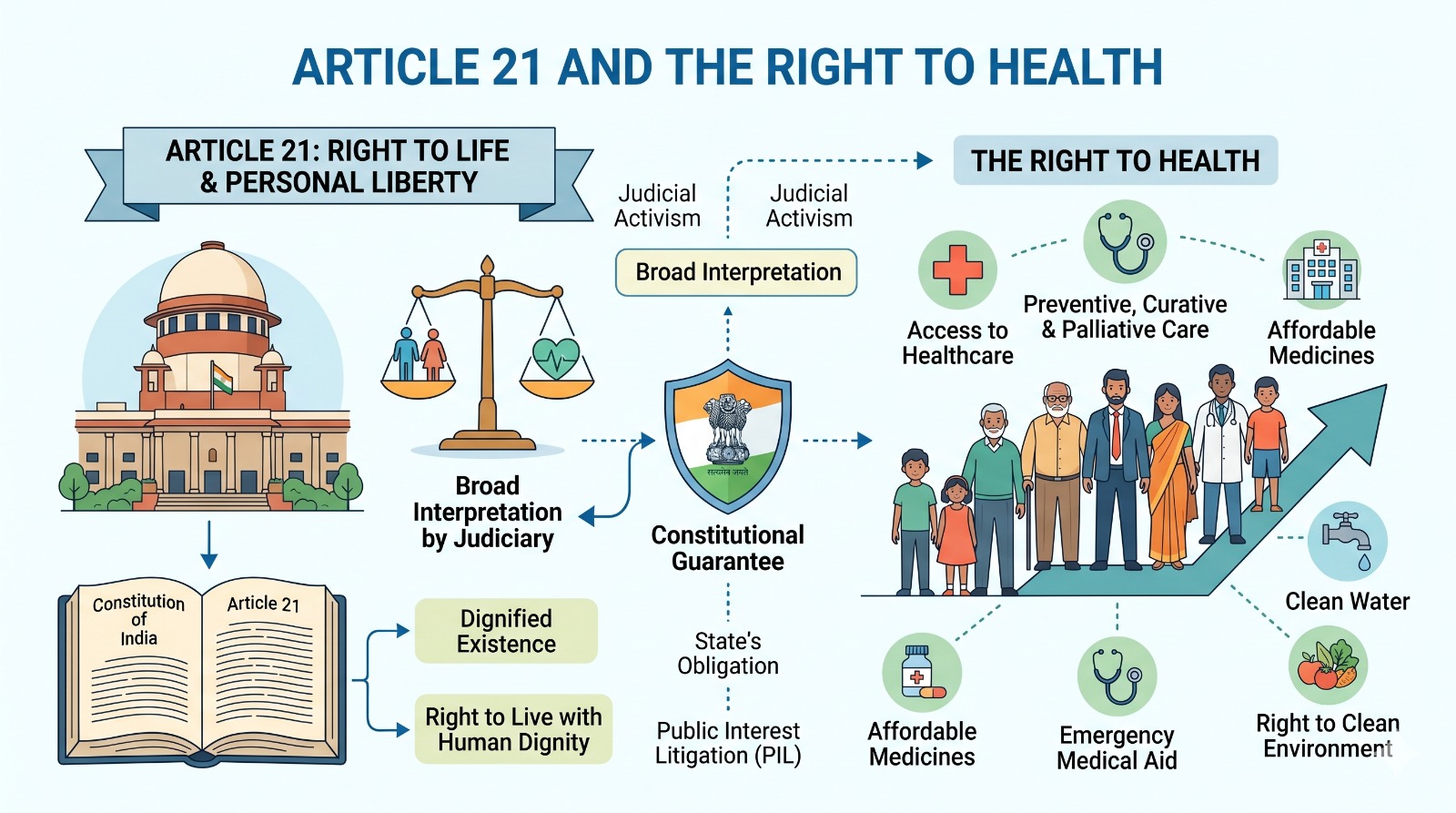
Article 21 of the Indian Constitution is arguably the most dynamic provision in the world’s longest written constitution. It states: “No person shall be deprived of his life or personal liberty except according to procedure established by law.” While a literal reading might suggest a mere protection against the unlawful deprivation of physical existence, the Indian Judiciary, through decades of judicial activism, has infused this Right to Life with qualitative meaning. In the eyes of the Supreme Court, ‘life’ is not merely animal existence; it includes the right to live with human dignity and all that goes along with it foremost among these being the Right to Health. As India aspires to developed nation status by 2047, the Right to Health under Article 21 stands as both a constitutional promise and a persistent challenge.
Journey of Right to Health
During the Pre-Activism Phase (1950s–1970s), the Right to Health was primarily conceptualized as a non-justiciable social goal rather than an enforceable fundamental right, as it was strictly confined to the Directive Principles of State Policy (Part IV) of the Constitution. Within this framework, Article 47 designated the ‘improvement of public health’ as a primary duty of the State, while Articles 39(e) and 42 addressed specific concerns regarding the health of workers and the provision of maternity relief.
However, because these provisions fell under Part IV, they were treated as moral obligations and guiding principles for governance rather than legal rights that could be vindicated in a court of law. During this era, if the State failed to establish a hospital or provide adequate medical infrastructure, citizens lacked the constitutional standing to sue for a violation of their rights, as the judiciary had not yet expanded Article 21 to encompass the qualitative aspects of life and human dignity.
During the Interpretative Revolution of the 1980s, the constitutional landscape of India underwent a seismic shift as the Judiciary began expanding the scope of Article 21 beyond mere physical existence to encompass the broader concept of personal liberty. This era was defined by the landmark ruling in Francis Coralie Mullin v. Union Territory of Delhi (1981), where Justice Bhagwati famously articulated that the ‘Right to Life’ inherently includes the right to live with human dignity and all that accompanies it, such as adequate nutrition, clothing, and shelter. The judicial logic was clear: a dignified life is impossible without the preservation of health, thereby transforming health from a secondary policy goal into a core fundamental right.
This period also saw the Court pioneering the link between health and the environment, most notably through the M.C. Mehta series of public interest litigations, where it was ruled that the right to health is fundamentally compromised by environmental degradation. By establishing that clean air and water are essential subsets of the Right to Life, the Judiciary effectively created a holistic constitutional framework where the State became legally accountable for the environmental factors that impact the physical well-being of its citizens.
The era of Rights-Based Realism (1990s–2010s) marked a critical transition in Indian constitutional law, shifting the Right to Health from abstract philosophical discourse into a framework of concrete State liability and enforceable legal obligations. This period was anchored by the landmark judgment in Paschim Banga Khet Mazdoor Samity v. State of West Bengal (1996), where the Supreme Court ruled that the denial of emergency medical treatment by a government hospital due to a lack of beds constitutes a direct violation of Article 21, effectively making healthcare an absolute and enforceable right in life-threatening situations. Simultaneously, the Judiciary expanded this protection to the industrial sphere in Consumer Education and Research Centre v. Union of India (1995), declaring that the right to health and medical care is a fundamental right for workers.
By holding that occupational health is an essential prerequisite for making a worker’s ‘life meaningful,’ the Court established that the State and employers bear a positive duty to protect the physical well-being of the labour force. Together, these decisions bridged the gap between theory and practice, ensuring that the Right to Life under Article 21 imposes a mandatory financial and administrative burden on the State to provide basic medical infrastructure.
Entering The Modern Frontier of Holistic and Mental Health (2020–2026), the constitutional interpretation of the Right to Health has transcended the mere absence of physical disease to encompass a comprehensive state of well-being. This evolution was accelerated by the Pandemic Shift, during which the COVID-19 crisis compelled the Judiciary to recognize that the Right to Health under Article 21 inherently includes access to affordable treatment and universal vaccination.
By treating healthcare as a ‘public good’ rather than a market commodity, the courts established that the State has a positive obligation to protect citizens from biological threats.
Furthermore, as of 2026, the legal landscape has reached a new milestone with the explicit integration of Mental Health into the fundamental Right to Life. Recent landmark rulings emphasize that the State must provide robust psychological support systems and ‘stigma-free’ healthcare environments, acknowledging that mental infirmity and psychological distress constitute as much a deprivation of a ‘meaningful life’ as physical illness.
This contemporary phase marks a shift toward a truly holistic jurisprudence where the sanctity of life is protected across both its physical and mental dimensions.
The Gap Between Doctrine and Reality
The gap between the constitutional doctrine of the Right to Health under Article 21 and its practical reality remains a significant hurdle in India’s legal landscape, often rendering the right a ‘paper promise’ for the marginalized. While the Judiciary has established a robust framework of State liability mandating emergency care in Paschim Banga Khet Mazdoor Samity (1996) and expanding the right to include menstrual hygiene in Dr. Jaya Thakur v. UOI (2026) implementation is hindered by a regressive financing architecture where out-of-pocket expenditure (OOPE) still remains a staggering 39.4% of total health spending according to PIB data (March 2026). This financial burden creates a dual constitutionalism where survival is contingent on socioeconomic status; medical shocks push millions into poverty annually, with Union Budget 2026 figures revealing that public health spending still lingers well below the 2.5% of GDP target set by the National Health Policy 2017.
Furthermore, there is a persistent mismatch between judicial mandates and administrative capacity; while the Courts declare holistic rights to mental well-being and stigma-free environments in recent rulings like Sukdeb Saha (2025), the State often lacks the underlying infrastructure, such as standardized hospital package rates or a sufficient ratio of specialized practitioners.
Additionally, despite the Clinical Establishments Act, the private healthcare sector which manages the majority of the patient load operates in a relative regulatory vacuum regarding public service obligations. Consequently, the transition from a negative right (protection from state interference) to a positive right (provision of quality healthcare) is stalled by resource constraints and a declining Union share in health spending, which fell to 0.29% of GDP in the 2025-26 estimates, leaving a vast divide between the dignity promised by the law and the survival experienced by the citizen.
Bridging the Gap and Clear The Road to Constitutional Fulfilment
Closing this doctrine-reality chasm requires multi-pronged action:
Legislative Codification: Enact a National Right to Health Act that clearly defines entitlements, creates justiciable grievance mechanisms, and regulates both public and private providers.
Fiscal Commitment: Raise public health spending to at least 2.5% of GDP by 2030, with a larger share for primary care and rural infrastructure.
Health Workforce Reform: Incentivise rural postings, expand medical education in underserved areas, and integrate AYUSH effectively.
Stronger Regulation and Public-Private Accountability: Mandate minimum standards and constitutional obligations on private providers performing public functions.
Focus on Prevention and Equity: Strengthen primary healthcare, mental health integration, and targeted interventions for vulnerable groups.
Federal Cooperation: Use the Inter-State Council and Finance Commission mechanisms to reduce regional disparities.
While the State still argues financial constraint, the Courts have increasingly held that budgetary issues cannot justify the total denial of basic health rights.