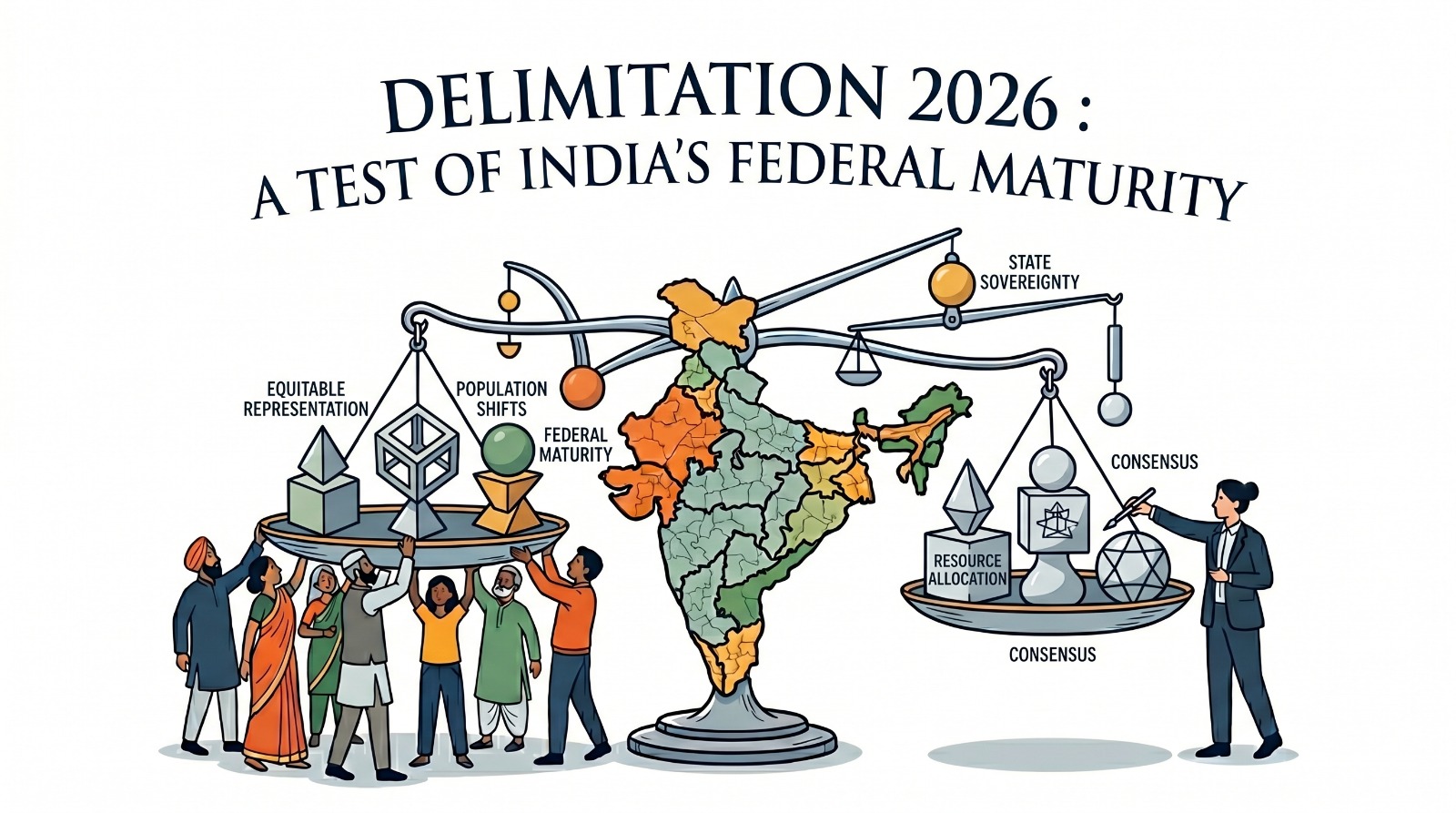
Delimitation 2026: A Test of India’s Federal Maturity
|
Getting your Trinity Audio player ready...
|
BLOG
In the grand theatre of Indian democracy, few exercises are as consequential or as contentious as the redrawing of electoral boundaries. As 2026 approaches, India stands at a constitutional crossroads. The Constitution (131st Amendment) Bill, 2026, along with the Delimitation Bill, introduced in mid-April, sought to expand the Lok Sabha from 543 to approximately 850 seats and enable fresh boundary redrawing. Though the amendment bill was defeated in the Lok Sabha on April 17, failing to secure the required two-thirds majority, the debate it unleashed has laid bare deep fault lines in Indian federalism. Whether the exercise proceeds via fresh consensus or is deferred, it remains a profound test of the nation’s ability to balance demographic equity with regional trust and cooperative federalism.
The Genesis of the Freeze (1976–2026)
To understand the gravity of 2026, one must look back to 1976. During the Emergency, the 42nd Amendment froze the allocation of Lok Sabha seats based on the 1971 Census. The logic was clear: states that successfully implemented family planning programs should not lose political weight to states with runaway population growth. This freeze was extended for another 25 years by the 84th Amendment (2001), pushing the day of reckoning to the first census after 2026.
The 42nd Amendment (1976): During the Emergency, the government froze seat allocation until the year 2000. The objective was to ensure that states successfully implementing family planning (primarily in the South) were not penalized with fewer seats compared to states with higher fertility rates (primarily in the North).
The 84th Amendment (2001): As the 2000 deadline approached, the Atal Bihari Vajpayee government extended this freeze for another 25 years. It stipulated that the first census conducted after 2026 would be the basis for the next seat readjustment.
The Status Quo: Consequently, while the boundaries within states were redrawn in 2002-08 (based on the 2001 census), the total number of seats per state has remained unchanged for over 50 years.
The 2026 Legislative Flashpoint
As of April 2026, the legislative landscape has become incredibly dynamic. The government recently introduced a ‘triple-bill’ package to resolve this:
The Constitution (131st Amendment) Bill, 2026: This landmark bill sought to increase the Lok Sabha’s capacity from 543 to 850 seats. It also proposed decoupling the 2026 exercise from the ‘first census after 2026’ (which would be 2031) and allowing the 2011 Census (or the ongoing 2026 Census data) to be used immediately.
The Delimitation Bill, 2026: Aimed at establishing a new Commission with the mandate to redraw the entire national map.
The Women’s Reservation Linkage: A critical constitutional caveat of the 106th Amendment (2023) is that the 33% reservation for women can only be implemented after a fresh delimitation.
Current Status (April 2026): The 131st Amendment Bill recently failed to pass in the Lok Sabha (falling short of the required two-thirds majority). This has created a constitutional stalemate, as the opposition and southern states argue that the bill was a ‘smokescreen’ to shift political power toward the North before the full Census 2026 data is even ready.
The Demographic Divergence: A Tale of Two Indias
The looming 2026 Delimitation exercise is frequently described as a ‘Tale of Two Indias.’ On one side is the North, a region characterized by a high demographic weight and a younger, growing population. On the other is the Southern states (Tamil Nadu, Kerala, Karnataka, Andhra Pradesh, and Telangana) have emerged as the engines of India’s economic growth and social development.
The Southern states argue that they followed national family planning goals and invested in human capital (education and health), only to be threatened with reduced political influence and pointed as ‘Performance Penalty.’
Economic Contribution: The five Southern states contribute roughly 30% of India’s GDP despite having only 20% of the population.
Fiscal Friction: There is a fear that a North-dominated Parliament will use its legislative might to divert more tax resources (GST) from the ‘performing’ South to the ‘populous’ North, leading to a permanent state of Taxation without (proportional) Representation.
The divergence is not just about seats; it’s about identity, but also of linguistic divide and political schism. Southern states fear that a massive increase in North Indian representation will lead to the imposition of Hindi as a primary national language, overriding the linguistic diversity of the Peninsula. Similarly, the ruling national parties have high strike rates in the North, while regional parties remain dominant in the South. Delimitation is seen by some as an attempt to redesign the electoral map to favour centralized national parties over regional aspirations.
Leaders like Tamil Nadu Chief Minister M.K. Stalin and others have warned of a deepening North-South divide. Shashi Tharoor described aspects of the proposal as ‘political demonetisation’ of southern voices. Beyond seats, concerns extend to future Finance Commissions, resource allocation, and the ability to shape national priorities. If Parliament tilts heavily northward, policies may increasingly reflect high-population, developing-region realities at the expense of efficient governance models pioneered in the South.
The 2026 Legislative Pivot
The introduction of the Delimitation Bill 2026 and the 131st Constitutional Amendment Bill has shifted the goalposts. Recognizing that stripping seats from the
South would be political suicide and a federal disaster, the government has proposed an expansion of the Lok Sabha potentially up to 816 or 850 seats.
The argument is that by increasing the total pool, every state can see its absolute number of seats rise. However, the relative share remains the point of friction. Even if Tamil Nadu goes from 39 to 59 seats, its percentage of the total House will likely fall, whereas Uttar Pradesh’s share would swell. This shift in relative power affects the election of the President, the passage of constitutional amendments, and the weight of regional voices in national policy.
Northern Imperatives and National Equity
From the northern perspective, perpetual freezing of seats defies democratic logic. Uttar Pradesh alone has a population exceeding many countries, yet its representation remains capped. Equitable ‘one person, one vote’ demands readjustment. Proponents argue that expansion mitigates losses and that national unity requires acknowledging current demographics rather than rewarding past performance indefinitely. Ignoring this risks breeding resentment in the Hindi heartland, which constitutes a significant share of India’s electorate.
Federalism on Trial
India’s Constitution envisions a ‘Union of States’ with a strong Centre — quasi-federal in design. This framework has served nation-building well but now faces stress in a mature, economically divergent democracy. Delimitation intersects with multiple tensions: the end of GST compensation (exposing fiscal strains), frequent Governor-state conflicts, shrinking divisible tax pool due to cesses, and centralisation in subjects like education and agriculture.
A mishandled delimitation could erode the spirit of cooperative federalism. Southern disenchantment might fuel demands for greater autonomy, alternative alliances, or
fiscal renegotiation. Conversely, blocking necessary reform could undermine democratic legitimacy. The defeat of the bill demonstrates federal checks in action but also highlights the absence of consensus-building mechanisms.
Charting a Mature Path
True federal maturity demands moving beyond binaries. Several principled options exist:
- Adopt hybrid criteria for seat allocation, incorporating population alongside GDP contribution, human development indices, and fertility performance.
- Pursue further House expansion or strengthen the Rajya Sabha as a federal chamber.
- Establish a broad-based Delimitation Commission with regional representation, judicial oversight, and transparent methodology.
- Link the exercise explicitly to the upcoming Census (expected 2027) for updated, credible data.
Dialogue between the Centre and states, possibly through an empowered Inter-State Council, is essential. Political leadership must demonstrate statesmanship reassuring the South on equity while addressing northern aspirations for representation.
Bridging the Divide: Potential Frameworks
To prevent the ‘Two Indias’ from drifting further apart, experts suggest moving toward a ‘Grand Federal Bargain’ during the post-2026 negotiations:
The US Senate Model: Reforming the Rajya Sabha to give equal seats to every state (e.g., 5 or 10 seats per state) regardless of size, acting as a true federal counterweight to the population-heavy Lok Sabha.
Weighted Representation: Using a formula that balances population with ‘Demographic Performance’ (rewarding states that met TFR goals).
The ‘Grandfather Clause’: Adopting a model like Canada’s, where a state is constitutionally guaranteed never to have fewer seats than it had in a baseline year (e.g., 1976).
Principle of Unity in Diversity: The Federal Maturity Stress Test
The 2026 delimitation is not just an administrative task; it is an existential question for the Indian Republic. If the process is seen as a ‘victory’ for the North and a ‘punishment’ for the South, it will damage the social contract that binds the union.
Federal maturity requires the North to recognize that the South’s development is a national asset, not a reason for political divestment. Conversely, it requires the South to acknowledge that the principle of ‘one person, one vote’ is the bedrock of democracy.
In essence, Unity in Diversity in 2026 is less about shared culture and more about equitable power-sharing. The central tension lies in the fact that southern and northeastern states have stabilized their populations (achieving ‘Diversity’ in developmental success), while northern states continue to grow (creating ‘Unity’ in sheer demographic weight). The path forward lies in a consensus-based expansion. By decoupling seat allocation from pure population and rewarding states for social responsibility, India can turn a potential crisis into an opportunity to modernize its democracy. Therefore, the ‘test of maturity’ for India lies in proving that National Unity does not require Regional Uniformity. To pass this test, the 2026 Delimitation must be more than a census-cleansing exercise; it must be a ‘Grand Federal Bargain’ that constitutionally protects the political share of states that have contributed most to the nation’s human development.