Can Gandhian Ideals Deliver Ethical Governance in the 21st Century?
The 21st century is defined by a paradox: we possess unprecedented technological tools for connectivity, yet we face a global crisis of institutional trust, rising socio-economic fragmentation, and the dehumanizing potential of a post-truth landscape. Governance in the modern era has largely evolved into a technocratic exercise in efficiency and data management. However, as the gap between the rulers and the ruled widens, there is a burgeoning realization that administrative efficiency is not a substitute for moral legitimacy.
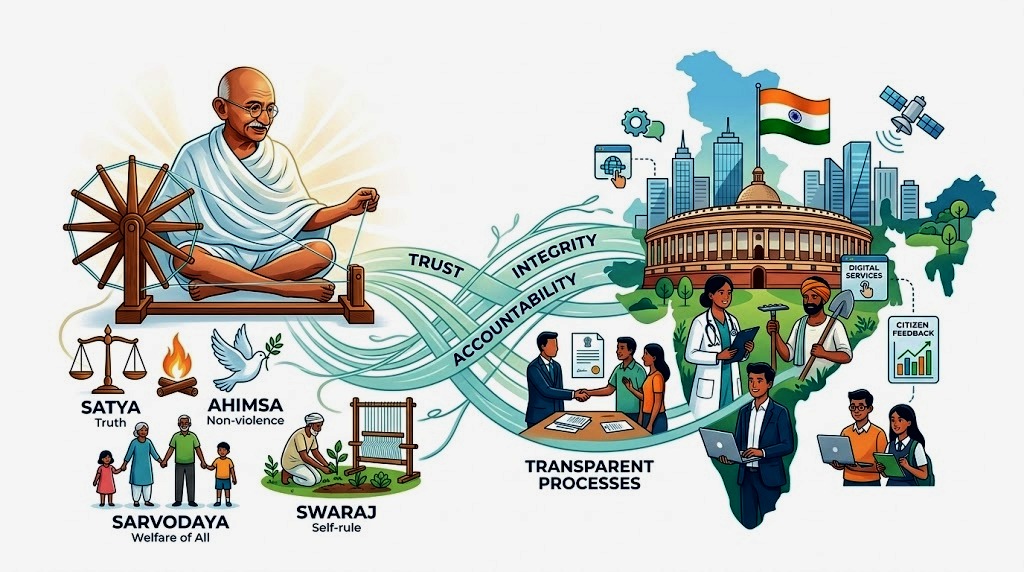
In this context, the timeless principles of Mahatma Gandhi—anchored in Truth (Satya), Non-violence (Ahimsa), and the Welfare of All (Sarvodaya)—offer a profound ethical compass. Far from being a nostalgic retreat into a pre-industrial past, Gandhian ideals provide a sophisticated, human-centric framework for navigating the complexities of 21st-century power, ensuring that the Last Person remains the primary beneficiary of public policy.
The Talisman as a Decision-Making Tool
At the heart of Gandhian ethics lies his famous Talisman. Gandhi suggested that whenever a public official is in doubt, they should recall the face of the poorest and weakest person they have seen and ask if the step they contemplate is going to be of any use to that person.
In the 21st century, where Big Data and Algorithms often abstract human suffering into statistical trends, the Talisman acts as a vital corrective. It shifts the focus from utilitarianism (the greatest good for the greatest number) to Antyodaya (the upliftment of the last person). For a modern administrator, this means ensuring that a digital initiative does not exclude those without access to technology. The Talisman transforms public service from a bureaucratic exercise into a moral mission.
The Pillar of Satya: Institutionalizing Transparency in a Post-Truth Era
Gandhi’s obsession with Satya (Truth) was not merely a spiritual pursuit; it was a functional requirement for a healthy polity. To Gandhi, truth was the bedrock of the Soul-Force. In the current digital age, characterized by deepfakes, algorithmic bias, and misinformation, the transparency deficit has become the greatest threat to democracy.
Ethical governance in the 21st century must move beyond mere compliance to Radical Honesty. This involves strengthening mechanisms like the Right to Information (RTI) and open-data policies. When a government prioritizes transparency over political convenience, it embodies the Gandhian ideal of Satyagraha —the pursuit of truth as a force for change. In the digital realm, this translates to protecting the integrity of information and ensuring that the relationship between the state and the citizen is built on verified facts and honest intent rather than curated perceptions.
Antyodaya: The Ethical Metric of Success
The standard metric for 21st-century progress is often GDP growth or stock market indices. However, these figures frequently mask the widening chasm between the elite and the marginalized. Gandhi’s concept of Sarvodaya (Universal Uplift) and Antyodaya (Uplift of the Last) shifts the goalposts of success. Governance is truly ethical only when its primary focus is the welfare of the most vulnerable.
Public policy today, such as Direct Benefit Transfers (DBT), universal health coverage, and the Housing for All initiatives, mirrors the Gandhian mandate: “Recall the face of the poorest person you have seen… and ask yourself if the step you contemplate is going to be of any use to him.” This talisman remains the gold standard for distributive justice. By integrating Antyodaya into the design of modern welfare states, governments ensure that technological advancements like Artificial Intelligence do not become tools of further exclusion, but rather bridges for empowerment.
Gram Swaraj and the Decentralisation of Power
Gandhi’s vision of Gram Swaraj (Village Self-Rule) was a warning against the dangers of over-centralized power. He believed that democracy is hollow if it is only exercised once every five years at a national level. Ethical governance requires the devolution of power to the grassroots not just as an administrative convenience, but as a moral imperative.
In the 21st century, the spirit of Gram Swaraj finds new life in Digital Decentralisation. Through e-governance and local digital hubs, the Global Village can achieve local self-reliance (Atmanirbhar). When a village panchayat can manage its own water resources via IoT sensors, track its own health data, and govern its school system through local transparency, it achieves the Gandhian ideal of an empowered, self-governing unit. True ethical governance ensures that the periphery becomes the center of decision-making.
Trusteeship: A Moral Blueprint for Corporate and State Power
Modern corporations and governments wield power equivalent to many nations, yet the pursuit of Shareholder Value or Political Survival often leads to social exploitation. Gandhi’s Doctrine of Trusteeship offers a radical alternative. He proposed that the wealthy and powerful are not owners of their resources, but “trustees” of wealth that ultimately belongs to society.
This has evolved into the modern concepts of Corporate Social Responsibility (CSR) and ESG (Environmental, Social, and Governance) standards. However, Gandhian Trusteeship goes deeper, it suggests a fundamental shift in identity where the state and businesses see themselves as social institutions. An ethical state in the 21st century is one that encourages this Moral Capitalism, where wealth creation is inseparable from social stewardship and environmental sustainability.
Simplicity (Aparigraha) and Planetary Ethics
The 21st century is defined by the existential threat of climate change, fueled by a culture of hyper-consumption. Gandhi’s principle of Aparigraha (Non-possession/Simplicity) living so that others may simply live is no longer a spiritual choice but a planetary necessity.
Ethical governance must transition from a model of unlimited growth to sustainable development. This involves policies that promote circular economies, carbon neutrality, and the protection of common resources. By adopting the Gandhian lens of need over greed, modern states can address the ecological crisis through the lens of intergenerational justice, ensuring that the rights of future citizens are not sacrificed at the altar of current consumption.
The Seven Social Sins: A Diagnostic Tool for Policy
Gandhi identified seven sins that lead to social collapse, which serve as an excellent diagnostic checklist for modern policymakers:
- Politics without Principles: Populism and opportunistic alliances.
- Wealth without Work: Speculative bubbles and predatory lending.
- Commerce without Morality: Data exploitation and unethical tech practices.
- Knowledge without Character: The potential for AI and biotechnology to be used as weapons.
Ethical governance in the 21st century involves creating a regulatory environment where character and morality are integrated into the Knowledge Economy, ensuring that innovation is always guided by human values.
The Path Forward
Gandhian ideals are often dismissed as idealistic or too difficult for the pragmatic world of 21st-century administration. However, the crises of our time from the erosion of democratic values to the looming climate catastrophe suggest that our current pragmatic systems are facing significant challenges.
The integration of Gandhian ethics into public service does not require us to abandon technology or return to a pre-industrial age. Rather, it requires us to humanize the machine. It asks the modern administrator to be a Karma Yogi one who performs their duty with excellence but without attachment to personal ego.
Ultimately, Gandhian ideals deliver ethical public services by shifting the definition of success. Success is no longer just the completion of a project or the meeting of a budget; it is the restoration of dignity to the citizen. In the complex landscape of the 21st century, Gandhi remains a deeply relevant thinker, providing the moral compass necessary to navigate the storms of governance with integrity, empathy, and truth.