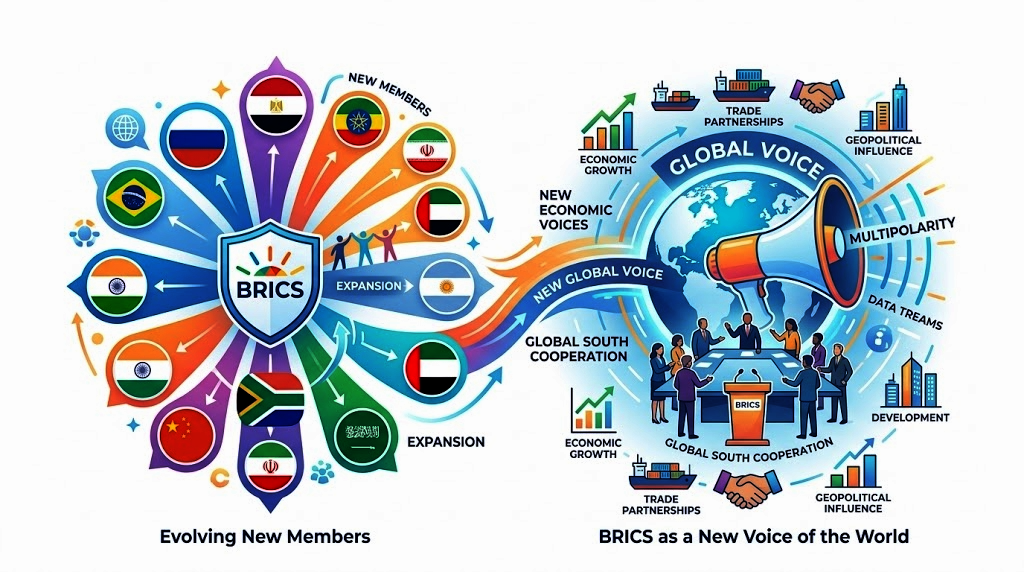
Evolving New Members: BRICS as a New Voice of the World
|
Getting your Trinity Audio player ready...
|
ARTICLE
For decades, the architecture of global governance has been anchored in the institutions created in the wake of World War II. The International Monetary Fund (IMF), the World Bank, and the United Nations Security Council (UNSC) have traditionally reflected a Western-centric geopolitical reality. However, the economic and political center of gravity has been shifting southward and eastward. At the forefront of this historic realignment is BRICS, an acronym that began as a Goldman Sachs investment thesis in 2001 but has since evolved into one of the most formidable geopolitical and economic blocs of the twenty-first century.
With its recent expansions, BRICS is no longer just a loose coalition of emerging markets; it has transformed into a institutionalized platform representing the Global South. By evolving new members, BRICS is actively positioning itself as a new voice of the world, challenging traditional hegemonies and advocating for a multipolar global order.
The Context of Expansion: Beyond the Original Five
To understand the significance of the BRICS-Plus era, one must examine the motivations of both the founding members and the aspiring applicants. The original core represented a diverse mix of economic powerhouses and regional leaders united by a shared grievance: the systemic underrepresentation of developing nations in Bretton Woods institutions.
The decision to expand, formalized at the Johannesburg Summit in August 2023 and operationalized through 2024 and beyond, marked a turning point. By admitting countries from the Middle East and Africa, BRICS deliberately transformed itself from a select club of emerging economies into a geopolitically diverse coalition.
The Strategic Drivers of Expansion
The decision to incorporate new members was neither accidental nor purely symbolic; it was driven by a convergence of shared grievances and strategic alignments among developing nations.
- The Quest for Multipolarity: The primary ideological glue binding the expanded BRICS is the desire for a multipolar world order. For many nations in the Global South, the current international system feels exclusionary. Decisions regarding global finance, sanctions, and security are frequently made in Western capitals with little consultation from the rest of the world. By expanding its ranks, BRICS creates a more representative platform where developing nations have a genuine say in global rule-making.
- Economic Diversification and De-dollarization: The weaponization of the US dollar through unilateral sanctions has sent shockwaves through emerging economies. Countries like Iran and Russia face direct Western sanctions, while nations in Africa and the Middle East watch with growing unease. The expanded BRICS network provides a framework for accelerating local currency trade. By reducing reliance on the greenback, member states seek to shield their economies from American monetary policy fluctuations and geopolitical leverage. The inclusion of major energy exporters like the UAE and Iran drastically alters the economics of global energy trade, opening the door for pricing oil and gas in currencies other than the dollar.
- Institutional Dissatisfaction: For years, emerging powers like India and Brazil have advocated for reforms within the UN Security Council and the IMF to reflect contemporary economic realities. These efforts have largely stalled due to institutional inertia. BRICS expansion serves as a direct response to this gridlock. If traditional institutions will not reform to give the Global South a seat at the table, the Global South will build its own table.
Analysing the New Entrants: Geopolitical and Strategic Value
The strategic expansion of BRICS incorporating pivotal regional heavyweights like Iran, Egypt, Ethiopia, the United Arab Emirates, and Indonesia marks a structural transformation in global governance. It shifts the bloc from an alternative economic club to a formidable counterweight to Western-led multilateralism.
Geopolitically, this enlargement fundamentally rewrites the arithmetic of global influence. By integrating Egypt and Ethiopia, the bloc consolidates its footprint across the crucial maritime trade arteries of the Suez Canal and the Bab-el-Mandeb strait. Meanwhile, the entry of Southeast Asia’s largest economy, Indonesia, projects the group’s diplomatic and economic weight deeply into the Indo-Pacific.
Strategically, the inclusion of primary energy powerhouses like the UAE, alongside regional giants, creates an unprecedented concentration of critical resource controllers within a single alignment. This gives the expanded configuration immense leverage over global energy security, supply chains, and infrastructure networks. Furthermore, the diverse geopolitical orientations of these new entrants enhance the bloc’s legitimacy as the definitive voice of a multi-aligned Global South, accelerating the transition toward a genuinely multipolar world order.
Rather than acting as a rigid, anti-Western alliance, the bloc operates as a flexible platform for non-Western states to hedge against economic vulnerability. By actively championing de-dollarization through local currency trade settlements and expanding the institutional reach of the New Development Bank, the newcomers fortify a financial architecture insulated from unilateral Western sanctions.
BRICS as the Voice of the Global South
With its expanded membership, BRICS can legitimately claim to represent a staggering cross-section of humanity. The bloc now accounts for more than 40% of the world’s population and commands a share of global Gross Domestic Product (GDP) based on Purchasing Power Parity (PPP) that surpasses that of the G7.
This economic weight gives the group unprecedented leverage on the international stage. BRICS is no longer just a forum for economic cooperation; it has evolved into a normative force. On issues ranging from climate finance and sustainable development to global health and digital sovereignty, BRICS champions the interests of nations that have long felt sidelined.
For instance, at global climate summits, BRICS members consistently advocate for the principle of Common but Differentiated Responsibilities (CBDR). They argue that while climate change is a global challenge, the historic responsibility lies with industrialized Western nations, who must provide the necessary financial and technological support to developing countries without imposing restrictive conditions.
Furthermore, during global crises such as supply chain disruptions or food shortages, the BRICS network offers alternative mechanisms for mutual aid. The inclusion of agricultural powerhouses alongside energy giants creates a self-sustaining ecosystem capable of weathering external shocks.
Internal Fault Lines: The Challenges of an Expanded Bloc
While expansion enhances the geopolitical weight of BRICS, it also introduces layers of complexity and potential fragmentation. Managing a larger, more diverse group of nations presents several systemic challenges.
Divergent Geopolitical Visions
The expanded BRICS is far from a homogenous monolith. It contains sharp ideological differences regarding how to approach the West:
- The Revisionist Camp: Countries like China, Russia, and Iran view BRICS primarily as a vehicle to actively counter Western hegemony and challenge the US-led international order.
- The Non-Aligned Camp: Nations like India, Brazil, the UAE, and South Africa favour a non-aligned, pragmatic approach. They do not wish to see BRICS become an overtly anti-Western alliance; instead, they view it as a mechanism for strategic autonomy, allowing them to maintain robust ties with both Washington and Beijing.
Balancing these contrasting philosophies will require sophisticated diplomatic navigation, particularly between traditional rivals like India and China, whose unresolved border disputes continue to simmer in the background.
Institutional Cohesion
Decision-making within BRICS operates strictly on the basis of consensus. As the number of member states grows, reaching a consensus on sensitive political and economic policies becomes inherently more difficult. The group risks becoming a talking shop similar to the Non-Aligned Movement (NAM) of the Cold War era, if it fails to translate its massive collective weight into decisive, unified action.
Future Outlook: Can BRICS Define the Next Century?
As BRICS continues to onboard new members and field dozens of additional applications, its trajectory will depend on its ability to balance institutional deepening with geographic broadening. To truly establish itself as the legitimate “New Voice of the World,” the bloc must achieve three core objectives over the coming decade:
- Institutionalize the NDB: The bank must scale up its lending capacity in local currencies, proving that it can fund large-scale infrastructure without the bureaucratic delays and political strings attached to Western capital.
- Formulate Internal Consensus: The core members must establish clear, transparent criteria for future expansion to avoid diluting the bloc’s strategic focus or turning it into an unmanageable debating society.
- Deliver Tangible Global Public Goods: BRICS must move beyond anti-Western rhetoric and deliver concrete solutions to Global South challenges, such as food security, tech sovereignty, and equitable climate transition funding.
The Future of Global World
The evolution of BRICS into an expanded, resource-rich, and demographically dominant coalition marks the definitive end of the unipolar era. It is no longer a speculative economic concept, but the primary institutional vehicle for an assertive, multi-aligned Global South.
While internal rivalries, economic disparities, and geopolitical contradictions will undoubtedly challenge its cohesion, the bloc’s fundamental premise remains incredibly potent. By offering an alternative architecture for finance, trade, and diplomacy, BRICS is successfully dismantling the monopoly of the Global North on global governance. It has emerged not merely as an alternative power bloc, but as the indispensable, long-awaited New Voice of the World one that the West can no longer afford to ignore.