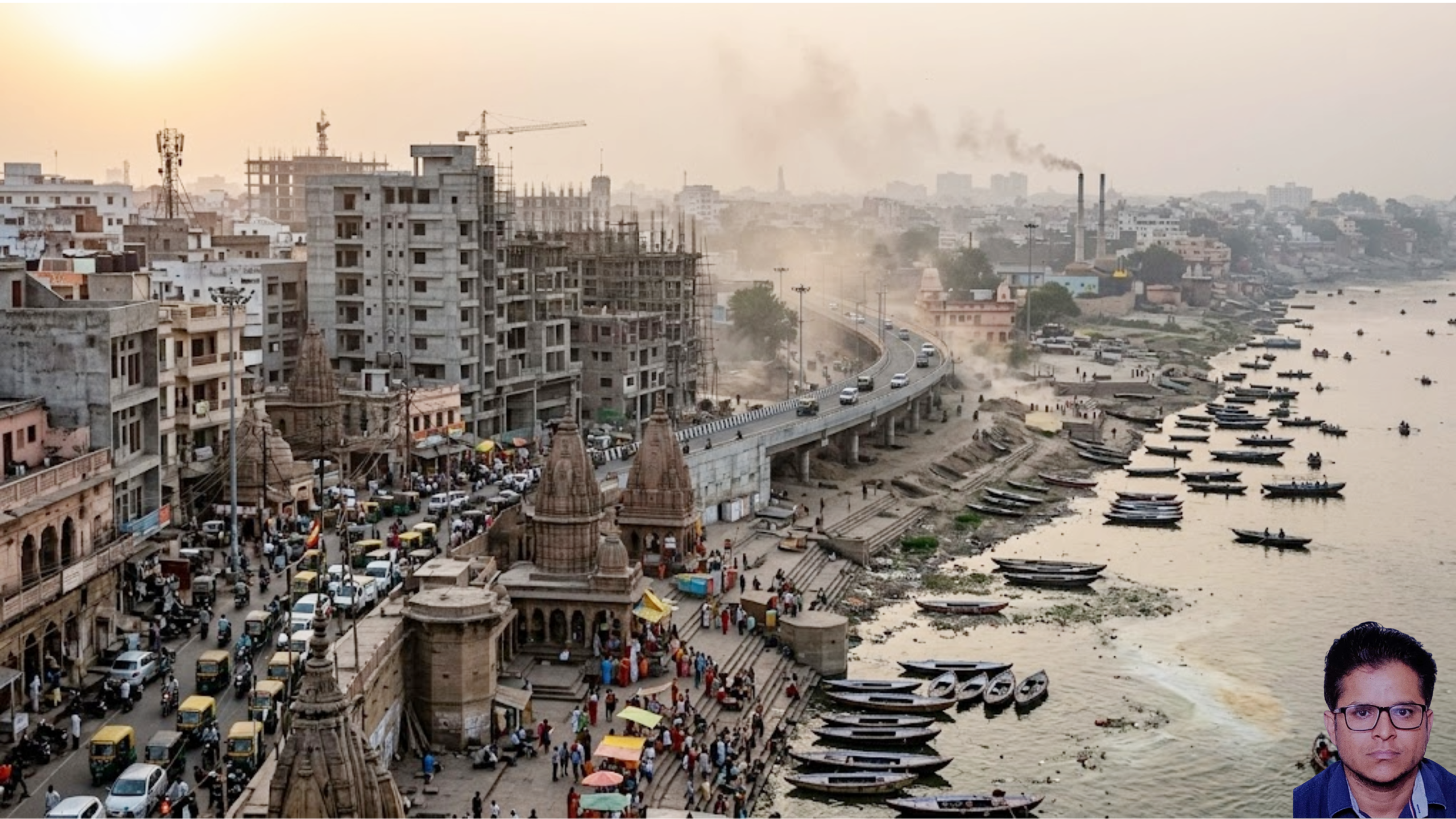
PhD Topic: Urban Growth and Environmental Challenges: A Case Study of Varanasi city, Uttar Pradesh
|
Getting your Trinity Audio player ready...
|
Research Scholar – Aditya Kumar
Supervisor – Dr. Kavita Mishra
Designation – Assistant Professor
Department of Geography
University of Allahabad
Prayagaraj (Uttar Pradesh)
Aim of the Study
The aim of this study is to examine the major forms of environmental degradation in a rapidly growing city like Varanasi, with special reference to the increasing pressure of population growth and urban sprawl. The study seeks to analyze the adverse effects of plastic waste on urban environmental health and associated public health risks.
It also aims to assess the impact of urbanization on environmental factors, particularly the formation and expansion of urban heat islands. Furthermore, the study intends to propose sustainable urban planning strategies to address and mitigate environmental challenges related to water resources and overall urban sustainability.
Research Methodology
This study adopts a mixed-method research approach combining both quantitative and qualitative methods to provide a comprehensive analysis of urban growth and its associated environmental challenges in Varanasi. The quantitative approach primarily focuses on the collection and analysis of both primary and secondary data. Primary data is collected through questionnaire surveys conducted in randomly selected wards of the city that are significantly affected by environmental problems.
A sample size of approximately 2,000 households is considered for the survey to understand issues related to urban expansion, environmental degradation, waste management, and public health risks. In addition, geospatial techniques such as satellite imagery, remote sensing, GIS mapping, and IoT sensor data are incorporated along with ground observation data obtained from agencies like the India Meteorological Department (IMD), Central Pollution Control Board (CPCB), and State Pollution Control Board (SPCB).
The qualitative aspect of the study supports the quantitative findings by examining the socio-environmental conditions of informal settlements, slum areas, ghettos, jhuggi-jhopri clusters, and other unregulated urban spaces. The study also differentiates between registered and non-registered settlements to better understand disparities in environmental conditions and access to urban resources.
The findings of the research can be used for academic purposes, policy formulation, urban planning, and sustainable environmental management in rapidly urbanizing cities like Varanasi.
The Application of Study
The study can beusefulness for both published and unpublished research related to urban environmental challenges and field-based investigations in Varanasi. The collected data can support detailed micro-level analysis of informal settlements such as slum areas, ghettos, jhuggi-jhopri clusters, and other unregulated parts of the city.
Through the adopted research approach, the study helps in identifying and distinguishing between registered and non-registered settlements, thereby providing a clearer understanding of disparities in urban infrastructure, environmental conditions, and access to basic services.
The findings of the study can further assist researchers, urban planners, policymakers, and government agencies in preparing sustainable development strategies, improving urban management, and addressing environmental and social issues in rapidly growing urban areas.