From Empowerment to Equality: The Story of Women Social Justice
|
Getting your Trinity Audio player ready...
|
ARTICLE
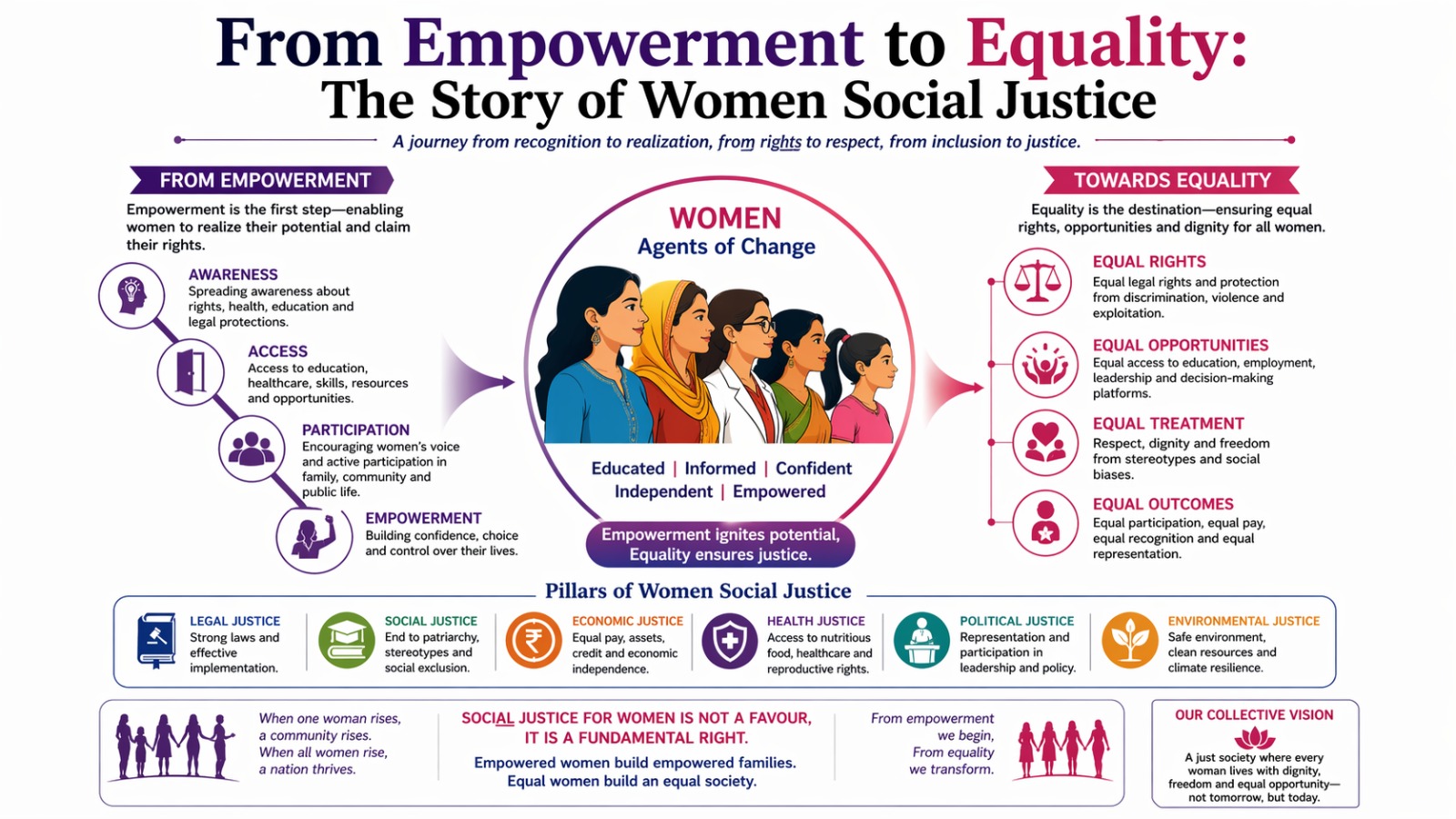
The lexicon of social justice of women has long been anchored by powerful word: Mahila Sashaktikaran, or Women’s Empowerment. Operating primarily as a welfare-driven and protective framework, this approach focused on uplifting a historically marginalized demographic by providing access to basic human necessities primary education, maternal healthcare, sanitation, and micro-credit. It was a language of survival, designed to grant women the basic agency required to navigate a patriarchal society.
However, as India navigates the mid-2020s and solidifies its position as a rising global economic power, this narrative is undergoing a profound philosophical shift. The new frontier is Equality (Samanata), a structural transformation where Indian women transition from being passive beneficiaries of state welfare to equal architects, decision-makers, and primary drivers of the nation’s macroeconomic destiny.
The Philosophical Shift of Indian Women: Agency vs. Architecture
For decades, the Indian women’s rights movement has operated on a fundamental, albeit unspoken, assumption: the socio-economic system is inherently rigid, and therefore, the woman must be fortified to survive it. This was the era of ‘Empowerment,’ a period dedicated to cultivating individual Agency. Today, as India undergoes a rapid macroeconomic and cultural transformation, a profound philosophical shift is occurring. The modern Indian woman is no longer just asking for the tools to navigate a patriarchal system; she is demanding the total redesign of the system itself.
The Triumphs of the Empowerment Era
For several decades after independence, the discourse on women in India revolved around the idea of empowerment. Successive governments introduced targeted welfare schemes aimed at improving the condition of women.
To understand the magnitude of this shift, one must first acknowledge the critical groundwork laid during the empowerment phase. Over the last few decades, India successfully dismantled several foundational barriers through targeted state interventions:
Educational Parity: The gender gap in primary and secondary education has effectively closed. Today, the Gross Enrolment Ratio (GER) for young women in higher education frequently surpasses that of young men across several Indian states, signaling a massive accumulation of female human capital.
Financial Inclusion and Dignity: Mega-initiatives like the Pradhan Mantri Jan Dhan Yojana brought millions of rural and urban women into the formal banking system, providing independent financial identities. Simultaneously, schemes focusing on clean cooking fuel (Ujjwala) and sanitation drastically reduced the domestic drudgery and health risks uniquely faced by Indian women.
Grassroots Political Agency: The historic 73rd and 74th Constitutional Amendments, which mandated a 33% reservation for women in Panchayati Raj Institutions (local governance), created a pipeline of over a million female grassroots leaders.
These initiatives successfully ‘empowered’ women with essential tools, but they inherently treated women as a vulnerable class requiring state protection. They did not automatically dismantle the structural patriarchies that prevent true economic and social parity at the highest levels.
Structural Barriers and Persistent Inequalities
Despite decades of empowerment programmes, women in India continue to face significant structural barriers. Female labour force participation remains low at around 25–27% in 2026. Women bear a disproportionate burden of unpaid domestic and care work, often spending five to seven times more hours than men on such responsibilities.
Property ownership by women is still below 13%, particularly in rural areas. Wage gaps persist across sectors, and safety concerns severely limit women’s mobility and economic participation. The situation becomes even more complex when viewed through the lens of intersectionality. Dalit, Adivasi, and minority women experience compounded discrimination based on caste, tribe, religion, and class. The COVID-19 pandemic further exposed these vulnerabilities, with women suffering higher job losses and a sharp rise in domestic violence cases during lockdowns.
The Shift Towards Equality
In recent years, the narrative has gradually shifted from empowerment to the demand for substantive equality. This marks an important evolution in the discourse on women’s social justice. Equality goes beyond providing schemes and reservations. It demands the removal of systemic barriers so that women can exercise their rights on equal terms with men in all spheres of life economic, political, social, and personal.
The passage of the Women’s Reservation Act 2023 (Nari Shakti Vandan Adhiniyam), which reserves one-third seats for women in Parliament and state assemblies, represents a significant step in this direction. When fully implemented after delimitation, it is expected to transform women’s political representation at the national and state levels.
Challenges on the Path to Equality
Achieving substantive equality remains a formidable challenge. Patriarchal social norms continue to undervalue women’s labour and restrict their decision-making power. Educational curricula and popular culture often reinforce traditional gender roles. Implementation of existing laws protecting women’s rights is weak, and access to justice is limited for many, especially those from marginalised communities.
Economic equality also remains distant.
While more women are entering higher education and professional fields, a large proportion continues to work in low-paying, informal jobs without social security. The burden of unpaid care work acts as a major barrier to women’s full economic participation. Without addressing this “care economy”, genuine equality will remain elusive.
The Road Ahead: Towards Substantive Justice
Since the framing of the Indian Constitution, the republic has guaranteed ‘Formal Equality’ the principle that the law is blind to gender and treats all citizens equally on paper. Over the decades, through the phases of welfare-driven empowerment and the push for systemic equality, this formal promise has expanded.
Yet, as India accelerates toward its vision of a developed nation, a glaring chasm remains between the rights written in the statute books and the lived realities of millions of women. Bridging this chasm requires the final, most complex leap in the gender rights movement: the shift from Formal Equality to Substantive Justice.
Substantive justice acknowledges that because the playing field is historically and structurally uneven, applying equal rules to unequal starting points only perpetuates disparity. True justice requires actively dismantling the invisible, deeply entrenched cultural and economic architectures that prevent formal rights from translating into everyday reality.
The Obsolescence of Empowerment
The transition from Agency to Architecture is the hallmark of a maturing democracy. The pioneers of the Indian feminist movement fought tirelessly to cultivate agency so that the women of today could have the voice to demand a new architecture.
As India marches toward its goal of becoming a fully developed nation, the ultimate success of its gender justice movement will be paradoxical: to make the concept of empowerment completely obsolete. When the structural architecture of the home, the workplace, and the parliament is inherently equal, the Indian woman will no longer need to be empowered to succeed she will simply be free to exist, innovate, and lead.
A Nation’s Unfinished Story
India’s growth story will remain incomplete without achieving genuine gender equality. As the country aspires to become a developed nation by 2047, women’s full and equal participation is both a moral imperative and an economic necessity. The transition from empowerment schemes to substantive equality demands stronger political will, better implementation of laws, cultural change, and structural reforms.
The story of women’s social justice in India is one of slow but steady progress amidst persistent challenges. From the early focus on welfare to the current demand for equality and agency, the trajectory is clear. However, the distance between constitutional promises and ground realities remains substantial. Bridging this gap will define not just the future of women in India, but the quality and sustainability of the nation’s overall progress.
True social justice will be achieved only when every woman in India has the freedom, opportunity, and dignity to realise her full potential as an equal citizen.