
Why Indian Agriculture Remains in Distress Despite Record Foodgrain Production?
|
Getting your Trinity Audio player ready...
|
ANALYSIS
Every year, the Ministry of Agriculture releases figures that should, in theory, be a cause for national celebration. India consistently breaks its own records in foodgrain production. According to the Second Advance Estimates released by the Ministry of Agriculture and Farmers Welfare in March 2026, foodgrain production is projected to reach a record level of approximately 348–349 million metric tonnes (MMT) for the 2025–26 crop year. Kharif output is estimated at 174.14 million tonnes and Rabi at 174.5 million tonnes, with notable gains in wheat (record 120.2 million tonnes) and rice. The previous year (2024–25) had already seen a record 357 million tonnes. On the surface, these figures suggest a resounding success, India remains self-sufficient in foodgrains and a major global producer.
Yet, behind these impressive aggregate numbers lies a deepening agrarian crisis. Farmer incomes remain stagnant or declining for millions of small and marginal holders, indebtedness is rising, distress migration continues, and farmer suicides persist at alarming levels. Agricultural labourers now account for a growing share of suicides. Why does record production fail to translate into farmer prosperity? The answer lies in structural distortions that have persisted for decades.
The Illusion of Averages and Shrinking Landholdings
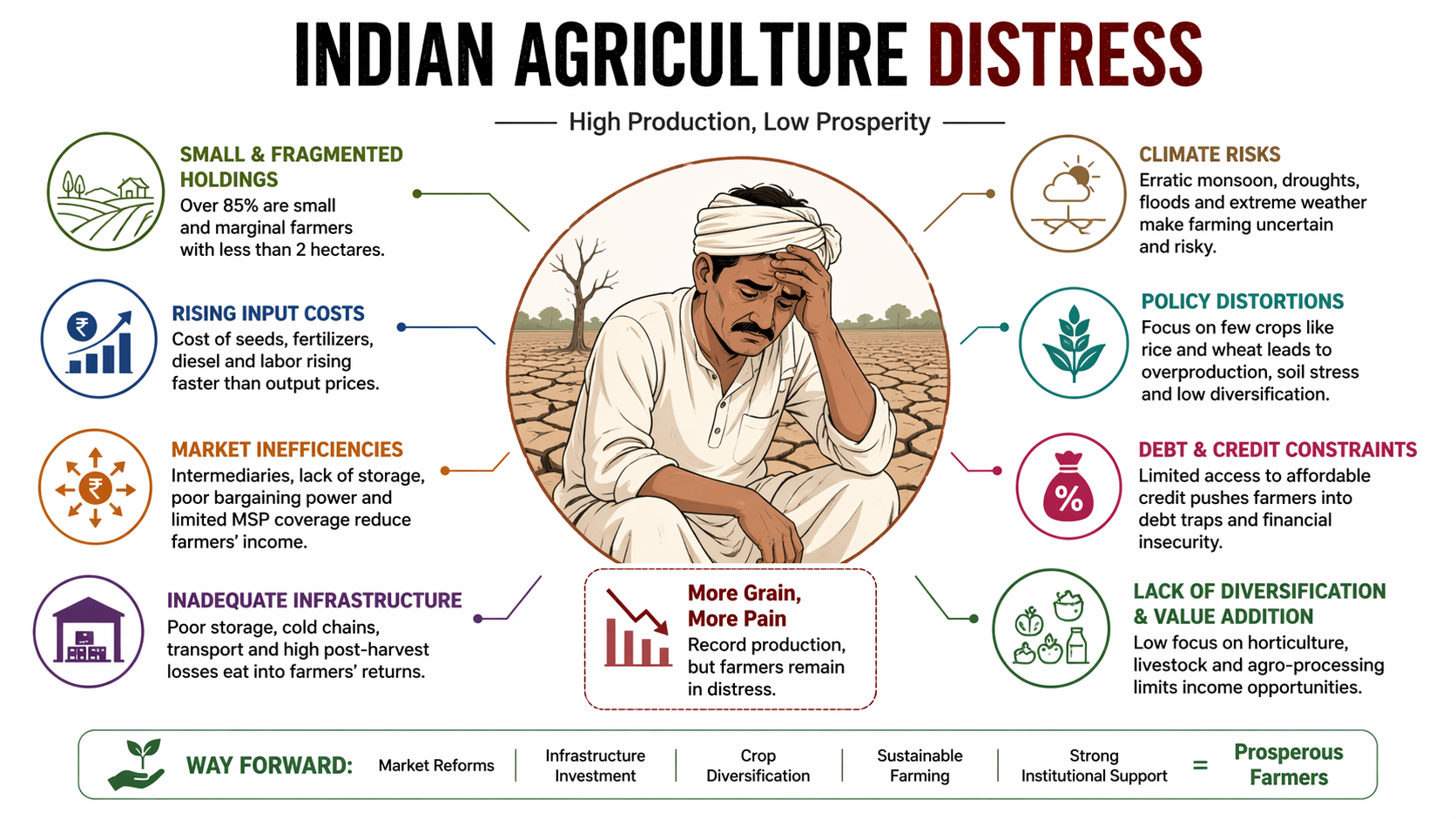
The fundamental disconnect between national production and individual prosperity stems from the fragmentation of land. Today, over 86% of Indian farmers belong to the “small and marginal” category, owning less than two hectares of land.
While the aggregate national yield is massive, the per-capita production for an individual farmer is highly constrained. For a farmer with just one acre, even a bumper crop of wheat or rice does not generate enough surplus to pull a family out of poverty.
Furthermore, the cost of cultivation driven by rising prices of seeds, fertilizers, pesticides, and diesel has consistently outpaced the rise in crop prices. Consequently, profit margins have relentlessly shrunk, leaving smallholders trapped in a cycle of debt, often relying on informal moneylenders at exorbitant interest rates.
The MSP Trap and Ecological Degradation
India’s agricultural policy is still heavily influenced by the legacy of the Green Revolution. The Minimum Support Price (MSP) regime, combined with an open-ended procurement policy, is heavily skewed in favour of water-intensive crops like paddy and wheat.
While this system ensured national food security decades ago, it has now created a severe ecological and economic distortion. Farmers in regions like Punjab and Haryana are incentivized to grow paddy in semi-arid zones, leading to the catastrophic depletion of groundwater tables and severe soil degradation from chemical overuse. This lack of crop diversification means farmers are overproducing cereals while the country imports massive quantities of edible oils and pulses. The land is losing its fertility, meaning farmers must spend more on fertilizers each year just to maintain the same yield, further eating into their nominal incomes.
Market Failures and the Missing Value Chain
Agriculture is the only sector where the producer has virtually no control over the pricing of their product. Despite various reforms, the agricultural market remains heavily fragmented and dominated by intermediaries. The absence of robust, decentralized post-harvest infrastructure such as cold storage, warehousing, and local food processing units forces farmers to engage in ‘distress selling’ immediately after harvest when market prices crash due to a supply glut. Without the holding capacity to wait for better prices or the ability to add value to their raw produce, farmers bear the entire burden of market volatility.
The Climate Reality
In the 2020s, agriculture has become a frontline casualty of climate change. Farming is essentially an open-sky factory, and Indian agriculture remains deeply dependent on the vagaries of the monsoon.
However, climate patterns have become increasingly erratic. Unseasonal rains during the harvest season, delayed monsoons, and extreme, prolonged heatwaves such as those witnessed in the spring of recent years can decimate months of labour in a matter of days. While risk mitigation tools like the Pradhan Mantri Fasal Bima Yojana (PMFBY) exist, issues with delayed damage assessments, technical glitches, and late payouts often leave farmers without a safety net when they need it most.
The Burden of Disguised Unemployment
Finally, the distress is magnified by a broader macroeconomic failure: the inability of the industrial and manufacturing sectors to absorb surplus rural labour. Nearly half of India’s workforce is still engaged in agriculture, yet the sector contributes less than a fifth to the national GDP. This severe “disguised unemployment” means that too many people are dependent on the same piece of land for their survival, dragging down the per-capita income of rural households.
The Way Forward
The narrative of Indian agriculture must urgently shift from a ‘yield-centric’ approach to an ‘income-centric’ one. Celebrating record production means little if the producer is driven to despair.
Solving this paradox requires bold structural reforms. It demands investing in rural infrastructure rather than just subsidies, promoting climate-resilient agriculture, restructuring the MSP to encourage crop diversification (particularly toward millets and pulses), and empowering Farmer Producer Organizations (FPOs) to bypass middlemen.
Ultimately, resolving India’s agrarian distress is not just about producing more food; it is about ensuring that those who feed the nation can afford to feed their own families.