
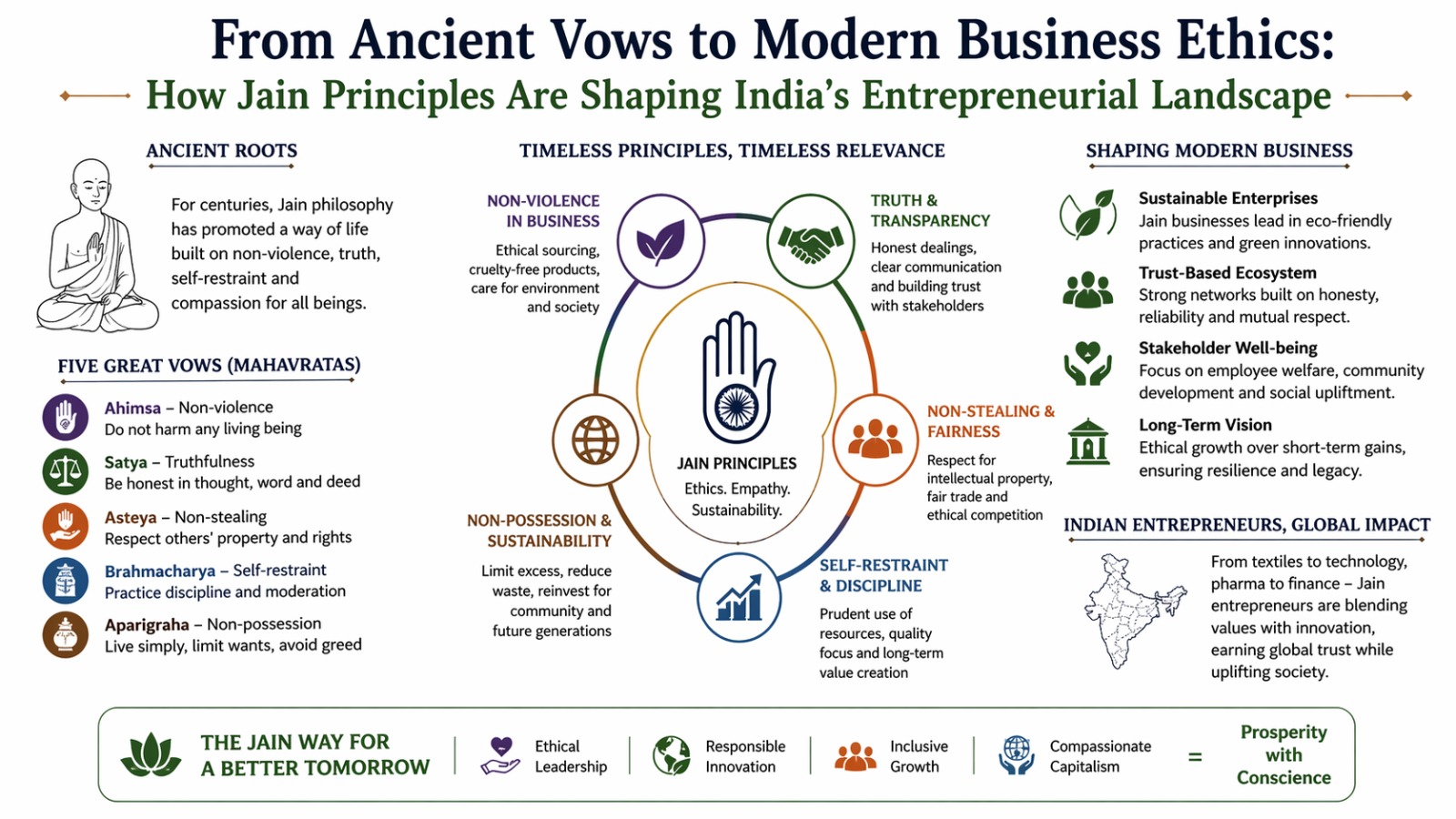
From Ancient Vows to Modern Business Ethics: How Jain Principles Are Shaping India’s Entrepreneurial Landscape
|
Getting your Trinity Audio player ready...
|
OPINION
In the high-stakes arena of modern global capitalism, success is frequently measured by relentless growth, aggressive market capture, and the uncompromising maximization of shareholder value. Yet, within India’s rapidly evolving entrepreneurial ecosystem, a profound counter-narrative is taking root. Driven by the urgent realities of climate change and social inequality, modern businesses are increasingly seeking ethical frameworks to guide sustainable development. Surprisingly, one of the most robust blueprints for this new ‘conscious capitalism’ is found not in a modern business school curriculum, but in the ancient Indian philosophy of Jainism.
The Jain Ethical Foundation
Jain philosophy, systematised by the 24th Tirthankara Mahavira around the 6th century BCE, emphasises extreme ethical rigour and personal responsibility. The principle of Anekantavada (multi-sided reality) promotes intellectual humility and tolerance, while Syadvada (conditioned predication) encourages nuanced understanding rather than dogmatic assertions. These philosophical tools naturally translate into modern business practices that value stakeholder harmony over zero-sum competition.
At the heart of Jain ethics lies Ahimsa not just physical non-violence but avoidance of harm in thought, word, and deed. For Jain entrepreneurs, this extends far beyond vegetarianism. It influences supply chain decisions, labour practices, environmental impact, and even competitive strategies. Many Jain businesses consciously avoid industries involving weapons, intoxicants, or animal exploitation.
Aparigraha (non-possessiveness) challenges the endless pursuit of accumulation that drives much of modern capitalism. It promotes simplicity, detachment from material wealth, and ethical restraint in profit-making. In practice, this translates into conservative financial management, long-term thinking, and a preference for sustainable growth over aggressive expansion.
Jain Communities and India’s Entrepreneurial Success
Jain communities, though constituting less than 0.4% of India’s population, have produced a disproportionately high number of successful entrepreneurs. Prominent business houses such as the Ruia Group (Essar), Bajaj Group, Lodha Group, and many diamond traders in Surat and Antwerp trace their ethical roots to Jain principles. The Jain business network is particularly strong in gems and jewellery, pharmaceuticals, textiles, manufacturing, and increasingly in fintech and renewable energy.
What distinguishes many Jain-led enterprises is their emphasis on trust-based relationships, conservative leverage, and long-term stakeholder value. Jain entrepreneurs often prioritise reputation (built on Satya and Asteya) over short-term gains. This approach has helped several Jain businesses survive economic downturns and build enduring legacies across generations.
Ahimsa: The Blueprint for Environmental, Social, and Governance (ESG)
The principle of Ahimsa is the cornerstone of Jain ethics. While traditionally understood as strict non-violence toward all living beings, in the modern entrepreneurial context, Ahimsa translates directly to the core principles of the ESG framework.
Modern Indian startups and established conglomerates alike are realizing that aggressive resource extraction is a form of economic violence. Ahimsa in business demands a meticulous audit of a company’s impact on the ecosystem. This philosophical underpinning is driving the surge in specific sectors across India:
The Green Transition: It fuels the logic behind investments in renewable infrastructure, such as geothermal energy and biofuel innovations (like bamboo-based ethanol plants), minimizing the violence inflicted upon the earth through carbon emissions.
Ethical Supply Chains: Ahimsa requires that products are created without exploiting labour or inflicting cruelty. This is catalyzing the growth of India’s booming plant-based protein market, cruelty-free cosmetics, and circular economy startups focused on zero-waste models.
In this light, Ahimsa is not a passive vow of do-no-harm; it is an active, structural mandate for sustainable development.
Anekantavada: Stakeholder Capitalism and Inclusive Governance
Perhaps the most intellectually mature contribution Jainism offers to modern business is Anekantavada—the doctrine of manifold aspects or ‘multi-sidedness.’ It posits that reality is complex and multi-faceted, and no single perspective holds the absolute truth.
In traditional corporate frameworks, ‘Shareholder Primacy’ dictated that a company’s sole responsibility was to its investors. Anekantavada shatters this narrow lens, demanding what is now known as Stakeholder Capitalism.
Boardroom Dynamics: A leader practicing Anekantavada recognizes that a business decision looks entirely different from the perspective of an investor, a factory worker, a local community, and the environment.
Conflict Resolution: In complex corporate negotiations or geopolitical supply chain disputes, this principle fosters empathy and intellectual humility. It prevents the rigid, dogmatic thinking that leads to corporate scandals and hostile labour relations, promoting instead a culture of dialogue, psychological safety, and inclusive leadership.
Aparigraha: Redefining Wealth and Corporate Social Responsibility (CSR)
Aparigraha is the vow of non-attachment and non-possessiveness. It does not forbid the creation of wealth, which is necessary for economic progress but it severely critiques the reckless hoarding of it.
In the context of India’s widening wealth disparities, Aparigraha offers a philosophical framework for equitable capitalism. It aligns closely with the concept of ‘Trusteeship’ the idea that wealth creators are merely custodians of society’s resources, obligated to use their surplus for the collective good.
Ethical Profitability: It encourages entrepreneurs to set limits on conspicuous consumption and endless accumulation. It shifts the corporate goalpost from profit maximization at any cost to profit optimization with social impact.
Institutional Philanthropy: Aparigraha is the cultural DNA behind the massive philanthropic arms of many traditional Indian business houses, driving capital back into education, healthcare, and rural development. It provides the moral justification for progressive corporate social responsibility (CSR) initiatives.
Challenges and Criticisms
Despite these strengths, the application of Jain principles in modern business is not without challenges. Strict adherence to Ahimsa can sometimes limit business opportunities in certain sectors. The emphasis on non-possessiveness occasionally creates tension with the risk-taking and aggressive growth mindset required in competitive markets, particularly in technology and startup ecosystems.
Moreover, as Jain businesses grow larger and more globalised, maintaining traditional ethical standards becomes increasingly difficult. Younger generations of Jain entrepreneurs often navigate the tension between inherited values and the demands of venture capital, quarterly targets, and rapid scaling.
The Broader Relevance for Indian Entrepreneurship
India’s entrepreneurial landscape is currently straddling two worlds: the aggressive, hyper-funded startup culture imported from Silicon Valley, and the deep-rooted, culturally specific values of the subcontinent.
As India navigates its unique developmental challenges from managing the energy security of a billion-plus population to fostering inclusive growth the integration of Jain principles provides a vital ethical compass.
The application of Ahimsa, Anekantavada, and Aparigraha proves that intellectual maturity in business does not require the abandonment of cultural philosophy. Instead, these ancient vows offer a sophisticated, resilient framework for modern enterprises. They remind today’s founders that true structural coherence in a business model is achieved only when economic ambition is perfectly balanced with ecological sustainability and profound social responsibility. In the pursuit of a modern, developed India, this ancient wisdom may be its most innovative business strategy.