Social Welfare: Constitutional Promise vs Ground Reality
|
Getting your Trinity Audio player ready...
|
ANALYSIS
When the architects of the Indian Republic drafted the Constitution, they did not merely design a framework for governance; they authored a profound social contract. For a nation emerging from the shadows of centuries of colonial exploitation, extreme poverty, and rigid social stratification, the promise of a ‘Welfare State’ was not just a political choice, it was a moral imperative. Today, over seven decades later, India stands as a global economic heavyweight in 2026. Meanwhile, the journey of social welfare remains an intricate paradox, marked by breathtaking scale, undeniable triumphs, and agonizing systemic gaps.
The Constitutional Vision of a Welfare State
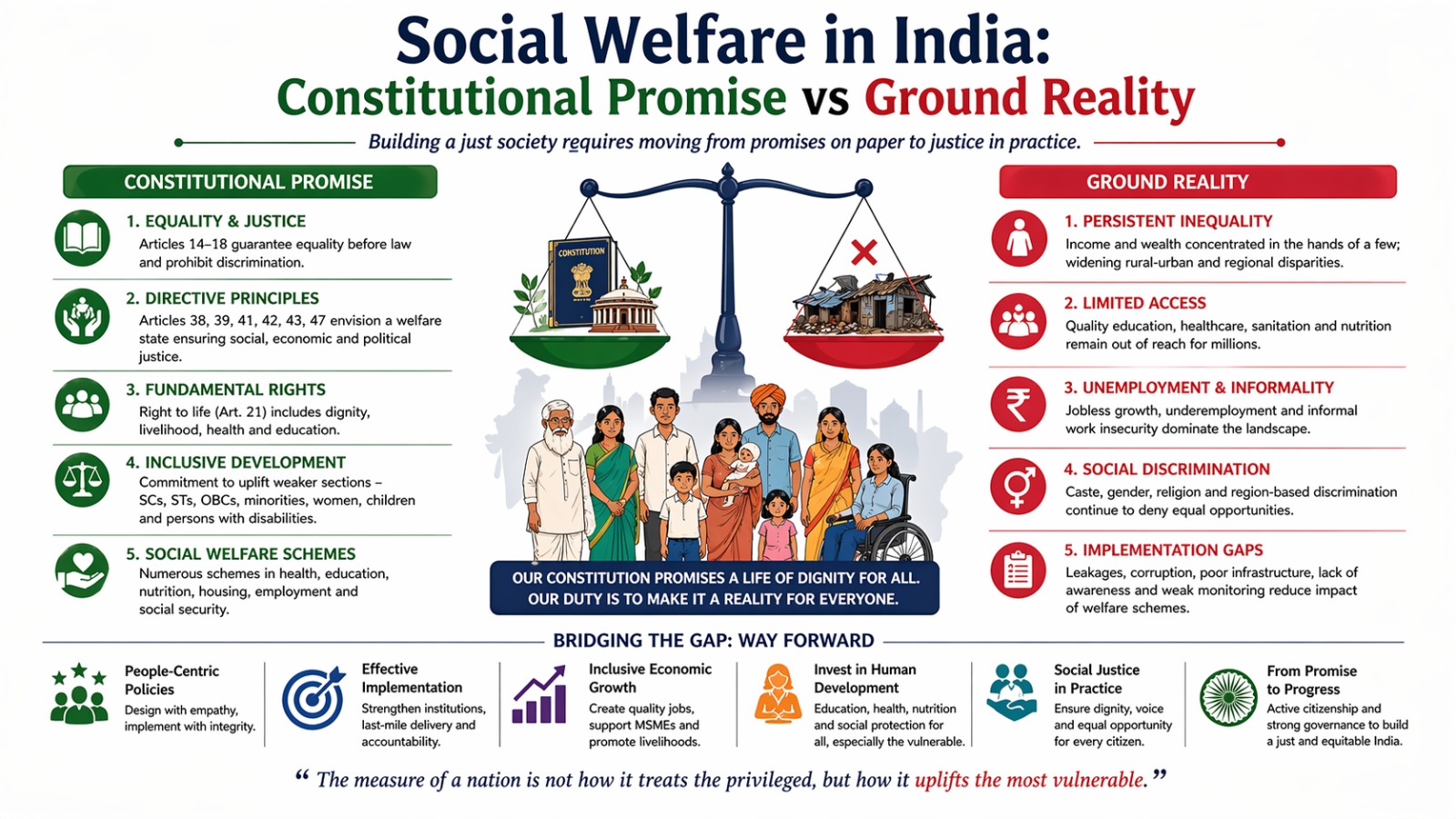
The framers of the Indian Constitution envisioned a modern welfare state that would secure social, economic, and political justice for every citizen. Part IV of the Constitution, containing the Directive Principles of State Policy (DPSP), lays down the moral compass for governance. Article 38 directs the state to promote the welfare of the people by securing a social order in which justice- social, economic, and political informs all institutions of national life. Article 39 further emphasises equal pay for equal work, protection of children and workers, and equitable distribution of material resources. Articles 41 to 47 specifically mandate the state to provide right to work, education, public assistance in cases of unemployment, old age, sickness and disablement, and adequate nutrition and living standards.
Dr. B.R. Ambedkar, the chief architect of the Constitution, repeatedly stressed that political democracy without social and economic democracy would be meaningless. The Constitution thus placed a clear obligation on the state to actively intervene in reducing inequalities and ensuring basic welfare, particularly for the vulnerable and marginalised sections of society.
Evolution of Social Welfare Programmes
Since independence, India has launched numerous social welfare schemes to translate these constitutional promises into reality. The early decades focused on community development and basic public services. The 1990s and 2000s saw the emergence of rights-based and targeted programmes. Landmark initiatives include the Mahatma Gandhi National Rural Employment Guarantee Act (MGNREGA, 2005), Right to Education Act (2009), National Food Security Act (2013), Ayushman Bharat – Pradhan Mantri Jan Arogya Yojana (2018), and Pradhan Mantri Garib Kalyan Anna Yojana.
In recent years, the government has emphasised Direct Benefit Transfer (DBT), Aadhaar linkage, and convergence of schemes to improve efficiency. As of 2026, social welfare spending constitutes a substantial portion of the Union and State budgets, covering food subsidies, pensions, health insurance, scholarships, housing, and skill development.
Visible Achievements and Progress
On several fronts, India has made undeniable progress. The Public Distribution System has expanded significantly, providing subsidised food grains to over 80 crore beneficiaries. MGNREGA has generated billions of person-days of employment, particularly benefiting rural women. Ayushman Bharat has issued health cards to crores of families, reducing out-of-pocket healthcare expenditure for many. Literacy rates have improved, maternal and infant mortality have declined, and access to sanitation has expanded under Swachh Bharat Mission.
Digital delivery mechanisms like DBT have reduced leakages and brought greater transparency. Several states have shown innovation in welfare delivery, demonstrating that when political will, administrative capacity, and technology converge, constitutional promises can be partially realised.
The Ground Reality: Quality vs. Quantity Paradox
The most glaring disparity between the constitutional promise and the ground reality lies in the quality of core social sectors: healthcare and education. In education, the Right to Education (RTE) Act succeeded in achieving near-universal primary school enrolment.
However, consecutive surveys consistently reveal a learning crisis. Millions of children in government schools fail to acquire foundational reading and arithmetic skills, turning the constitutional promise of education into a hollow statistical victory rather than a tool for social mobility.
In healthcare, schemes like Ayushman Bharat represent ambitious steps toward universal health coverage by providing insurance to the bottom 40% of the population. Yet, insurance cannot substitute for infrastructure. The acute shortage of primary healthcare centers, doctors, and critical care beds in rural India forces the poor into the arms of expensive private healthcare, leading to catastrophic out-of-pocket expenditures that push families back into the poverty trap.
Intersectional Vulnerabilities and Emerging Challenges
The gap between promise and reality is most pronounced among the most vulnerable sections. Dalit, Adivasi, and minority women face multiple layers of exclusion. Migrant workers, particularly those who returned home during the COVID-19 pandemic, often fall through the cracks of welfare delivery systems due to lack of portable benefits.
New challenges have further complicated the landscape. Climate-induced disasters are increasing the vulnerability of the poor. Rising economic inequality means that the benefits of growth are not trickling down effectively. The rapid expansion of the gig economy is creating new forms of precarious employment without social security. Digital divides exclude many from availing DBT and online welfare services.
Fiscal constraints and competing demands on the budget have also limited both the scale and quality of welfare spending. Interest payments on public debt are increasingly crowding out much-needed capital expenditure on health, education, and social infrastructure.
Systemic and Structural Reasons for Gap
Several systemic factors explain the persistent gap. First, weak administrative capacity at the grassroots level hampers effective implementation. Second, poor coordination between central and state governments leads to duplication, confusion, and inefficiency. Third, political populism often results in short-term schemes rather than long-term structural solutions. Fourth, inadequate focus on outcome measurement and accountability allows under-performing programmes to continue without correction.
Finally, social attitudes and deep-rooted inequalities based on caste, gender, and location continue to influence who actually benefits from welfare schemes. Without addressing these structural barriers, even well-designed programmes fail to deliver equitable outcomes.
From Beneficiaries to Stakeholders- Bridging the Constitutional Gap
The current paradigm of social welfare in India is heavily skewed toward palliative care providing subsidies, free food, and cash transfers to keep citizens afloat. While absolutely necessary in a developing economy, this approach risks trapping populations in a cycle of dependency.
To truly bridge the gap between the Constitutional promise and the ground reality, welfare must transition from a dole-out model to an empowerment model. This requires heavy, uncompromising investment in human capital. The focus must shift
from merely building schools to ensuring quality pedagogy, from providing health insurance to building robust rural hospitals, and from guaranteeing minimum wages to upskilling the youth for the modern economy.
The Constitution promised a state that enables its citizens to thrive, not just survive. Until the Indian welfare state transitions from managing poverty to genuinely eradicating, it through capacity building, the gap between the visionary text of the Constitution and the dusty reality of the Indian village will remain a profound national challenge.