Who is Most Affected by SIR Deletions?
PERSPECTIVE ANANLYSIS
The Special Intensive Revision (SIR) of 2025–2026 has emerged as one of the most polarizing administrative exercises in the history of the Election Commission of India (ECI). Designed to purify the electoral rolls through door-to-door verification and AI-driven deduplication, the SIR has resulted in the deletion of millions of names across several states most notably in West Bengal, Uttar Pradesh, and Bihar.
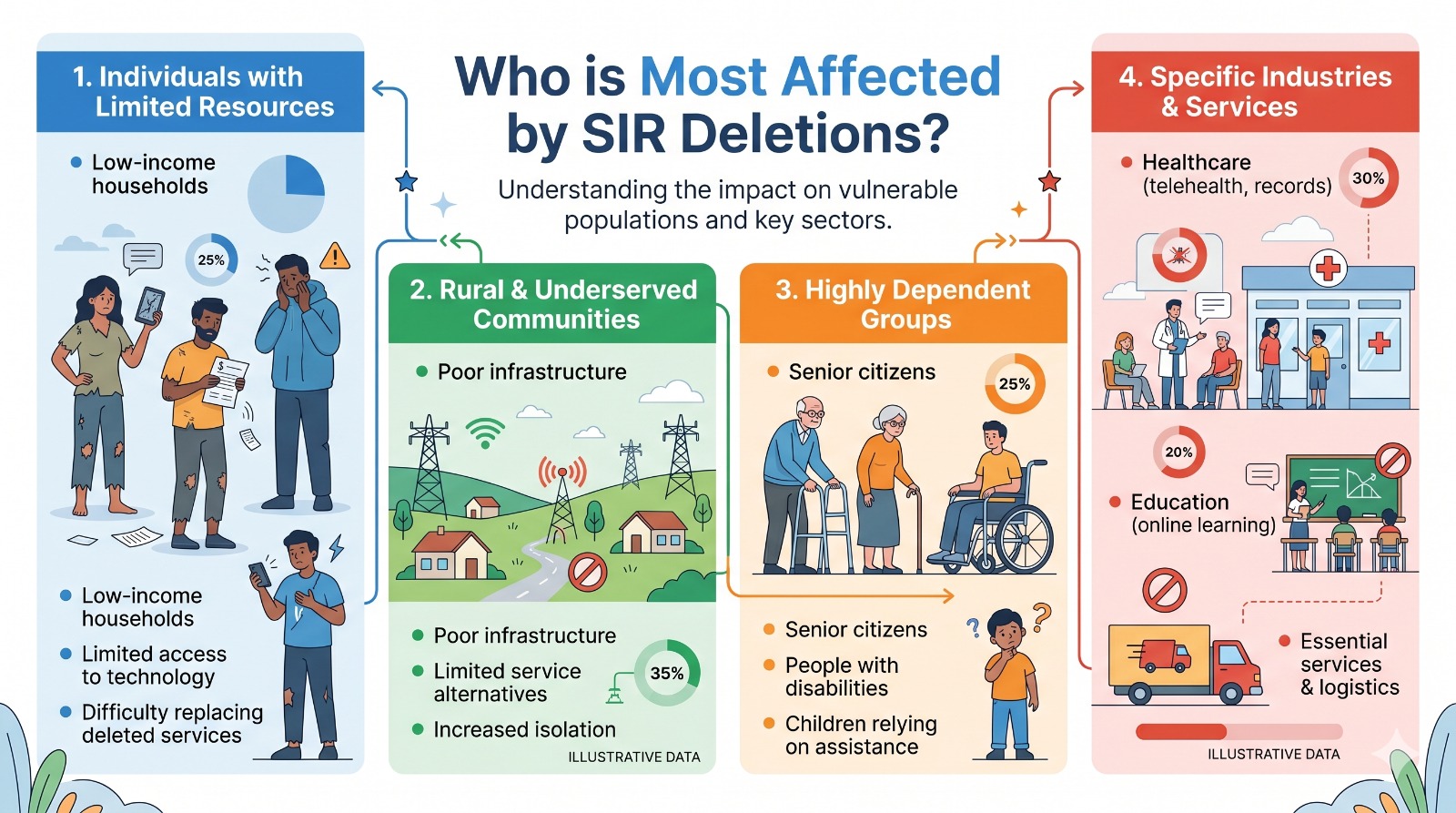
Launched to purge duplicates, dead voters, and permanently shifted names, SIR has so far resulted in net deletions of approximately 5.2 crore voters (10.2 per cent) across 12 states and Union Territories in Phase 2 alone. While the stated goal is cleaner, more accurate rolls to prevent bogus voting, the human cost is uneven. Data and ground reports reveal a clear pattern: the most affected are not random citizens but the structurally vulnerable women, youth, internal migrants, the poor, and certain minority communities.
The Scale of Deletions: A National Picture
Phase 2 of SIR, covering nearly 51 crore voters, saw gross deletions of 7.2 crore names, offset partially by 2 crore inclusions. Uttar Pradesh led with over 2 crore deletions (13.2 per cent purification rate), followed by West Bengal (around 91 lakh, or 10.9–11.6 per cent drop) and Tamil Nadu (97 lakh). Reasons cited include 3.1 crore permanently shifted, 1.3 crore duplicates, and 66.9 lakh deaths. On paper, this is a massive purification exercise. In practice, it has disproportionately hit groups least equipped to navigate bureaucratic verification those without stable addresses, digital documents, or the ability to appear before Booth Level Officers (BLOs) during door-to-door checks.
The Marginalized and the Document-Poor
In a country where identity is often tied to paper, those with the weakest documentation are the first to be erased. The SIR process relies heavily on the matching of names across different databases. For the urban poor, rural laborers, and
marginalized communities, discrepancies in the spelling of a name or a slight mismatch in a date of birth between an Aadhaar card and a Voter ID can trigger a deletion.
The Literacy Gap: Many voters from low-income backgrounds cannot verify their own data on the ECI portal or respond to Booth Level Officer (BLO) inquiries with technical precision.
Marginalized Communities: Data from West Bengal and Assam suggests that religious and linguistic minorities are disproportionately affected. In these regions, SIR deletions are often viewed through the prism of the National Register of Citizens (NRC), creating a climate of documentation anxiety where the loss of a voting right is equated with the loss of citizenship.
The Internal Migrant: A Citizen in Transit
Internal migrants daily-wage labourers, construction workers, sharecroppers form another major casualty. In Uttar Pradesh and Bihar, millions were tagged permanently shifted simply because they were away at work sites when BLOs visited. In Rajasthan’s border districts, seasonal agricultural migrants faced similar fates. Entire families have been deleted because one member was absent, creating a cascading effect.
Reports from Prayagraj and Bihar districts show over 11 lakh voters flagged in single districts alone under “absent, shifted, or dead” categories. For India’s 40-crore-strong migrant workforce, SIR has turned seasonal absence into permanent electoral erasure. The poor, who rely on voting as their primary tool of political voice, are now least likely to exercise it.
Women: The Silent Majority in the Deleted Lists
Perhaps the starkest disparity is in gender. In Bihar’s earlier pilot, the gender ratio in voter lists fell sharply from 907 to 892 women per 1,000 men after deletions.
In West Bengal, data from the Sabar Institute shows that 61.8 per cent of deleted or adjudicated voters nearly 62 lakh women have been struck off. Deletions are heavily concentrated in Muslim-majority and marginalised districts like Murshidabad and Malda.
The primary reason? The SIR’s reliance on automated algorithms has created a unique Gendered Erasure. Women in India frequently undergo name or address changes following marriage. In many traditional settings, these updates are not synchronized across all government IDs immediately.
AI Inconsistencies: The Supreme Court recently flagged that AI software used in the SIR often flags anomalous family structures (such as a woman having a different surname than her husband or father-in-law) for deletion.
The Documentation Dependency: Many women in rural areas do not have independent property titles or electricity bills in their names to prove residency during an intensive revision, making them more susceptible to being struck off during door-to-door verification.
The Political Opposition and State-Specific Impact
The analytical reality of SIR deletions is inseparable from the political geography of India. In states like West Bengal and Tamil Nadu, where regional parties are in power, the deletion of nearly 10%–15% of the electorate has sparked allegations of electoral engineering.
West Bengal: With over 9 million deletions reported, the ruling Trinamool Congress has argued that the exercise targets their loyal support base, particularly in border districts.
Uttar Pradesh: Conversely, in UP, where deletions reached a staggering 20 million, the controversy is bidirectional. While the opposition claims the move targets minorities, the ruling party has also expressed concern that their own grassroots cadres have been inadvertently removed due to administrative overzealousness.
The most affected here are the regional parties whose traditional ‘vote banks’ may be hollowed out by technical purges, potentially tilting the scales in high-stakes Assembly elections.
The Silent Demographic: The Elderly and PwD
Despite the ECI’s ‘Joyathon’ campaigns and the use of volunteers to assist vulnerable populations, the elderly and Persons with Disabilities (PwD) remain highly vulnerable to SIR deletions.
Intensive revisions often require an active response to a notice or a physical presence during a BLO visit. For those with limited mobility or those living in old-age homes where residency documentation is non-standard, the risk of being marked as untraceable or dead is significantly higher. In a fast-paced intensive window, these voters lack the digital literacy to check the Draft Roll and file Form 8 for reinstatement.
Minorities and Marginalised Communities: Disproportionate Scrutiny
In West Bengal the most politically charged SIR theatre Muslims account for 34 per cent of the 90 lakh deletions despite comprising only 27 per cent of the state’s population. In certain border and Muslim-majority districts, the share of Muslim deletions exceeds 40 per cent. Hindu deletions, while numerically higher overall, cluster in specific Matua refugee communities. Opposition parties allege targeted scrutiny; the ECI maintains it is religion-neutral.
Tribals, Dalits, and slum dwellers nationwide face similar challenges. Lack of land documents, poor Aadhaar linkage, and living in logical discrepancy areas (urban slums, forest hamlets) make verification difficult. The burden of proof has shifted from the state to the citizen a reversal that hits the document-poor hardest.
The Psychological Toll: From Voter to ‘Illegal’
Beyond the loss of a ballot, the most profound effect is psychological. In the current Indian political climate, the deletion of a name from the electoral roll is no longer seen as a mere clerical error. For millions, especially in the border states, it is perceived as a precursor to statelessness.
The affected are not just those who cannot vote, but those who now live in fear that their primary proof of Indian identity has been invalidated. This fear has led to distress migrations and a breakdown in trust between the citizen and the local administration (the BLO).
Implications for Indian Democracy
The SIR exercise is not without merit. Removing dead voters and duplicates strengthens electoral integrity and could explain higher turnouts in early 2026 polls in Assam and Puducherry. Yet the data paints a troubling picture of systemic bias against mobility, gender realities, and economic vulnerability.
When women, youth, migrants, and minorities groups that often vote for welfare-focused or regional parties are deleted at higher rates, the electorate tilts subtly. Voter turnout may appear high, but representation becomes skewed. In a democracy of 1.4 billion, excluding even 1 per cent of legitimate voters on procedural grounds raises questions about universal adult suffrage.
The ECI has defended SIR as a one-time purification. But with Phase 3 now underway in 22 more states, the pattern risks becoming structural. Without better safeguards mobile verification camps, simplified family linkage rules, extended objection windows, and technology-driven de-duplication that does not penalise the poor SIR could evolve into a recurring tool of selective exclusion rather than inclusion.
Unjustified Cost of a Clean Roll
The Special Intensive Revision aims for a noble goal: a 100% accurate voter list. However, an analytical look at the SIR Deletions suggests that the “purity” of the roll often comes at the cost of inclusivity.
The most affected are the socio-economically invisible the woman who changed her name, the labourer who is working three states away, and the minority citizen whose voter status is their only shield against social exclusion. As India moves toward more tech-heavy electoral management, the challenge remains: ensuring that in the quest to delete ‘ghost voters,’ the state does not turn its most vulnerable living citizens into ghosts.