Leadership Transitions and Dynastic vs. Merit-Based Politics in Indian Political Parties
ARTICLE
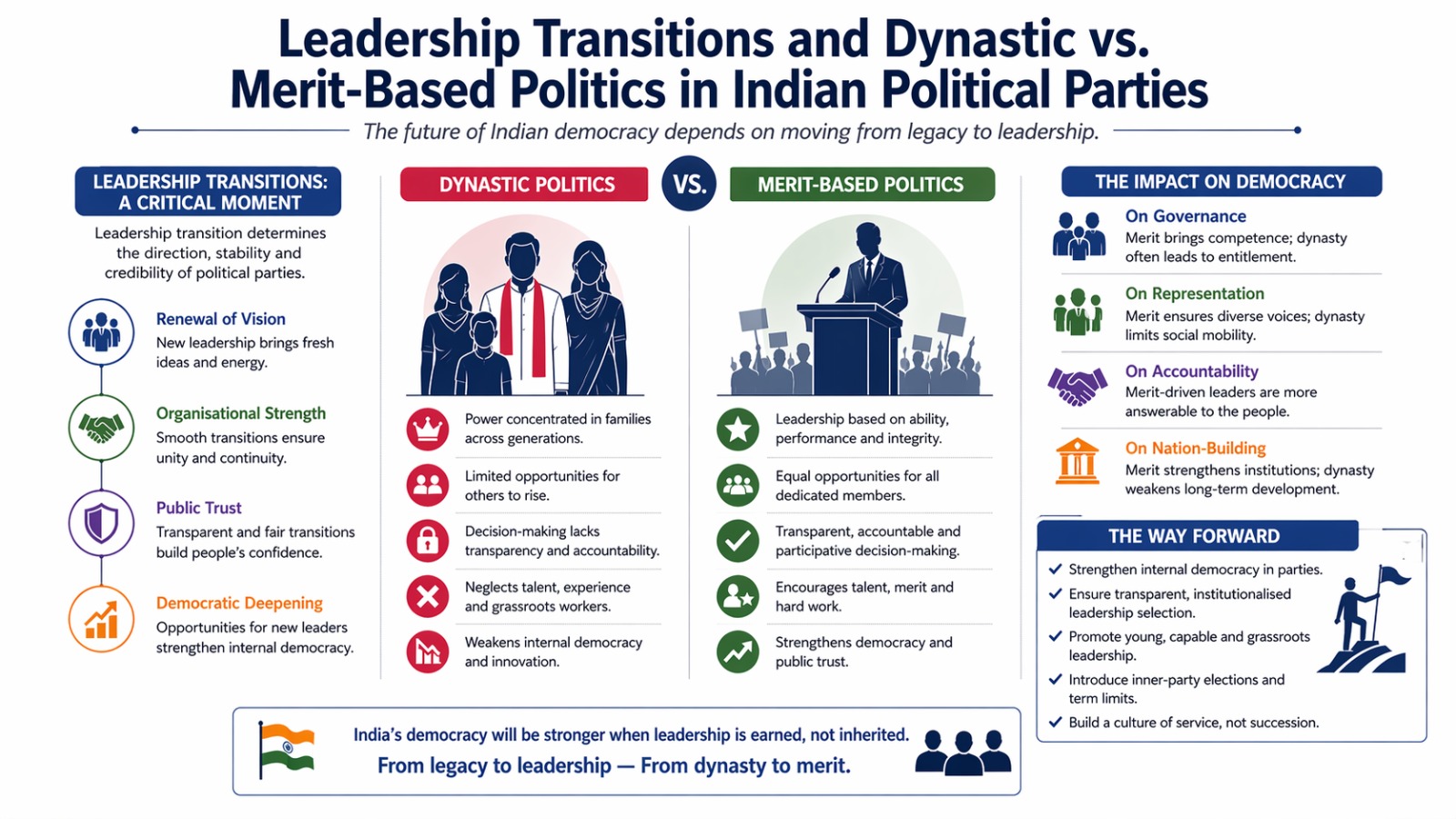
The architecture of Indian political parties is often defined by the tension between institutional stability and individual charisma. As the world’s largest democracy, India presents a fascinating study in how power is handed down, seized, or inherited. The central friction in this evolution lies between dynastic succession where lineage dictates leadership and merit-based transitions, where organizational prowess and electoral viability determine the next head of state or party.
The recent appointment of 45-year-old Nitin Nabin as the Bharatiya Janata Party’s (BJP) National President in January 2026 offers a powerful contrast to the dynastic patterns that continue to dominate much of the Indian political landscape. This generational shift in the ruling party underscores a broader debate: should leadership be inherited through family lineage or earned through merit, organisational grit, and proven governance? The answer will shape the future of Indian democracy.
The Dynastic Default
Dynastic politics remains deeply embedded in India’s multi-party system. According to a 2025 report by the Association for Democratic Reforms (ADR), analysing over 5,200 sitting MPs, MLAs, and MLCs, approximately 21% hail from political families. The figure rises to 31% in the Lok Sabha. The Congress leads among national parties with around 32% dynastic legislators, while the BJP stands lower at about 17%. Regional parties often fare worse, with many functioning as family enterprises. Voters, conditioned by familiarity, often reward familiar surnames, specially in high-stakes, resource-heavy elections. Yet, as senior Congress leader Shashi Tharoor has forcefully argued, this model poses a grave threat to democracy. When power flows by bloodline rather than ability or grassroots service, governance quality suffers and talent is stifled.
The Roots of Dynastic Politics
Dynasticism is not a bug in the Indian political system; for many parties, it has historically been a feature. The phenomenon is most famously associated with the Nehru-Gandhi family of the Indian National Congress (INC). For decades, the family served as the glue that held a diverse, often fractious coalition together.
The logic behind dynastic politics is rooted in brand recognition and internal stability. In a country with massive geographic and linguistic diversity, a single recognizable surname provides an instant emotional connection with the electorate. Internally, a dynasty prevents palace coups. If the top spot is reserved by birthright, mid-level leaders are less likely to fight one another for the throne, preserving a fragile peace within the party ranks.
The Rise of the Merit-Based Model
In contrast to the dynastic model stands the meritocratic or organizational approach, most prominently exemplified by the Bharatiya Janata Party (BJP) and the Communist parties. In these structures, leadership transitions are generally governed by the party’s ideological parent organizations (like the RSS for the BJP) or rigorous internal committees.
The BJP’s ‘Karyakarta’ Culture
In contemporary political parties, BJP has projected a more open, albeit controlled, model of leadership transition. Nitin Nabin’s elevation as the party’s youngest-ever national president, a five-time MLA from Bihar with a strong organisational background is being presented as validation of the karyakarta (worker) route. Succeeding J.P. Nadda in a smooth, unopposed process, Nabin’s rise was endorsed by Prime Minister Narendra Modi and senior leaders.
The BJP benefits from its scale and the ideological ecosystem of the RSS, which grooms leaders through years of grassroots work. Multiple presidents in recent years and the induction of performers from diverse backgrounds demonstrate fluidity at the top. This hybrid approach merit combined with ideological loyalty and central oversight has helped the party expand its cadre and deliver consistent messaging.
That said, no party is entirely free of dynastic influences. Families of prominent BJP leaders have gained visibility in allied spheres, and patronage networks exist. Yet, the lower percentage of dynasts and emphasis on performance metrics give the party a broader talent pool compared to many rivals.
Regional Political Parties: The ‘Private Limited’ Model
The debate becomes more complex when looking at regional parties. From the DMK in Tamil Nadu to the Samajwadi Party in Uttar Pradesh and the TMC in West Bengal, regional politics is heavily dominated by political families.
In these cases, the party is often run like a private firm. The founder builds the brand through a specific social or caste movement, and the successor is groomed to ensure the legacy (and often the party’s financial assets) remains within the family. However, even these dynasties are facing a merit challenge. Modern Indian voters, particularly the youth, are increasingly skeptical of entitlement. To survive, current dynastic heirs like M.K. Stalin or Tejashwi Yadav have had to prove their mettle through grueling campaigns and administrative performance, blending lineage with a proven-in-the-field merit.
Why Merit Matters for Democracy
Studies show growing unease with hereditary politics among the under-35 demographic. It narrows the talent pool, discourages innovation, and perpetuates inequality of opportunity in a system meant to be egalitarian.
Merit-based leadership, by contrast, fosters competition, accountability, and better governance. Leaders who rise through ranks must deliver results jobs, infrastructure, welfare to sustain legitimacy. The BJP’s organisational experiments and focus on booth-level management illustrate how structured pathways can broaden participation. Young, educated voters, increasingly influential through social media and data-driven awareness, demand performance over pedigree.
However, pure meritocracy is elusive in India’s context. Caste equations, financial clout, and loyalty will always play roles. The ideal lies in a balanced system: transparent internal elections, performance-based candidate selection, term limits for office-bearers, and reduced money power through campaign finance reforms.
Leadership Transitions: The Crisis of Transition
The most dangerous moment for any Indian party is the transition of power.
In Dynastic Parties: The crisis usually occurs when a clear heir is absent or unpopular. If the “glue” fails, the party often splinters into several factions, as seen with the various iterations of the Shiv Sena or the NCP in Maharashtra.
In Meritocratic Parties: The crisis is often one of over-centralization. When a merit-based leader becomes too powerful, the party’s internal democratic mechanisms can weaken, making the eventual transition to a successor a volatile and unpredictable event.
The Road to Reform
Institutional reforms are essential. Mandatory organisational elections, independent oversight of candidate selection, and voter education campaigns can gradually shift the culture. Civil society and media must continue highlighting the issue without partisan bias.
Indian democracy has evolved remarkably since Independence. Its next leap requires political parties to reflect the diversity, energy, and aspirations of its people not the privileges of birth. Leadership must be earned through service, competence, and vision. For Indian democracy to thrive, parties must move toward institutionalizing their transition processes. Whether a leader is a son of the soil or the son of a former Premier, the true test of their legitimacy will increasingly depend on their ability to win a mandate through performance, rather than simply inheriting a throne. The transition from Subject to Citizen in the voter’s mind is finally demanding a transition from Dynast to Leader in the halls of power.