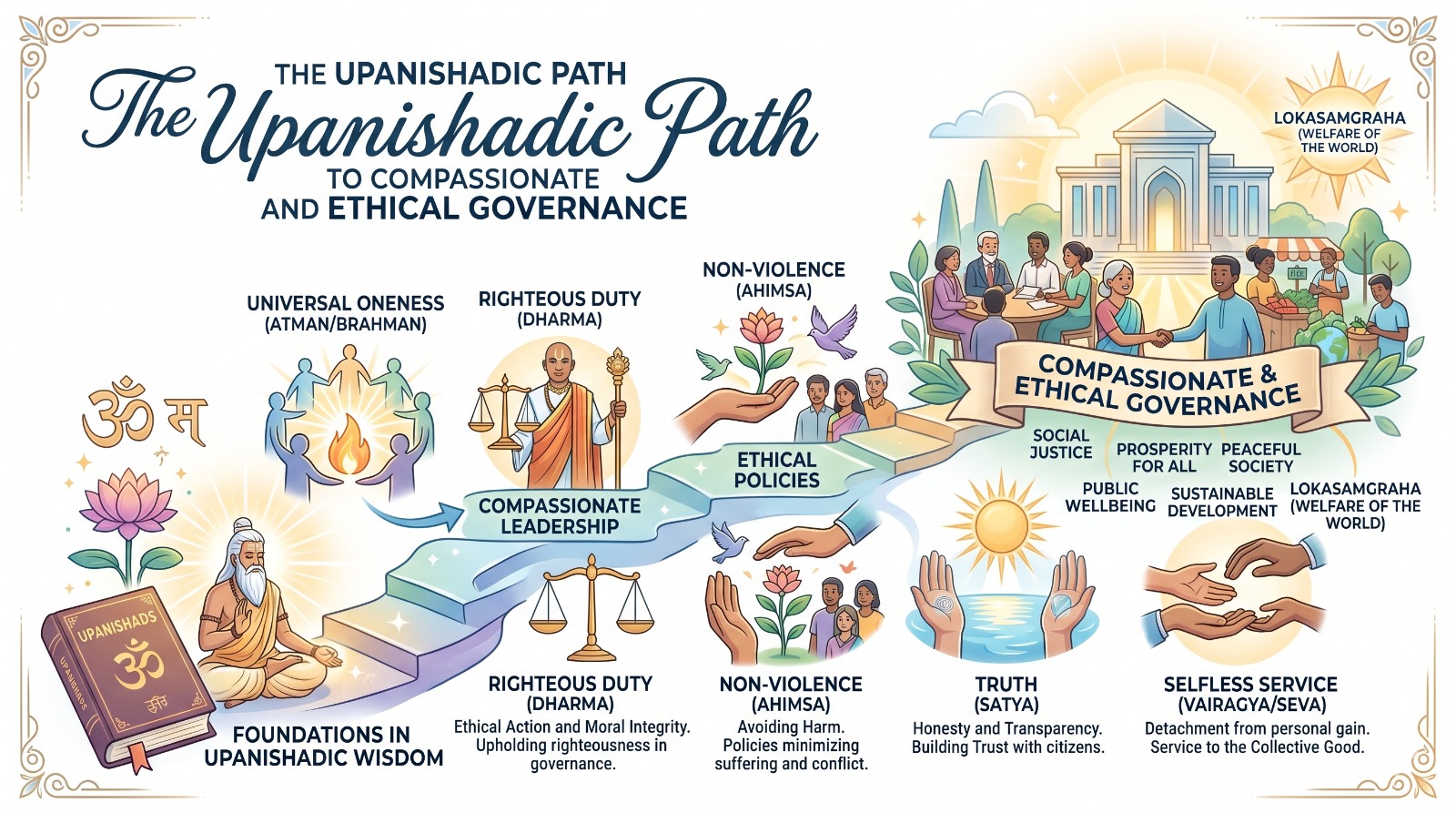
The Upanishadic Path to Compassionate and Ethical Governance
|
Getting your Trinity Audio player ready...
|
ARTICLE
The Upanishads, forming the philosophical core of the Vedic tradition, are not merely metaphysical texts but profound guides to ethical living and rational inquiry. While they are spiritual and metaphysical in nature, their teachings offer a profound ethical framework that is remarkably relevant to the modern civil servant. In an era where governance is often reduced to data points and bureaucratic procedures, the Upanishadic philosophy provides the moral compass and spiritual depth necessary to transform ‘administration’ into ‘service.’ Public service, at its core, is not just administrative execution but a moral responsibility an idea strongly echoed in the Upanishads.
‘Vasudhaiva Kutumbakam’: The Vision of Oneness and Universal Empathy
At the heart of the Upanishads lies the concept of Advaita (non-duality), the idea that the individual soul (Atman) is identical to the universal reality ‘Brahman’. This is best encapsulated in the Maha Vakya from the Chandogya Upanishad: ‘Tat Tvam Asi’ -That Thou Art.
For a public servant, this is the ultimate lesson in empathy. If the administrator views the public not as others or clients but as an extension of their own self, the nature of service changes. It moves away from cold institutionalism toward compassionate action. When a civil servant realizes that the suffering of a marginalized citizen is not distinct from their own, the ‘Ends of Justice’ are pursued not just as a legal duty, but as a moral necessity. This vision fosters a sense of Universal Brotherhood, essential for maintaining social harmony in a diverse nation.
‘Satyameva Jayate’: The Standard of Truth
The national motto of India, ‘Satyameva Jayate’ -Truth alone triumphs, is taken from the Mundaka Upanishad. In the context of public service, ‘Truth’ (Satya) is not merely the avoidance of falsehood; it is the alignment of thought, word, and deed.
A public servant is often caught in a web of political pressure, systemic corruption, and ethical dilemmas. The Upanishads teach that Dharma (righteousness) is rooted in Satya. By adhering to intellectual and professional honesty, an administrator ensures transparency and accountability, the two pillars of good governance. The Brihadaranyaka Upanishad prays, ‘Asato Ma Sadgamaya’ – Lead me from the unreal to the real. This is the guiding light for a Public Servant tasked with sifting through misinformation to find the truth, ensuring that policy decisions are based on reality rather than political convenience.
‘Nishkama Karma’: The concept of Detachment and Duty
Although the Bhagavad Gita is the primary text associated with Nishkama Karma-selfless action, the seeds of this philosophy are found in the Isha Upanishad. The first verse states: ‘Tena Tyaktena Bhunjitha’ – Enjoy by renouncing.
In public service, the temptation of power, prestige, and personal gain is constant. The Upanishads advocate for a ‘detached involvement.’ An administrator must be deeply committed to their project be it building a dam or implementing a health scheme but detached from the personal accolades or the fruits of that labor. This detachment prevents burnout and ensures that the officer remains objective. When a civil servant is not clouded by personal ego or the fear of failure, their decision-making becomes rational and unbiased.
‘Ishavasyam Idam Sarvam’: The Ethics of Stewardship
The Isha Upanishad begins with the declaration that everything in the universe is permeated by the Divine. Therefore, no one truly owns anything. We are merely trustees of the resources we manage.
This concept of Trusteeship is a vital contribution to Public Service. A district collector or a secretary to the government manages vast public funds and natural resources. The Upanishadic view discourages the exploitative ownership mindset and encourages stewardship. It promotes sustainable development and environmental ethics. If a public servant believes that the resources under their command belong to the Universal Whole, they are less likely to engage in corruption or the misuse of power.
‘Atma-Jnana’: Self-Mastery and Leadership
The Katha Upanishad famously uses the metaphor of the Chariot. The body is the chariot, the intellect (Buddhi) is the driver, the mind (Manas) is the reins, and the senses are the horses.
For a public servant, this is a lesson in Self-Regulation and Emotional Intelligence. To lead a district or a department, one must first lead oneself. An officer who cannot control their ‘horses- senses and emotions like anger or greed’ will inevitably lead the chariot of administration into a ditch. The Upanishads emphasize Atma-Jnana – Self-knowledge. A leader who is self-aware is more likely to be tolerant, patient, and resilient qualities that are indispensable when dealing with public grievances or internal security crises.
‘Samadarshana’: Inclusivity and the Elimination of Bias
The Aitareya Upanishad and others emphasize that the same consciousness resides in all beings, regardless of caste, creed, gender, or social status. This provides a spiritual foundation for the Principle of Equality enshrined in the Indian Constitution.
In the discharge of official duties, bias is a silent enemy. Whether it is a Simultaneous Execution of a decree or the distribution of welfare benefits, the Upanishadic philosophy demands an ‘Equanimous Eye – Samadarshana’. It challenges the administrator to look beyond the exterior identity of a person and recognize their inherent dignity. This philosophical grounding makes the public servant a true protector of civil liberties and a champion of social justice.
Bridging Philosophy and Practice
The philosophical contributions of the Upanishads extend far beyond spiritual inquiry; they offer a timeless guide for ethical public service. In today’s complex governance environment, the challenges of corruption, inequality, and ethical dilemmas demand a strong moral compass. The Upanishadic values of truth, duty, self-awareness, and inclusivity provide that compass. Integrating these principles into administrative training and practice can lead to more ethical and effective public services. Initiatives like ethical governance frameworks and civil service codes of conduct reflect similar ideals, showing the enduring relevance of this ancient wisdom.
From Bureaucracy to Seva
The contribution of the Upanishads to Public Service is essentially the transition from being a ‘Ruler’ to being a ‘Sevak’ (Servant). By integrating these ancient values -Truth, Empathy, Trusteeship, and Self-Mastery into the modern administrative framework, a civil servant can transcend the limitations of rules and regulations. In essence, the Upanishads remind public servants that governance is not merely about authority, but about responsibility toward society. As the Taittiriya Upanishad commands: ‘Satyam Vada, Dharmam Chara – Speak the Truth, Walk the path of Righteousness’. When these principles are internalized, public service transforms into a noble pursuit serving not just the state, but humanity as a whole.