
Can Ethanol Blending Strengthen India’s Economic Resilience?
|
Getting your Trinity Audio player ready...
|
PERSPECTIVE ANALYSIS
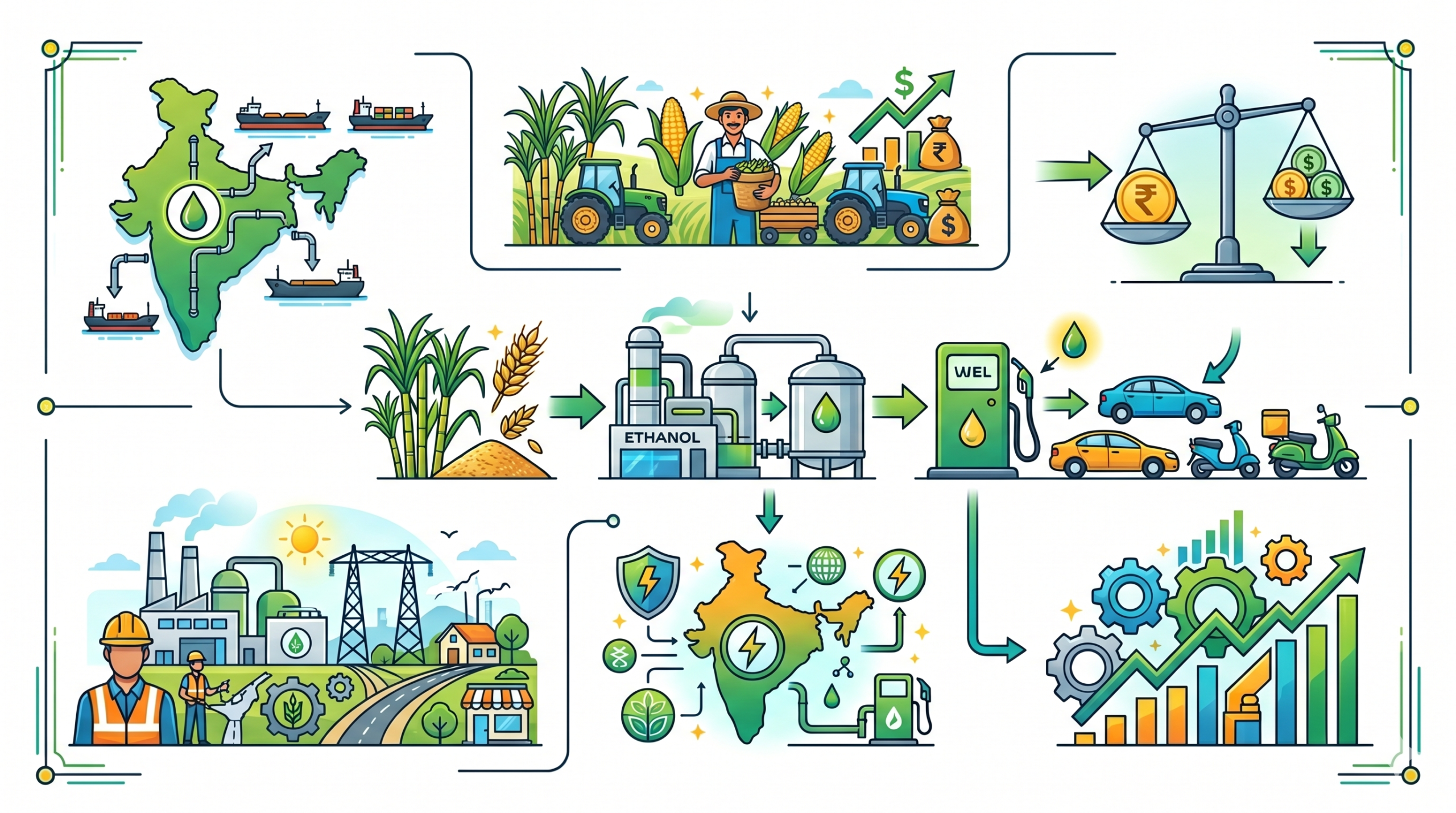
In an era marked by geopolitical conflicts, volatile crude oil prices, climate change concerns, and growing energy insecurity, India’s pursuit of economic resilience has become a strategic necessity. As the world’s third-largest importer of crude oil, India spends a substantial portion of its foreign exchange reserves on energy imports, making the economy vulnerable to global supply disruptions and price shocks. In this context, ethanol blending has emerged as a significant pillar of India’s energy transition strategy.
Ethanol blending refers to mixing ethanol, a biofuel derived mainly from agricultural feedstocks such as sugarcane, maize, damaged grains, and biomass, with petrol. India’s Ethanol Blended Petrol (EBP) Programme aims to reduce dependence on imported fossil fuels while simultaneously promoting cleaner energy and supporting rural incomes. The government has accelerated the blending target from 20% by 2030 to 20% by 2025–26, reflecting the strategic importance attached to the sector.
However, the debate extends beyond energy substitution. The larger question is whether ethanol blending can genuinely strengthen India’s economic resilience in a sustainable and balanced manner. While ethanol offers opportunities related to energy security, rural development, employment generation, and environmental sustainability, it also raises concerns regarding food security, water stress, ecological sustainability, and long-term economic viability.
This rapid progression forces a critical evaluation: Can mixing plant-derived alcohol with fossil fuels genuinely fortify the economic resilience of the world’s fastest-growing major economy? The answer is complex but overwhelmingly affirmative, requiring a deep dive into trade balances, agricultural dynamics, capital investments, energy security, and the inherent structural challenges of transitioning to a biofuel economy.
The Geopolitical and Macroeconomic Shield
At the macroeconomic level, ethanol blending acts as a direct hedge against imported inflation and currency depreciation. When global crude oil prices surge unpredictably, the economic fallout for India is usually immediate: the import bill swells, the trade deficit widens, the rupee depreciates, and domestic inflation spikes. Alternatively, if the government chooses to shield consumers from price hikes, Oil Marketing Companies (OMCs) are forced to absorb massive under-recoveries, straining fiscal resources.
Ethanol provides a strategic buffer against this cycle. By substituting a significant portion of imported petrol with domestically produced biofuel, India has effectively retained capital within its borders. Since the acceleration of the EBP programme, the country has saved upwards of Rs. 1.4 lakh crore (approximately $19.8 billion) in foreign exchange. Every drop of ethanol blended into the fuel supply represents a fractional reduction in dollar outflows, strengthening the foreign exchange reserves.
Furthermore, ethanol decentralizes the energy supply chain. Unlike fossil fuels, which rely on a handful of vulnerable coastal refineries and vast import terminals, ethanol distilleries are distributed across the agricultural hinterlands. This decentralization inherently builds resilience, ensuring that regional disruptions or global maritime bottlenecks cannot entirely paralyze the domestic transport sector.
Revitalizing the Rural Economy
For decades, Indian agriculture has grappled with the dual challenges of surplus production in certain crops and volatile market prices, leading to chronic rural distress. The ethanol blending mandate has introduced a powerful, guaranteed industrial market for agricultural output, fundamentally altering the rural economic landscape. The government’s vision of transforming farmers from Annadatas (food providers) to Urjadatas (energy providers) is materializing on a massive scale.
Historically reliant on sugarcane molasses, the ethanol sector provided a lifeline to the beleaguered sugar industry, allowing mills to clear mounting cane dues by diverting excess sugar to fuel production. Today, the feedstock base has strategically diversified. Grain-based ethanol particularly from maize and surplus rice—now accounts for nearly 69% of the country’s ethanol output.
This diversification has generated substantial rural wealth. Ethanol procurement has injected over Rs. 1.18 lakh crore directly into the farming community while spurring nearly Rs. 2 lakh crore in revenue for distilleries. Beyond direct income, the boom has stimulated rural industrialization. New distilleries require civil construction, logistics, and maintenance, creating localized employment in states like Uttar Pradesh, Maharashtra, Bihar, and increasingly in the maize-growing belts. By linking the internal combustion engine directly to the farm gate, ethanol blending creates a circular rural economy that acts as a domestic shock absorber when external industrial growth falters.
Spurring Infrastructure and Capital Investment
Economic resilience is also built upon domestic capital expenditure (capex). The push for higher ethanol blending has birthed an entirely new industrial sub-sector: the modern biorefinery ecosystem. To meet the E20 target, and now to prepare for E30, massive investments have flowed into building new distilleries, expanding existing capacities, and upgrading supply chain logistics.
The current ethanol production capacity in the country has surpassed 1,500 crore liters, split between molasses-based and grain-based distilleries. This expansion has created thousands of direct industrial jobs in rural and semi-urban areas, decentralizing industrial growth away from traditional coastal hubs.
Furthermore, oil marketing companies (OMCs) are investing heavily in customized storage tanks, blending infrastructure, and dedicated dispensing systems at thousands of retail outlets across the country. This capital deployment stimulates the domestic engineering, construction, and manufacturing sectors, adding another layer of robust economic activity.
The Green Economic Dividend
Economic resilience is inextricably linked to environmental sustainability. Traditional economic models have long ignored the negative externalities of fossil fuel consumption namely, the massive public health costs associated with urban air pollution and the long-term economic damages wrought by climate change.
Blending ethanol significantly reduces tailpipe emissions, particularly carbon monoxide, volatile organic compounds, and unburnt hydrocarbons.
While the primary narrative surrounding this reduction is ecological, the economic implications are profound. Improved urban air quality translates directly to lower public healthcare expenditures, reduced hospital admissions for respiratory ailments, and higher workforce productivity.
Furthermore, as global trade mechanisms increasingly penalize high carbon footprints such as the European Union’s Carbon Border Adjustment Mechanism (CBAM) greening the domestic transportation sector improves the overall carbon competitiveness of the Indian economy.
By aligning the EBP with its Panchamrit climate commitments, India is positioning itself as an attractive destination for green finance and Environmental, Social, and Governance (ESG) compliant global capital.
The Food-Water-Energy Nexus: The Unseen Vulnerability
Perhaps the most critical threat to the resilience narrative lies in the unintended consequences of rapidly shifting agricultural patterns to feed the ethanol machine. The Confederation of Indian Industry (CII) recently highlighted the necessity of treating the 3Fs – fuel, fertilizer, and food as an integrated challenge. Solving for fuel security must not come at the expense of food security or ecological stability.
The aggressive pivot toward maize for ethanol production perfectly illustrates this risk. Driven by lucrative procurement prices and guaranteed distillery demand, maize acreage has expanded rapidly, often displacing essential crops like pulses and oilseeds. India already relies heavily on imports for edible oils and certain pulses; squeezing their domestic acreage to produce fuel exacerbates a different kind of import dependency, driving up food inflation.
The water footprint of this transition is equally alarming. While maize is theoretically less water-intensive than sugarcane or paddy, its cultivation in India relies heavily on groundwater extraction.
In regions expanding maize for ethanol, the water requirement can exceed 3,000 cubic meters per tonne. India is effectively exporting its precious, depleting groundwater through the tailpipes of its vehicles.
Currently, the incentive structure is all acceleration and no brakes. Distilleries enjoy tax breaks and soft credit, and farmers receive assured Minimum Support Prices (MSP) for energy crops, but there are few statutory guardrails to prevent the diversion of food and feed grains when domestic stocks are tight. Grain ethanol has also disrupted the livestock and poultry feed markets.
While ethanol by-products like Dried Distillers Grains with Solubles (DDGS) are offered as premium cattle feed, the sheer volume of grain diversion frequently triggers price spikes in raw feed materials, pressuring the dairy and poultry sectors.
Balancing the Scales of Resilience
Can ethanol blending strengthen India’s economic resilience? The answer is a definitive yes, but with a crucial caveat: only if it is managed as a complex, interconnected system rather than a blunt instrument for import substitution.
The first phase of India’s ethanol journey has been an undeniable triumph. Reaching E20 has proven that the country can execute large-scale energy transitions, save billions in foreign exchange, and revitalize its agricultural sector. It has insulated the economy from the worst shocks of global crude volatility and aligned the nation closer to its net-zero emissions targets.
However, moving beyond E20 requires an evolution in policy maturity. The government must quickly resolve the infrastructure bottlenecks at retail outlets and incentivize the adoption of flex-fuel vehicles to ensure the multi-billion-dollar investments in distillery capacity do not turn into non-performing assets.
More importantly, policymakers must urgently build the ecological and nutritional guardrails that the sector currently lacks. This means implementing dynamic blending mandates that automatically scale down grain diversion when food prices spike or monsoons fail. It requires mapping “no-go” zones for energy crops based on groundwater depletion levels and actively pushing research into second-generation (2G) cellulosic ethanol derived from agricultural waste, rather than competing for arable land.
Ethanol blending is a potent tool for economic resilience. But true resilience means ensuring that the quest for fuel independence today does not plant the seeds of a food, water, or inflation crisis tomorrow.