
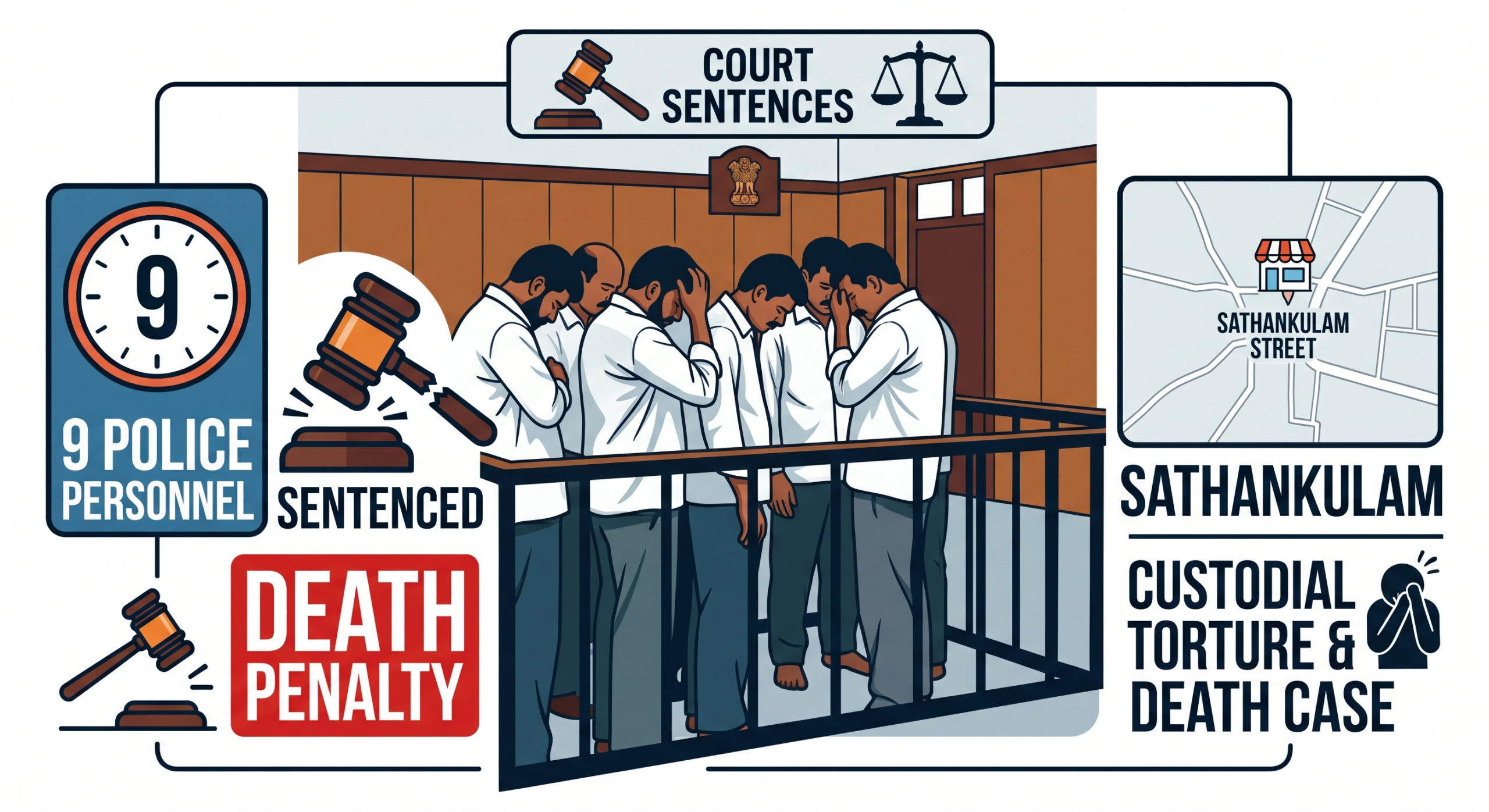
Court Sentences 9 Police Personnel to Death Penalty in Sathankulam Custodial Torture and Death Case
|
Getting your Trinity Audio player ready...
|
ARTICLE
On June 19, 2020, a father and son, P. Jayaraj and J. Beniks, were picked up by the police in the small town of Sathankulam, Tamil Nadu. Their crime was a minor violation of COVID-19 lockdown hours regarding their mobile phone shop. Days later, both were dead, their bodies bearing the horrific marks of unimaginable brutality. In a landmark judgment delivered today, a Special Court has sentenced nine police personnel including an Inspector and a Sub-Inspector to the death penalty.
This verdict is not merely the conclusion of a high-profile criminal trial; it is a seismic shift in the Indian judicial landscape regarding police accountability, the ‘rarest of rare’ doctrine, and the sanctity of Article 21 of the Constitution.
What Happened in Sathankulam?
The Sathankulam case stood out even in a country where custodial violence is tragically common. The details revealed during the CBI investigation were stomach-churning. According to the CBI investigation and eyewitness testimonies, the two men were subjected to brutal, hours-long physical and sexual torture while in police custody. Despite being visibly injured and bleeding profusely, they were presented before a magistrate who remanded them to judicial custody without adequately inspecting their physical condition.
By June 22 and 23, both Beniks and Jayaraj succumbed to their injuries at a Kovilpatti hospital. The incident triggered a massive national outcry, drawing parallels to the George Floyd protests in the United States and forcing a transfer of the case to the Central Bureau of Investigation (CBI). The investigation dismantled the initial police narrative of natural death, revealing a deliberate cover-up and a blue wall of silence within the station. In a landmark judgment delivered in May 2026, a Special Court sentenced nine police personnel to the death penalty.
Redefining the Rarest of Rare
The imposition of the death penalty on nine police officers simultaneously is almost unprecedented in Indian history. Typically, the rarest of rare doctrine – stablished in Bachan Singh v. State of Punjab is applied to crimes of extreme depravity or terrorism. By awarding the death sentence, the court has sent a clear message: Custodial torture by those sworn to protect the law is a betrayal of trust that qualifies as the rarest of rare.
The Aggravating Factor: The court viewed the police uniform not as a mitigating factor, but as an aggravating one. Using state-sanctioned power to commit murder is seen as a direct assault on the democratic fabric of the nation.
Deterrence over Reform: While the Indian legal system generally leans toward the reformation of criminals, this verdict prioritizes absolute deterrence. It serves as a grim warning to the nearly 2.5 million police personnel in India that the “khaki” is not a shield against the law.
Article 21 and the Right to Life
This case brings the interpretation of Article 21 (Protection of life and personal liberty) into sharp focus. The Supreme Court has repeatedly held that the Right to Life includes the right to live with dignity and the right against torture.
“Custodial torture is a naked violation of human dignity and a blow to the rule of law.” – This sentiment, often echoed in high courts, has finally found its ultimate expression in the Sathankulam sentencing.
The judgment reinforces the D.K. Basu v. State of West Bengal guidelines, which mandate transparency in arrests. The Sathankulam officers ignored every single one of these guidelines, from not informing relatives to failing to conduct mandatory medical examinations.
Restoring Public Trust
In many parts of India, the police are viewed with a mix of fear and skepticism. The Sathankulam case had initially shattered the public’s trust in the Tamil Nadu police force. However, the rigor of the CBI investigation and the subsequent judicial swiftness have begun the slow process of restoration.
The Role of Civil Society: The case gained momentum only after a massive social media outcry and protests by local traders. It proved that a vigilant public can prevent state-sponsored amnesia.
The Blue Wall of Silence: The conviction of nine personnel, including high-ranking station officers, challenges the “Blue Wall of Silence the tendency of police officers to protect their own.
Why Death Penalty?
This case saw a rarest of rare classification based on three critical pillars:
Betrayal of Public Trust: The court observed that the police, who are the guardians of the law, turned into executioners. The court held that when the state’s machinery, meant to protect citizens, is used to systematically annihilate them, it shakes the foundation of democracy.
Unmatched Brutality: Forensic reports indicated over 40 injuries on the bodies of the victims. The court noted that the torture was not interrogative but sadistic, aimed at dehumanizing the victims over a minor regulatory infraction.
Conspiracy and Cover-up: The sentencing took into account the coordinated effort by the police station staff to falsify the General Diary (GD) entries and intimidate the judicial magistrate during the initial inquiry.
The Global Context
India is one of the few countries that has signed but not yet ratified the United Nations Convention against Torture (UNCAT). The Sathankulam verdict strengthens the argument for a dedicated Anti-Torture Law in India.
Currently, torture is prosecuted under general sections of the BNS (formerly IPC) like voluntarily causing hurt. A specific law would define custodial torture as a distinct, heinous crime, making it harder for perpetrators to find legal loopholes.
The Shift in Accountability
Historically, custodial death cases in India have seen low conviction rates. According to NCRB data, while hundreds of custodial deaths are reported annually, convictions are few and far between. The Sathankulam verdict marks a departure from this trend.
By awarding the death penalty, the judiciary has sent a clear message: The uniform is not a shield against the hangman’s noose. This judgment aligns with the evolving international human rights standards, reinforcing that torture is a crime against humanity and must be met with the highest degree of punishment.
Beyond the Verdict
While the sentencing provides closure to the family of Jayaraj and Beniks, the broader battle against custodial violence remains. For the verdict to translate into systemic change, the following reforms are essential:
Ratification of UNCAT: India is one of the few major democracies that has signed but not yet ratified the United Nations Convention Against Torture (UNCAT). Ratification would mandate a dedicated domestic law against custodial torture.
Implementation of Prakash Singh Guidelines: The 2006 Supreme Court directives on police reforms aimed at separating the investigation wing from the law-and-order wing and creating an independent Police Complaints Authority remain largely ignored by states.
Technological Accountability: Every police station must be under 24/7 CCTV surveillance with storage feeds directly linked to a district-level monitoring body, as mandated by the Supreme Court in the Paramvir Singh Saini case.
A Lesson for the Future
The death penalty for nine police personnel is a harsh, historic, and perhaps necessary intervention. It tells every station house officer (SHO) and constable that their loyalty must lie with the Constitution, not with a culture of departmental impunity.
For the family of Jayaraj and Beniks, justice has been served in its most absolute form. For the Indian state, the work has just begun. The goal should not just be to punish the torturers, but to build a system where the Sathankulam incident becomes a psychological impossibility. The rule of law has prevailed, but the true victory will be when the uniform is once again a symbol of safety for the common man, not a source of terror.