The Bridge-Builder’s Dilemma of Indian Diplomacy in Iran-US Peace Talks
|
Getting your Trinity Audio player ready...
|
EXPLAINER
What exactly is the Bridge-Builder’s Dilemma?
The dilemma is the strategic paradox where India’s greatest diplomatic asset, its high level of trust with both Washington and Tehran becomes a severe vulnerability during active conflicts. Being a ‘bridge’ means India is expected to mediate, but taking any definitive stance risks alienating either its primary global strategic partner (the US) or its crucial civilizational and energy partner (Iran).
Why is India uniquely positioned as a diplomatic “bridge”?
India operates on Strategic Autonomy. To the US, India is a vital democratic partner essential for a free Indo-Pacific. To Iran, India is a fellow Asian civilization that respects sovereignty and resists Western bloc politics. This ‘dual credibility’ allows New Delhi to keep back-channels open when formal US-Iran diplomatic lines are frozen.
How does the current geopolitical climate in West Asia amplify this dilemma?
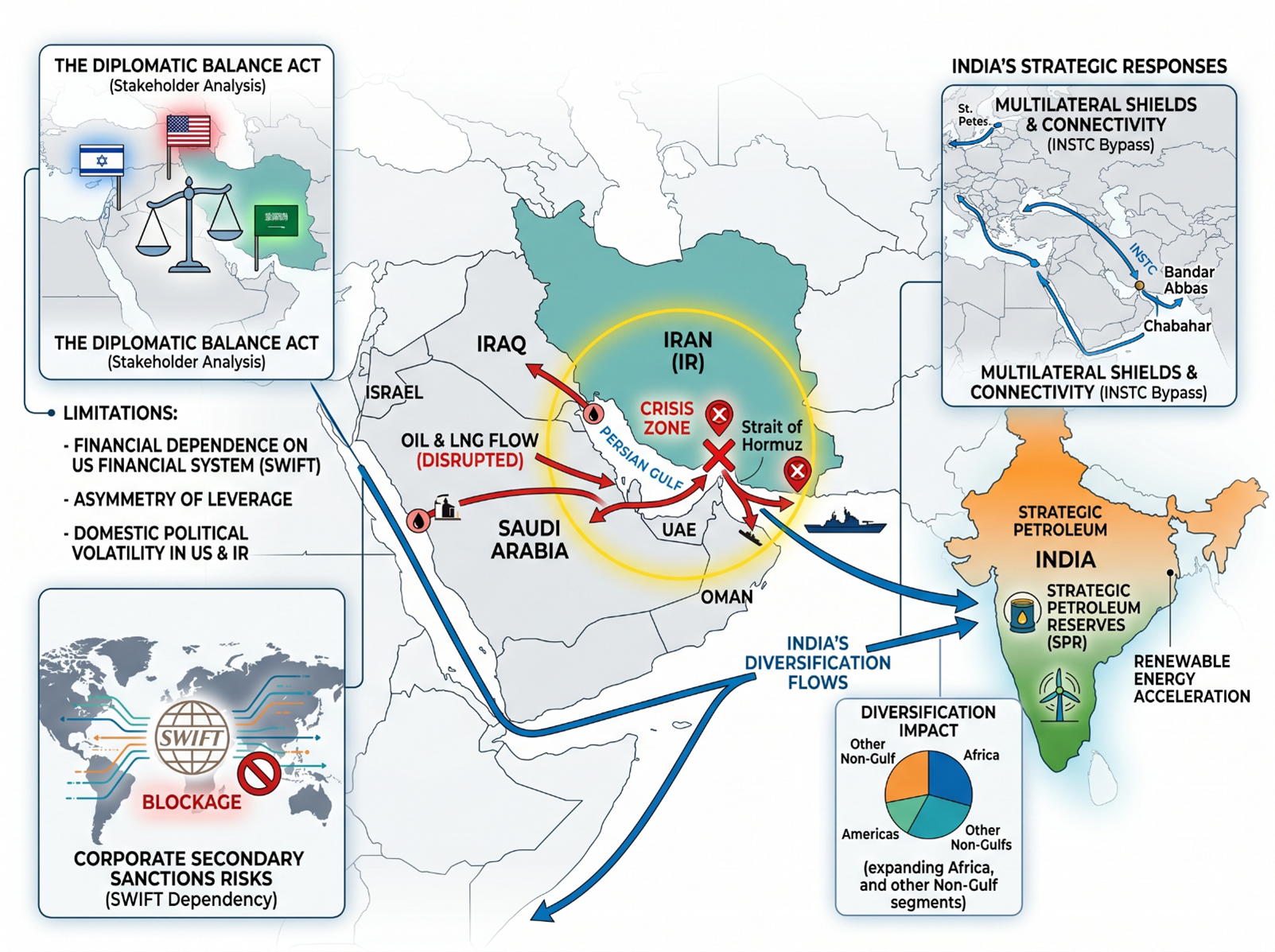
In times of high escalation (such as disruptions in the Strait of Hormuz), the middle ground shrinks. The US often expects India to isolate Iran economically, while Iran expects India to defy US sanctions in the name of strategic autonomy. India is caught between protecting its global financial integration and securing its immediate energy needs.
What is “Connectivity Diplomacy,” and how does India use it constructively?
Instead of focusing on military or ideological alignments where the US and Iran clash, India focuses on shared economic infrastructure, specifically the International North-South Transport Corridor (INSTC). By framing its engagement with Iran around trade and transit to Eurasia, India shifts the narrative from conflict to shared prosperity, creating a stabilizing economic interdependence.
How does the Chabahar Port serve as a diplomatic tool rather than just a trade hub?
Chabahar is India’s gateway to Afghanistan and Central Asia, bypassing Pakistan. Constructively, it represents a rare convergence zone: India uses it to build regional trade, Iran gains infrastructure, and the US (historically) tolerates it because it aids Afghan stability and counters Chinese dominance at Gwadar. It is a physical manifestation of diplomatic balance.
How does India handle the constant threat of US secondary sanctions?
India handles this through Strategic De-risking rather than outright defiance. While India respects the US-led SWIFT financial system to protect its own economy, it constructively seeks alternative payment mechanisms (like Rupee-Rial arrangements) for essential commodities. It negotiates exemptions (like the Chabahar waiver) by proving that the project serves broader, shared geopolitical goals.
How does India balance its growing ties with Israel and Saudi Arabia while engaging Iran?
India uses a strict policy of De-hyphenation. India’s relationship with Israel (defence/tech), Saudi Arabia (energy/investments), and Iran (connectivity/civilization) are kept completely separate. India makes it clear to all parties that its bilateral ties with one nation are never directed against another, ensuring it doesn’t get dragged into their internal Middle Eastern rivalries.
Can India realistically mediator a formal “Peace Treaty” between Washington and Tehran?
Realistically, no. mediating a final peace treaty usually requires the mediator to offer ‘hard security guarantees’ or wield massive economic leverage to force compliance. India lacks the capacity to be a security guarantor in the Persian Gulf. Instead, India’s constructive role is that of a Strategic Stabilizer preventing miscalculations and facilitating dialogue.
How is India leveraging multilateral forums to manage the US-Iran rift?
By utilizing forums like BRICS and the Shanghai Cooperation Organisation (SCO), both of which now include Iran – India creates a ‘multilateral umbrella.’ Engaging Iranian officials on the sidelines of a BRICS summit dilutes bilateral friction. It allows India to maintain high-level contact with Tehran without triggering the optics of defying Washington.
How does India’s domestic green transition aid its foreign policy?
India’s aggressive push toward renewable energy (solar, wind, green hydrogen) is not just an environmental policy; it is a strategic diplomatic tool. By reducing long-term dependence on imported fossil fuels, India constructively reduces its vulnerability to Persian Gulf chokepoints, giving its diplomats more room to maneuver without the immediate pressure of an energy crisis.
What is India’s strategy if the Strait of Hormuz is weaponized or blocked?
In a worst-case scenario, India’s strategy shifts to crisis management. The constructive groundwork laid via the INSTC and the Chabahar bypass becomes vital. India would leverage these alternative land and sea routes to maintain supply chains, while utilizing its naval presence (like Operation Sankalp) to secure the immediate safety of Indian commercial vessels and diaspora.
How does India ensure its “neutrality” isn’t interpreted as weakness?
India ensures this by practicing Proactive Neutrality. Instead of just staying quiet, India actively uses its voice to condemn terrorism, advocate for the protection of civilian lives, and uphold the freedom of navigation. It replaces passive silence with active advocacy for international law.
How does India’s “Vishwa Mitra” (Global Friend) concept apply here?
The “Vishwa Mitra” doctrine frames India not as a transactional power, but as a reliable friend to the Global South. In the US-Iran dynamic, India uses this status to advocate for the nations that are disproportionately hurt by high oil prices and supply chain disruptions, framing peace as a necessity for global development, not just regional politics.
What is the ultimate constructive goal of India’s diplomacy in this conflict?
The ultimate goal is Systemic Preservation. India understands that the ideological rift between the US and Iran may not be resolved in this decade. India’s goal is to prevent the “Cold War” in West Asia from turning into a systemic “Hot War” that collapses global supply chains. By keeping back-channels open and pushing for de-escalation, India ensures the architecture of regional stability remains intact.