
Scientific Understanding of Hanta Virus
|
Getting your Trinity Audio player ready...
|
EXPLAINER
What is the fundamental structure of a Hantavirus?
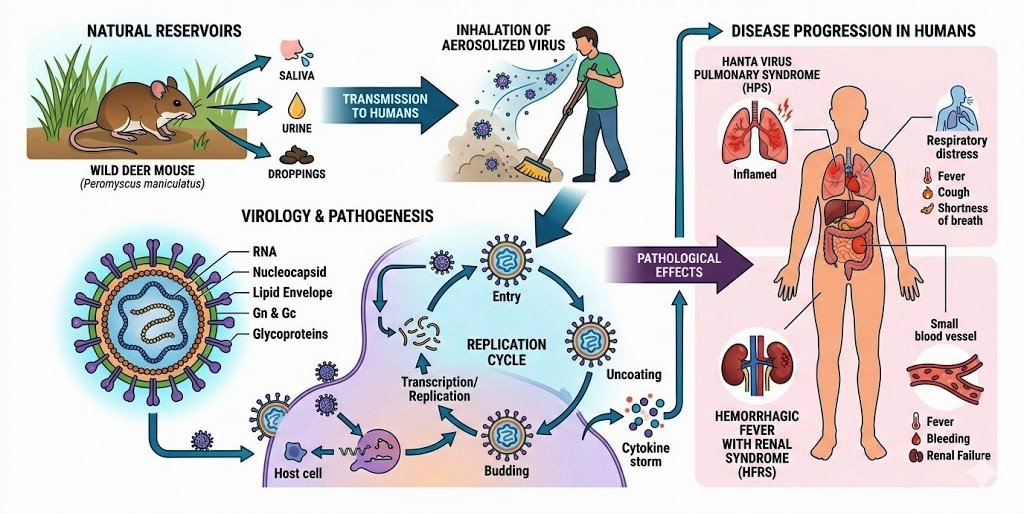
Hantaviruses belong to the family Hantaviridae (order Bunyavirales). Structurally, they are enveloped viruses, meaning they are wrapped in a lipid bilayer membrane derived from the host cell. Inside this envelope, the virus contains three segments of single-stranded RNA, designated as Large (L), Medium (M), and Small (S). The L segment encodes the viral polymerase responsible for replication, the M segment encodes the surface glycoproteins (Gn and Gc) that allow the virus to attach to and enter host cells, and the S segment encodes the nucleocapsid (N) protein, which protects the viral RNA. This segmented nature is a key scientific feature because it theoretically allows for genetic reassortment if two different strains infect the same cell, potentially leading to new viral variants. Unlike many other viruses, Hantaviruses are roughly spherical or pleomorphic, measuring about 80 to 120 nanometers in diameter.
How does the virus hijack a human cell?
The science of Hantavirus entry is centered on the interaction between viral glycoproteins and host cell receptors. The virus typically targets endothelial cells, which line the blood vessels. The surface glycoproteins (Gn/Gc) recognize and bind to specific integrins specifically β3 integrins for New World hantaviruses (like Sin Nombre) and β1 integrins for others. Once bound, the cell pulls the virus inside through a process called endocytosis. Once inside the acidic environment of the endosome, the viral envelope fuses with the endosomal membrane, releasing the viral RNA segments into the cytoplasm. This process is highly specific; the lock-and-key fit between the virus and endothelial receptors explains why the disease primarily manifests as vascular leakage the virus essentially disrupts the very cells that keep fluid inside your blood vessels.
What is the difference between Old World and New World Hantaviruses?
Scientifically, Hantaviruses are divided geographically and clinically into two groups. ‘Old World’ hantaviruses are primarily found in Europe and Asia (such as the Hantaan and Seoul viruses). These typically cause Hemorrhagic Fever with Renal Syndrome (HFRS), where the primary damage occurs in the kidneys. ‘New World’ hantaviruses are found in the Americas (such as the Sin Nombre and Andes viruses) and cause Hantavirus Pulmonary Syndrome (HPS), where the primary damage occurs in the lungs. While they share similar structures, their genetic divergence leads them to target different vascular beds. HFRS involves a systemic drop in blood pressure and acute kidney injury, while HPS leads to rapid fluid accumulation in the lungs (pulmonary edema), which is often more lethal, with a case fatality rate nearing 35–40%.
Why don’t the rodent hosts get sick?
This is a fascinatng area of evolutionary biology. Hantaviruses have co-evolved with their rodent hosts (mice, rats, and voles) for millions of years. In rodents, the infection is persistent and asymptomatic. The virus enters a state of equilibrium with the rodent’s immune system; the rodent produces a controlled immune response that prevents the virus from causing disease but fails to clear it entirely. As a result, the rodent becomes a lifelong shedder of the virus through urine, feces, and saliva. Humans are accidental hosts. Because our immune systems did not co-evolve with the virus, our response is often over the top or dysregulated. It is actually the human immune system’s aggressive reaction to the virus not the virus itself that causes most of the tissue damage.
What is the mechanism behind ‘capillary leak syndrome’?
The hallmark of severe Hantavirus infection is the sudden leakage of plasma from the blood vessels into surrounding tissues. This occurs because the virus infects endothelial cells and triggers a massive release of cytokines (signaling proteins) and other inflammatory markers like bradykinin. These chemicals cause the tight junctions between endothelial cells to loosen. Imagine a garden hose developing millions of microscopic pores; the fluid stays the same, but the pressure drops as the liquid escapes. In HPS, this fluid fills the alveoli (air sacs) in the lungs, essentially causing the patient to drown from the inside. In HFRS, the leakage occurs in the retroperitoneal space and kidneys, leading to hemorrhaging and renal failure.
How does Aerosolization work in transmission?
The primary way humans contract Hantavirus is through the inhalation of aerosolized viral particles. When rodent droppings or urine dry, the virus remains stable within the organic matter for a period. When this material is disturbed such as by sweeping a dusty barn or moving woodpiles microscopic particles become airborne. These particles are small enough to bypass the upper respiratory defences and settle deep into the lower respiratory tract (the bronchioles and alveoli). Once there, the virus encounters alveolar macrophages and endothelial cells, initiating the infection. This is why dry sweeping is discouraged in infested areas; wetting the area with a disinfectant like bleach prevents these particles from taking flight.
Can Hantavirus spread from person to person?
For almost all Hantaviruses, the answer is no; humans are dead-end hosts. However, there is a significant scientific exception: the Andes virus found in South America. Research has confirmed that Andes virus can be transmitted between humans, likely through close contact or shared respiratory droplets. This is a unique trait in the Hantavirus family and is a subject of intense study to determine which specific proteins allow the Andes virus to transmit this way while the Sin Nombre virus cannot. Understanding this gain of function in nature is critical for pandemic preparedness, as it represents the potential for a localized zoonotic outbreak to become a broader public health threat.
How does the ‘Cytokine Storm’ contribute to the disease?
When the Hantavirus infects the body, the immune system detects the invader and overreacts. It releases an excessive amount of pro-inflammatory cytokines, such as Interleukin-6 (IL-6) and Tumor Necrosis Factor-alpha (TNF-α). This cytokine storm increases vascular permeability and recruits T-cells to the lungs or kidneys. However, instead of just killing infected cells, this massive influx of immune cells and chemicals damages healthy tissue. This is why the disease often appears in phases an initial flu-like stage followed by a cardiopulmonary phase where the immune system’s counter-attack leads to a rapid decline in the patient’s ability to breathe or maintain blood pressure.
What is the Incubation Period and what happens during it?
The incubation period for Hantavirus is typically 1 to 8 weeks after exposure. During this time, the virus is quietly replicating within the body’s endothelial cells and regional lymph nodes. The patient feels completely healthy because the viral load hasn’t yet reached the threshold necessary to trigger a systemic immune response. Scientifically, this silent phase makes Hantavirus difficult to track; by the time a person feels sick, the exposure event (like cleaning a garage) might have happened a month prior. As the viral load peaks, the body enters the prodromal phase, characterized by fever, chills, and muscle aches (myalgia), which are often mistaken for the common flu.
How is Hantavirus diagnosed in a laboratory?
Because symptoms are initially non-specific, laboratory confirmation is essential. The most common method is Serology, which looks for specific antibodies (IgM and IgG) that the body creates to fight the virus. If IgM antibodies are present, it indicates an active or very recent infection. Another method is RT-PCR (Reverse Transcription Polymerase Chain Reaction), which detects the actual viral RNA in the blood or tissue. PCR is highly sensitive and can identify the specific strain of Hantavirus. In fatal cases, Immunohistochemistry (IHC) is used on lung or kidney tissue samples to visualize the presence of viral antigens directly within the cells.
Can pets carry Hantavirus?
There is no evidence that common domestic pets like cats or dogs can become sick from Hantavirus or transmit it to humans. However, they play a secondary role in the science of the house. Cats and dogs may bring infected rodents (dead or alive) into the home, increasing the risk of human exposure to droppings or saliva. Furthermore, cats and dogs can develop antibodies to the virus if they live in an endemic area, which is sometimes used by researchers as a sentinel indicator to see if the virus is present in a specific neighborhood, even if no humans have gotten sick yet.
What is the ‘Vascular Endothelial Growth Factor’ (VEGF) link?
Scientists have discovered that Hantavirus infection increases the levels of VEGF, a protein that normally helps the body grow new blood vessels. However, in the context of an infection, high levels of VEGF contribute to leaky vessels. This is a critical discovery because it offers a potential therapeutic target. If doctors can use drugs to block the VEGF signaling pathway during the peak of the infection, they might be able to seal the blood vessels and prevent the life-threatening fluid buildup in the lungs or kidneys. This is one of the most promising frontiers in Hantavirus clinical research today.
Why is Hantavirus considered a Neglected Zoonosis?
A zoonosis is a disease that jumps from animals to humans. Hantavirus is often considered neglected because it primarily affects rural, agricultural, or impoverished populations who are more likely to live in close proximity to rodents. Because cases are sporadic and often occur in remote areas, there has historically been less pharmaceutical investment in vaccines or specialized treatments compared to global threats like Influenza or COVID-19. However, as human encroachment into wilderness areas increases and climate change shifts rodent habitats, Hantavirus is gaining more attention as a significant emerging infectious disease.
Is there any Antiviral treatment available?
Currently, there is no FDA-approved antiviral specifically for Hantavirus. The drug Ribavirin has been tested extensively. Scientifically, Ribavirin works by interfering with viral RNA synthesis. It has shown some effectiveness in treating Old World HFRS if administered very early in the infection. However, clinical trials for New World HPS have been largely disappointing, showing little to no benefit once the pulmonary phase has begun. Because the disease progresses so rapidly once symptoms appear, the “window of opportunity” for antivirals is extremely narrow, making supportive care (like mechanical ventilation) the primary treatment strategy.